I’ll freely admit that I now have an unhealthy addiction to buying sets of old Kodachrome slides and trying to piece together the long forgotten story they tell. Sadly, however, the vast majority of slides available in the usual places are “random” lots in carrier bags and boxes or even worse “lucky dip” which simply means someone has poured box after box of slides into a container and mixed them all together, ruining any chance you’d have of grouping them back up again and making sense of them. Every now and again you get lucky and an untouched bundle comes up for sale and for a bargain price you can purchase your own slice of someone else’s family history.
To those who took these pictures in the first place or know the people and places they portray, they are priceless. More valuable than any revered or famous photographs taken by the greats, it is the simple family snaps that hold the greatest value to an individual. They’re irreplaceable mementos of special moments, births, holidays, family days out that mean everything to those present and absolutely nothing to anyone else.
Picking these sets of images up is a privilege. What were once treasured memories that had been discarded are now no longer abandoned and given value once more. They live to tell their story one more time and transport you into a curated album of someone’s personal memories, a window into their best times and, if you’re lucky, give an often fascinating snapshot of social history. They deserve to be preserved and by putting them here, they’ll be forever archived and that’s something, isn’t it?
Whether it’s coincidence or not, today’s story begins in 1963 in the North East Yorkshire village of Ravenscar which is minutes down the road from Goathland which appeared in our last trawl through a box of slides. Even more coincidental is that both families also went on holiday to Venice. I did check, the sellers are completely different and there’s no connection between this set and those. The coincidence is nice, though, and we’re going to trawl through some classic British seaside holiday favourites, go on a holiday or two and witness the formation of a family on our journey.
Right, let’s go back to 1963…
The big freeze of 1963…
As anyone old enough will tell you, they did winters properly back in 1962/3. On 11th December 1962 it began to snow and, a long story short, it basically didn’t stop snowing or being cold until March 6th 1963. Remarkably, whilst some areas were quite literally buried under snow, unlike today most places managed to stay open. Children still went to school, the buses and trains carried on running and people went to work. They probably came home with fewer fingers and toes than they went out with, but they carried on nonetheless. Luxury. Partially, the country kept going because health and safety hadn’t been invented. In the fantastic old BBC documentary below, there is video (9 mins 35 seconds in) of a train simply driving full speed into a snow drift to clear it. Derailment? Death? Who cares, full steam ahead, fireman!
The country didn’t fare too well during this time, being totally unprepared for an unprecedented weather event as you might expect. Considering they were suffering the coldest winter on record since 1740 (yes, that’s not a typo, seventeen forty) and the entire place ran on coal this was a recipe for shortages. Trains, power, heating, the occasional snack – all coal. In order for trains to keep running, coal supplies were prioritised and diverted to transport and they couldn’t get the stuff out of the ground quick enough and, as you might expect, people started to worry that they’d freeze to death in their own homes if supplies ran out.
I think it’s easy to joke if you weren’t there, and I wasn’t, but it is almost impossible to understand just how biblically cold things got. The sea froze over to the extent that you could walk a mile into the English Channel and the French could walk four miles out from Dunkirk towards England in the channel at a time when temperatures averaged -2 degrees for the whole of January. Meanwhile, the swimming pool at Raven Hall Hotel in Ravenscar had turned into the world’s biggest ice cube. Given a small paper umbrella, they could’ve won a world record for the biggest cocktail ever…
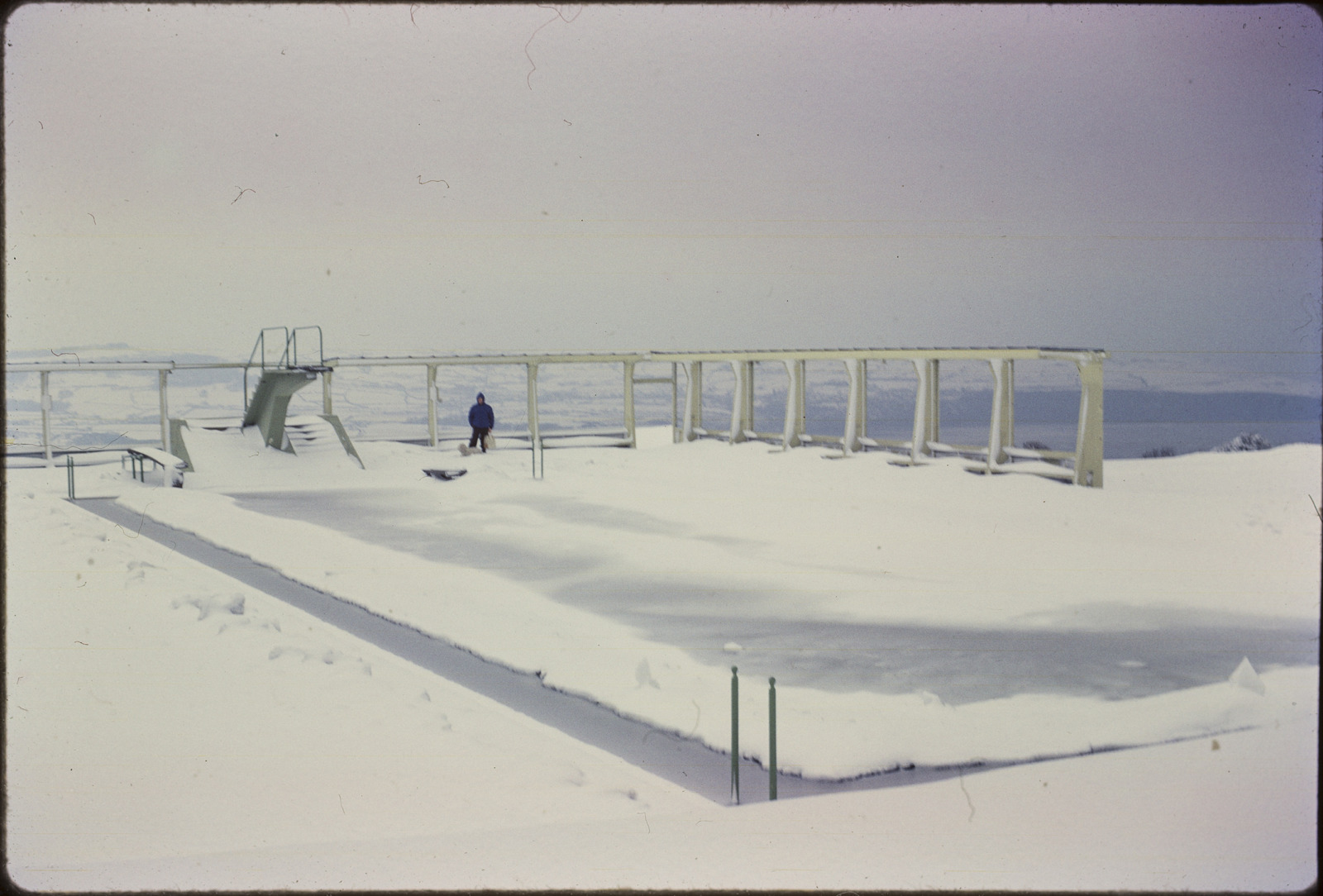
I’ve got a lot to thank the winter of 1963 for, and making it very east to work out where these pictures were taken is one of them. I imagine that as the winter ground on, thousands of people realised the historic significance of what was happening and went out to document it with their cameras. I must admit that the quality of the two cameras used by our photographer throughout the 60’s and into the 70’s wasn’t fantastic. Lots of the shots have the hallmarks of a poor lens, soft edges and nowhere near the quality of slides we saw in our last outing. The owner quickly abandoned his or her 35mm camera and switched to 126 square format, probably in some kind of Kodak Instamatic camera. A poor choice, but thank God they went out to take photos anyway, they’re fascinating.
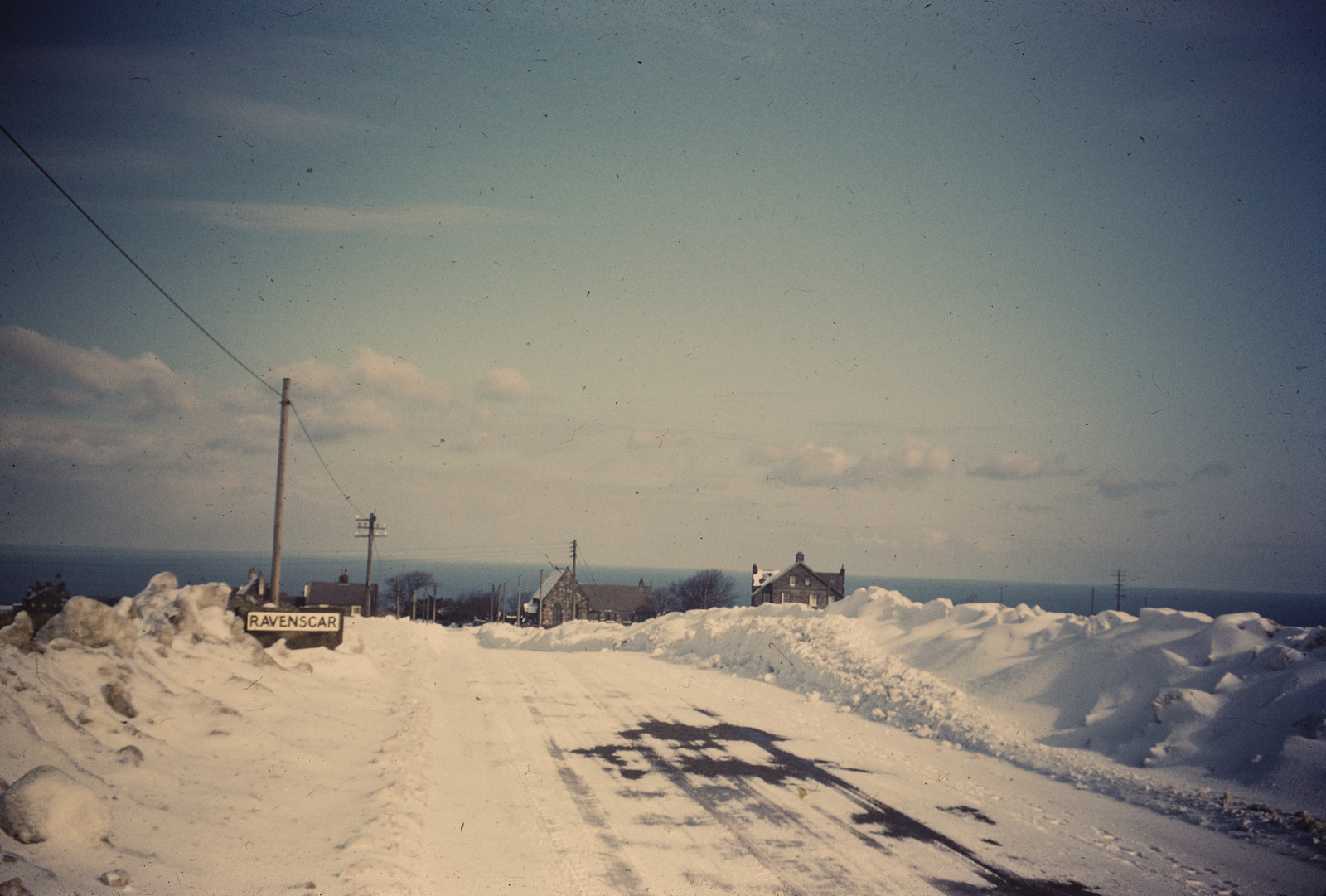
Our intrepid explorer went out and took pictures of the main road into Ravenscar – Raven Hall Road. This is the view North East and it’s a shame the road has been cleared because it takes something away from the scale of snowfall they’d had, but the piles by the side of the road should give you some idea. Better is the view from the other direction:
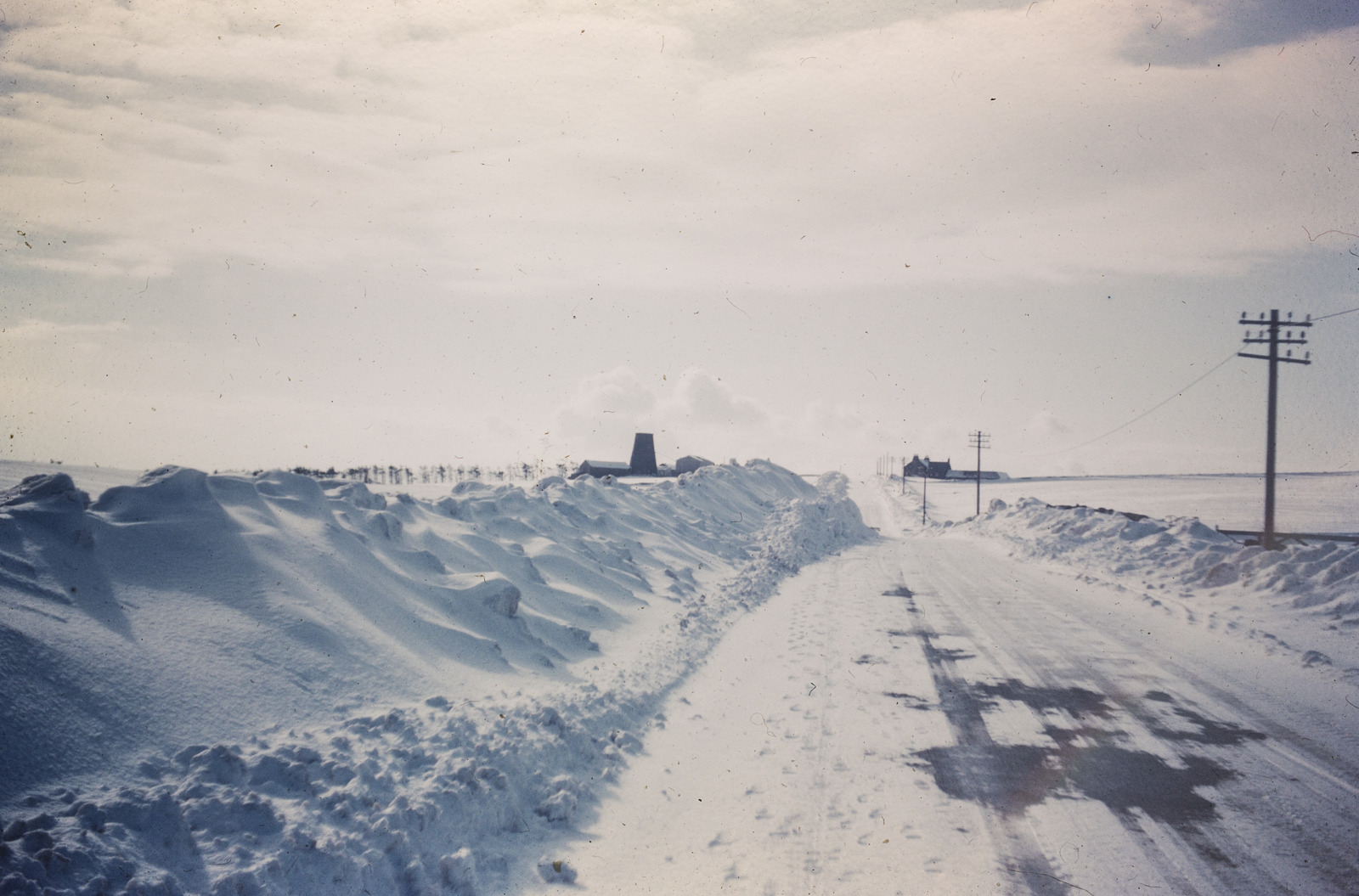
That snow drift on the left hand side is easily 6ft tall and the road, in a car from the 1960’s, would’ve been absolute murder to drive along. Even accounting for the fact that there were far fewer cars on the road then than now, there are apparently only a few people who’d been brave enough to risk it down that road.
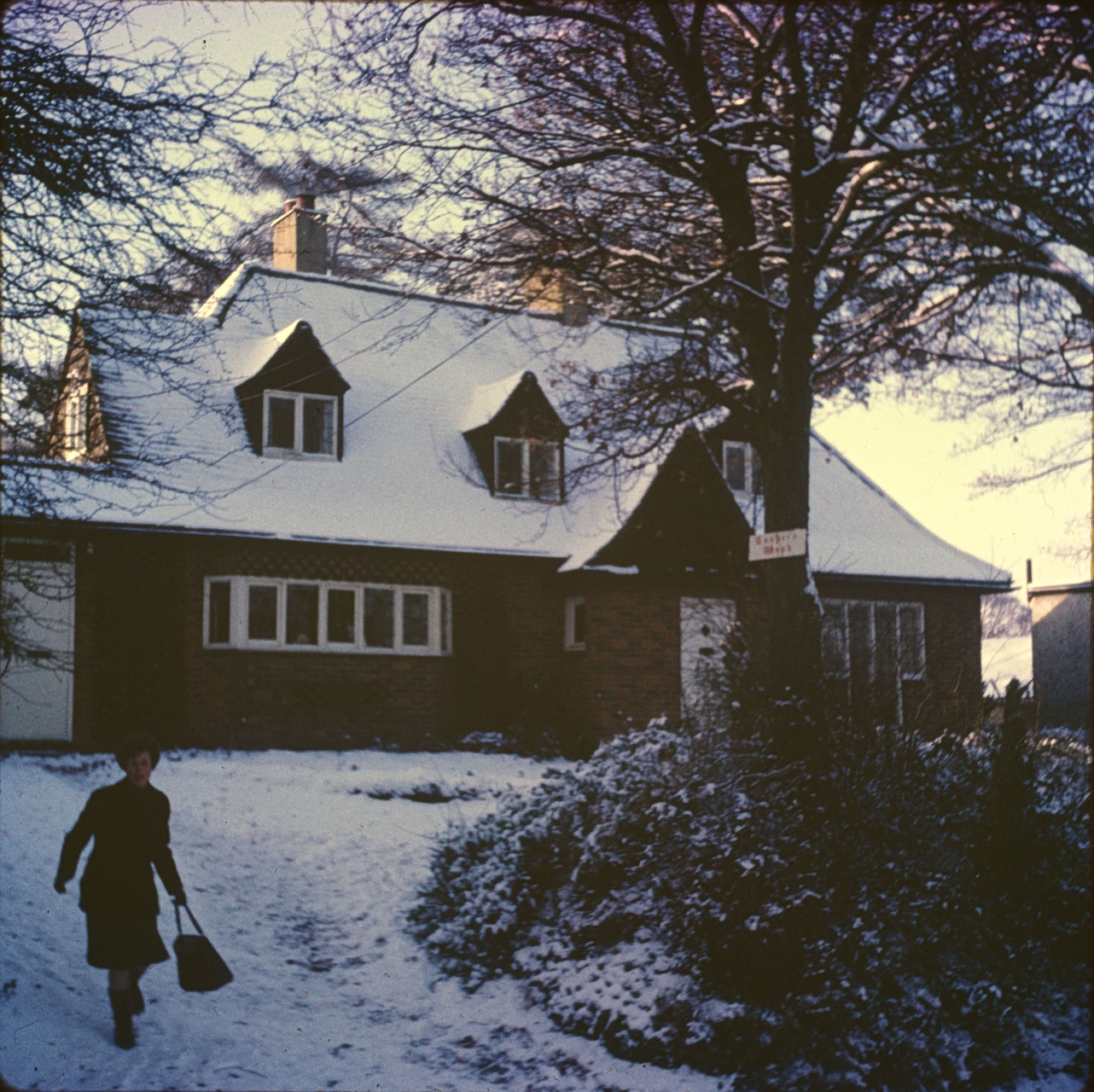
If you turn left off Raven Hall Road you end up on Robin Hood Road and that’s where our photographer lived in this relatively remote house and, at first glance, things don’t look too bad:
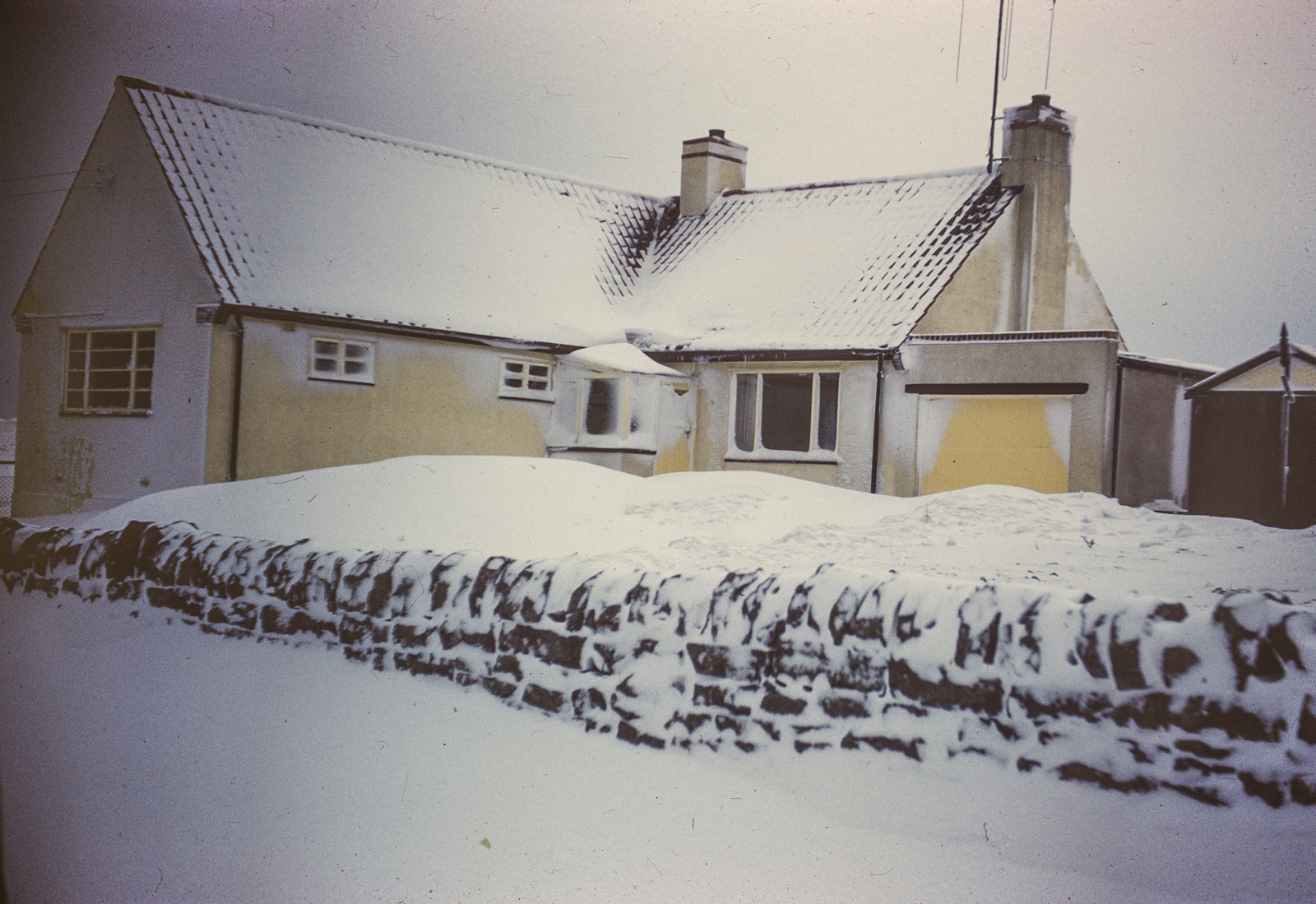
But get round to the front gate and we see that the front door situation is quite concerning:
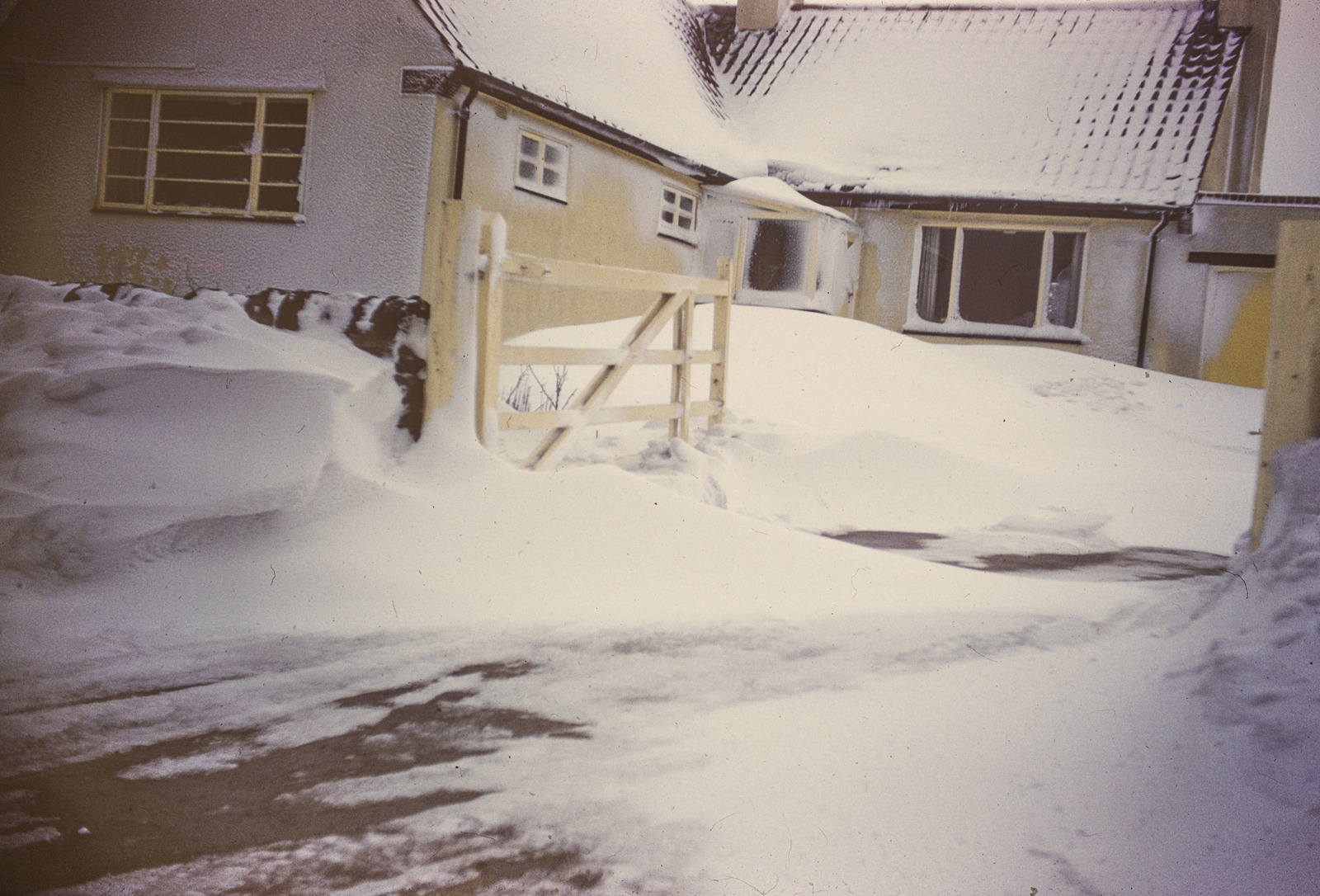
Yep, that’s half way up the door!
Again, let’s take a moment to consider how grim things were. That house has single glazed windows and probably next to bugger all insulation in the loft. when your parents or grandparents tell you they used to wake up with ice on the inside of the windows, they’re not lying. Looking at the number of chimneys in that house, there’s also a reasonable chance that they didn’t have central heating either. Those Northerners really were made of tougher stuff back then.
Their beautiful house looked a lot better during the summer months. There were a few slides that show it in better weather but had no dates on. I’m sure they were taken before 1966 in the garden round the side:
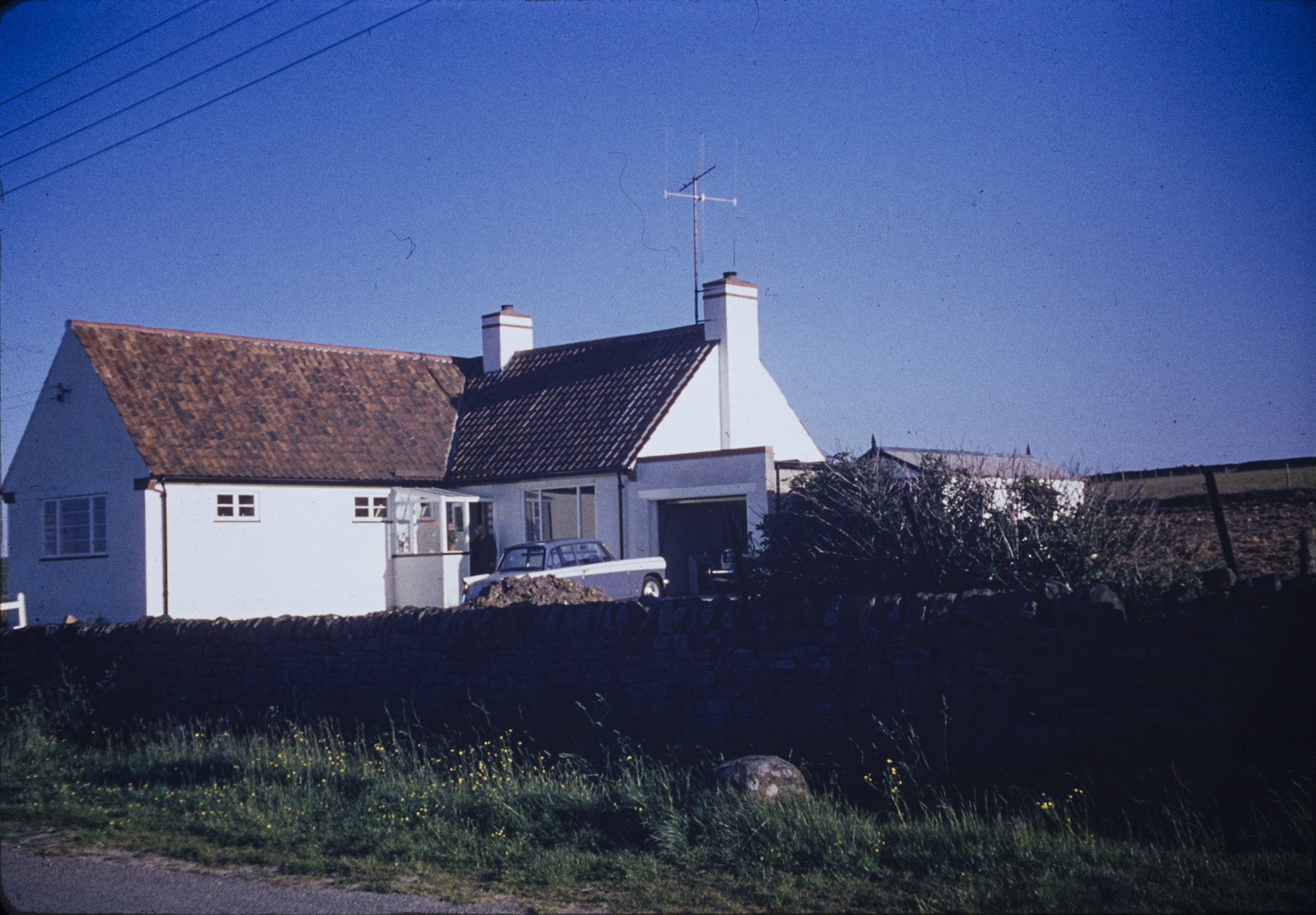
Slides age and as they do the colours shift and distort. However, unless something truly mad went on with the snow pictures, the house has changed colour… Someone who knows a lot about classic cars would probably be able to age this picture based on what’s parked on the drive. The next shot introduces us to a large portion of the family who feature throughout these images.
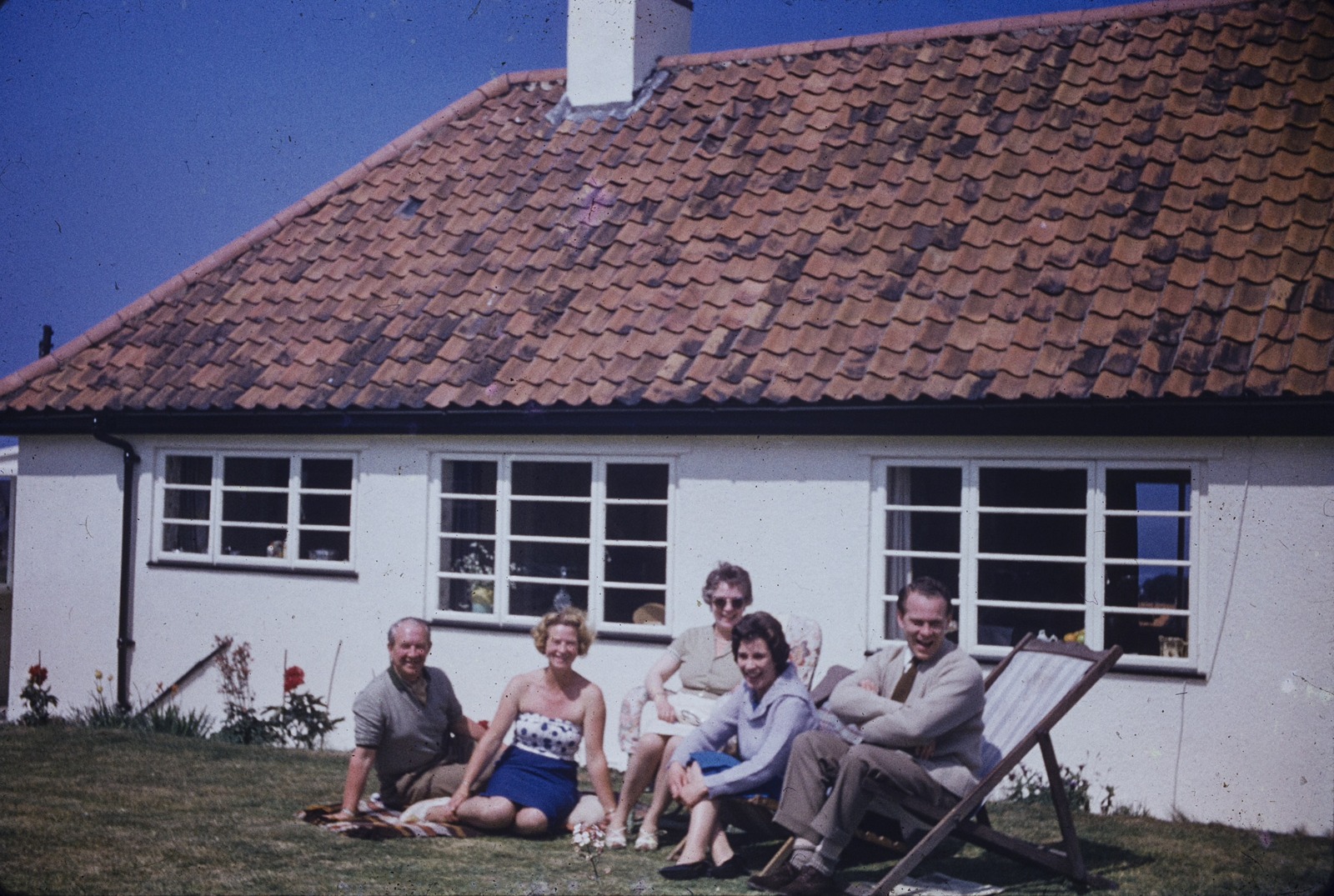
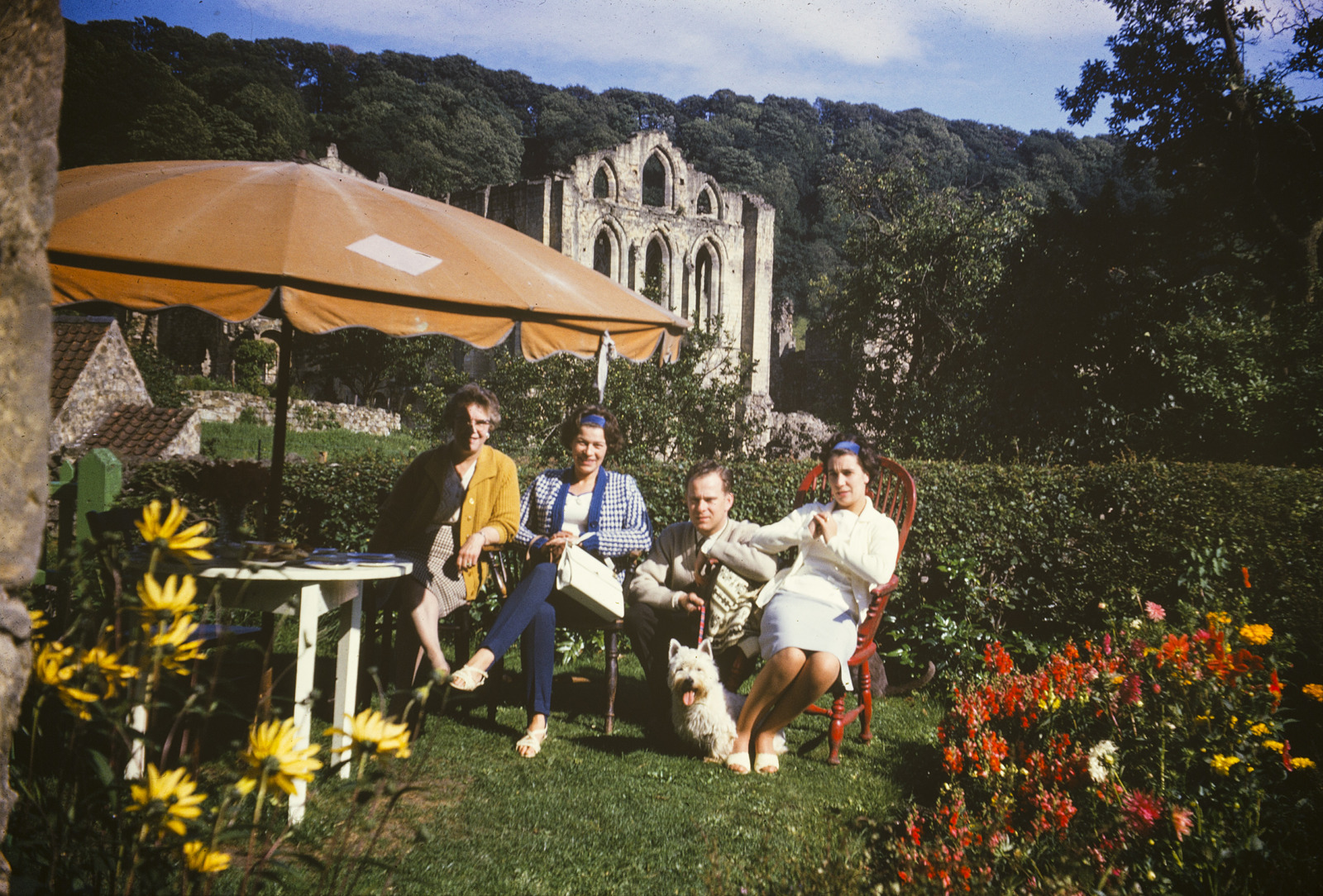
The man on the right is married to the woman next to him and I think her name is Jo who has (and all of this is pretty much guesswork) a sister called Mary. I could be completely wrong about the names, but it’ll help tell a story if we name them like this anyway. The others in the picture are parents, which side of the family I don’t know.
As usual, people change in appearance over the years and this does cause some confusion along the way to the point where I wondered if there might be three sisters or a third person taking these photos that we only see once. I’m really not sure for reasons you’ll see.
Anyway, to return to the snow for a moment, there’s a few scenes from the view directly opposite their house and I’m genuinely quite jealous of the beautiful location of their house. At the time these pictures were taken, some of their rooms definitely had distant sea views.
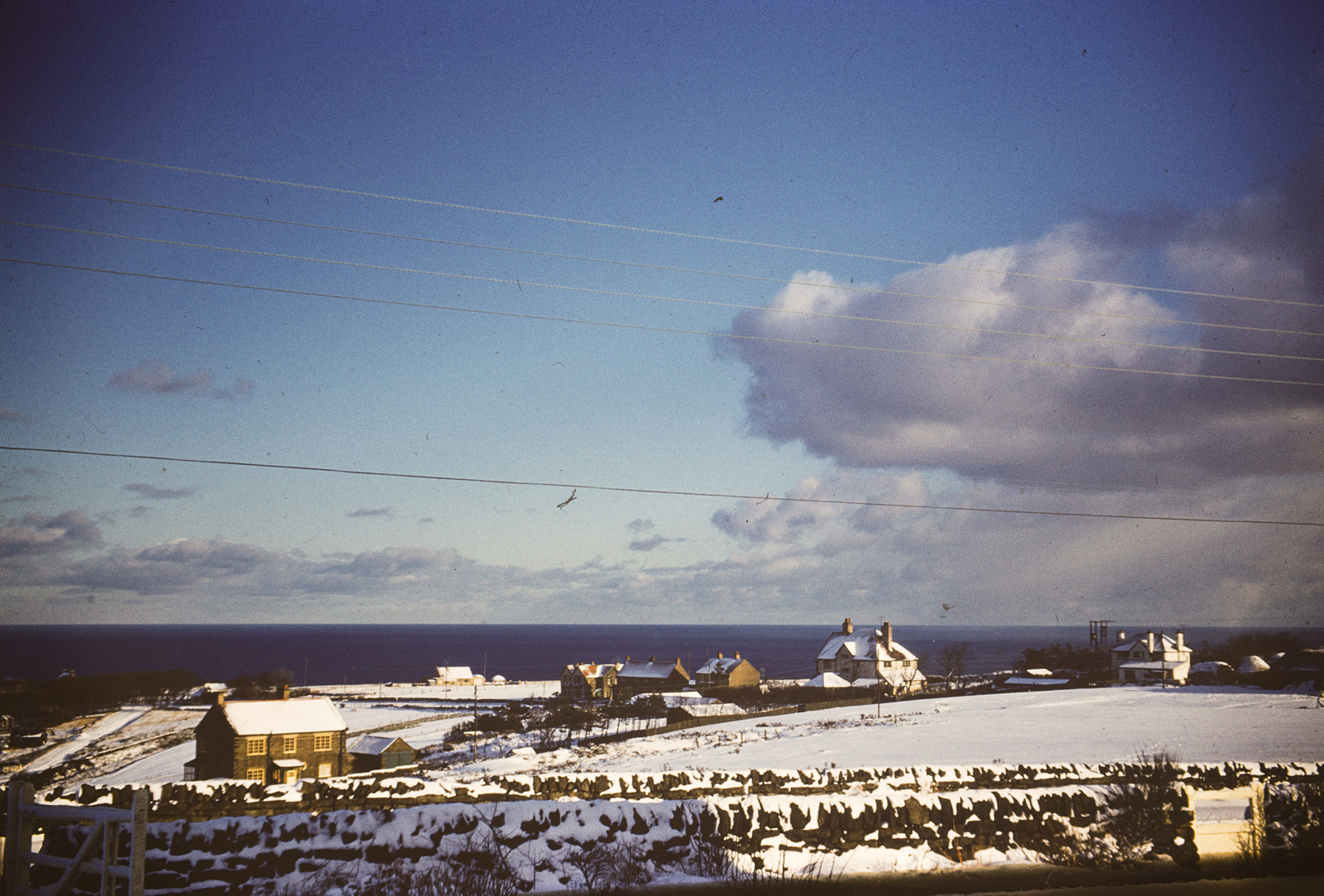
The house is called “Ravenheath” and wasn’t in great condition in 2009, but has been extensively refurbished and extended before being sold in 2024 for the not insignificant sum of £585,000 (for our international readers panicking, this information is public in the UK). It is almost unrecognisable in its current state, but the Google Streetview of 2009 shows it is, without a doubt, the same house as we’ve seen here.
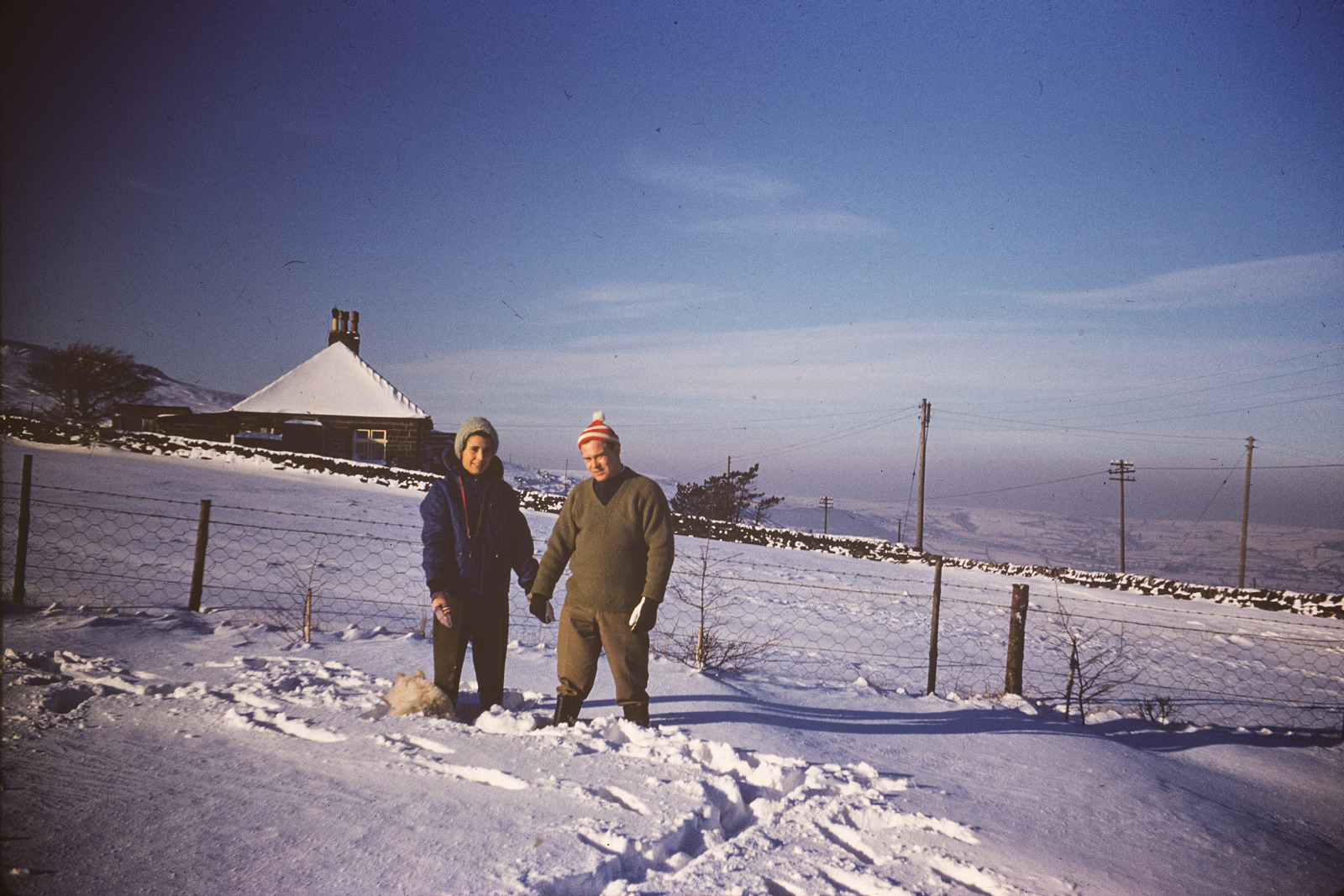
Back in 1963, our young couple are seemingly doing the impossible, and at best a thankless task, of trying to dig a path through their garden. Still, the dog seems to be enjoying itself and the views are beautiful.
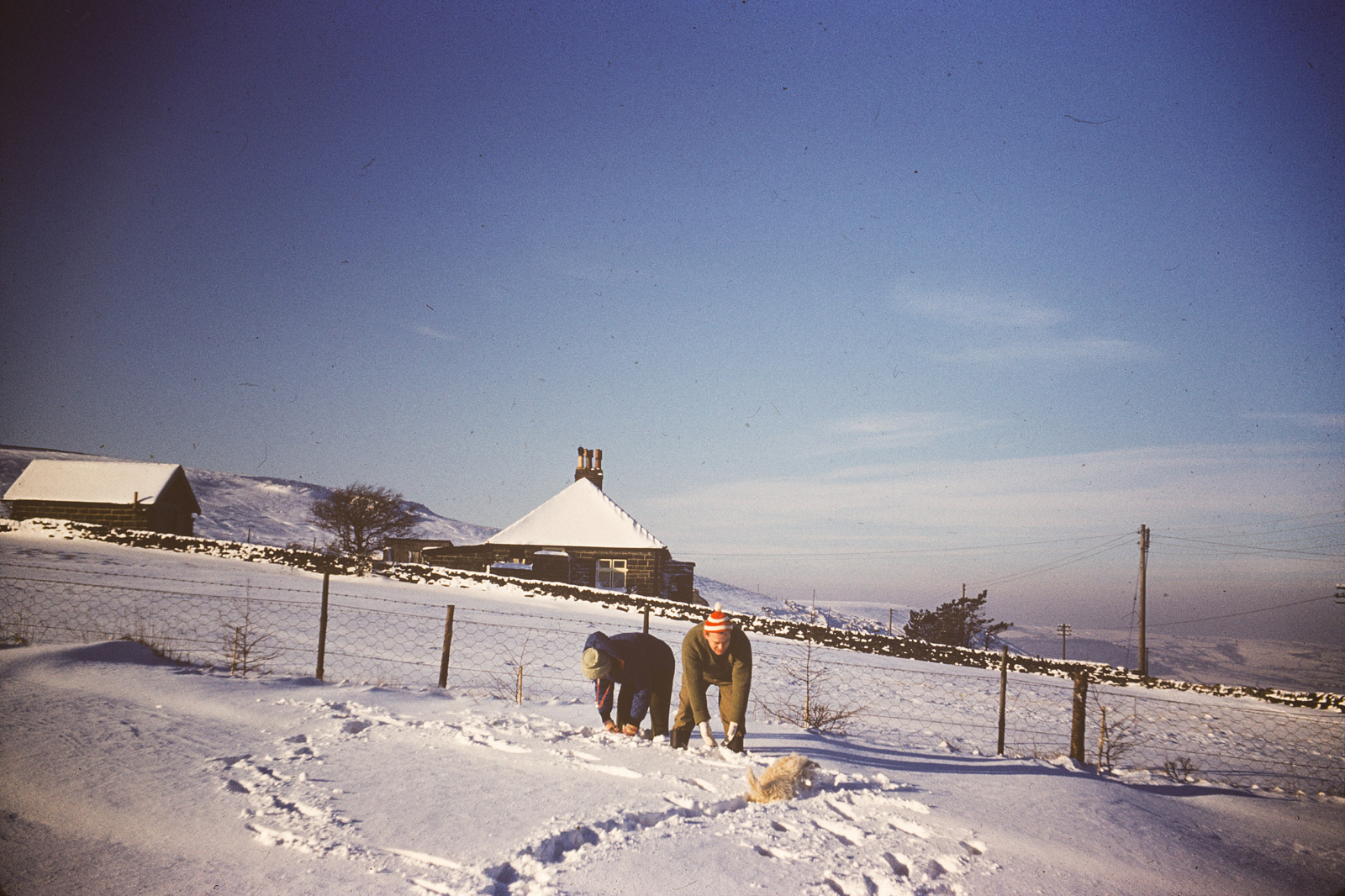
I’d truly love to know who is taking these photographs. I don’t think it’s a self timer, and to get to the house in these conditions wouldn’t have been easy and as we’ll learn, wherever Jo seemed to go, Mary went with her. The only reason I don’t think they live together is that there’s a very blurry shot of Mary coming out of a rather posh looking house, presumably her own, which the photographer has gone to the trouble of labelling as being her. Odd.
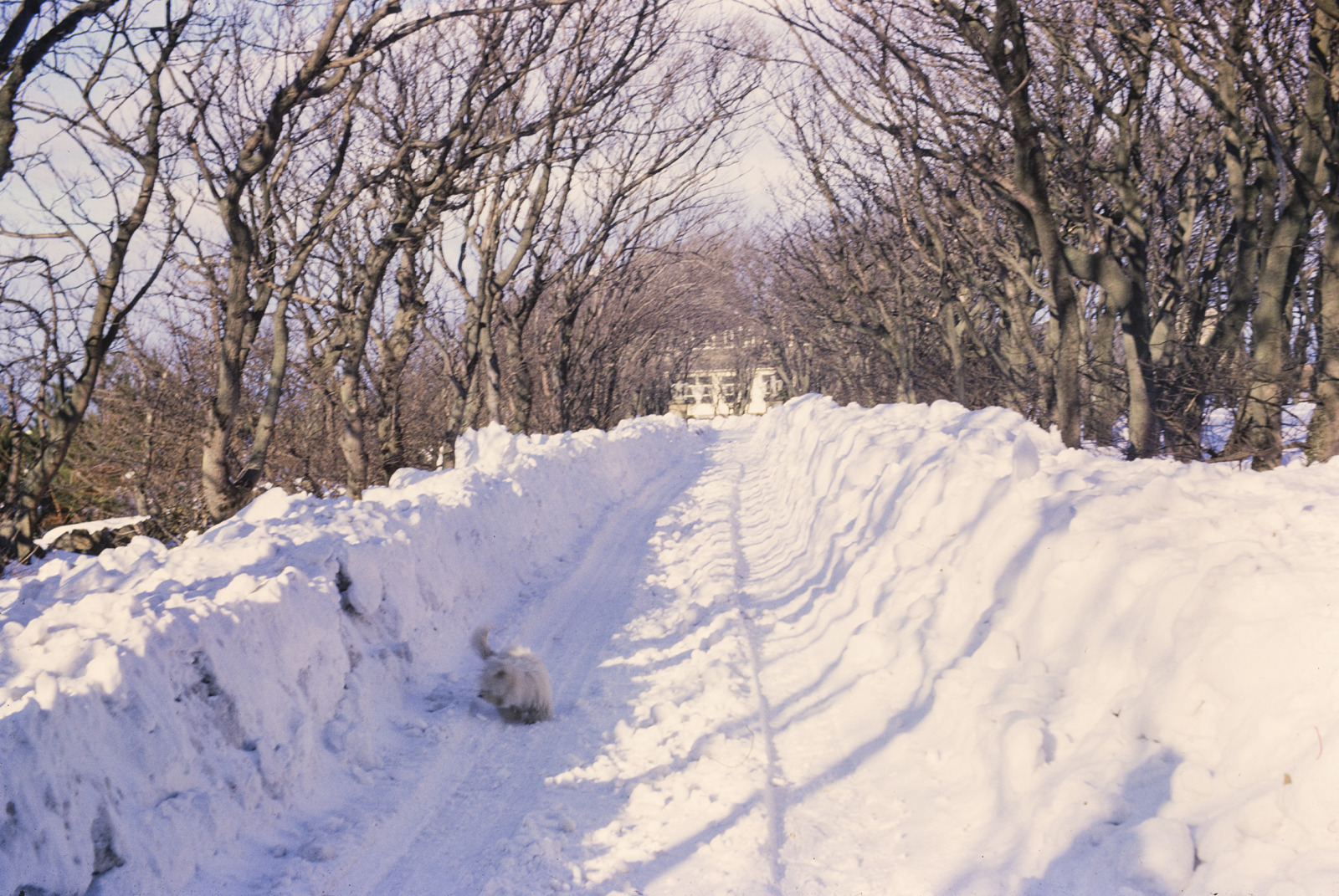
There’s one more of the snow worth showing you, if not just for the artistic nature of it. This is “The Avenue” and is the driveway to Raven Hall hotel, with the very frozen swimming pool. According to Street View, there is no wall to the right hand side of this drive so that is just a huge amount of snow.
…and thaw…
The processing date on the previous roll of film was March 1963, so you’d imagine they hot footed it down the development lab the second the snow started to melt. The rest of the year was spent catching up on some nice days out in tourist hotspots that are definitely a lot busier today than they were then.
First up is a trip to Rievaulx Abbey, just down the road from Ravenscar and it seems that back then you could just pitch up and have yourself a picnic right in front of the ruins of an 11th century abbey.
Reivaulx is historically extremely significant. It is one of the earliest examples of Cistercian settlement in the UK, dating back to 1132. Initially the site consisted of wooden buildings used as a monastery, later developing with a large chapter house and, I quote English Heritage, a “monumental church.”
The site expanded further and lasted until 1538 when Henry VIII fancied himself another wife and did what any self respecting king would do and set himself up an entirely new religion just to get around some minor technicalities with him not being allowed to divorce his current wife. The subsequent “Suppression of the Monasteries” was surely one of the most regretful and wilful destructions of large chunks of English architecture and heritage for not very good reasons at all. However, the level of destruction varied throughout the country and Reivaulx got off lightly by only losing its roof, windows and bells before the inevitable decay set in.
Iron smelts and forges continued to operate at Reivaulx in the subsequent years until about 1640 and apparently the now disused refectory buildings were used as stores until they quite literally ran out of wood to burn to make charcoal and fuel the furnaces.
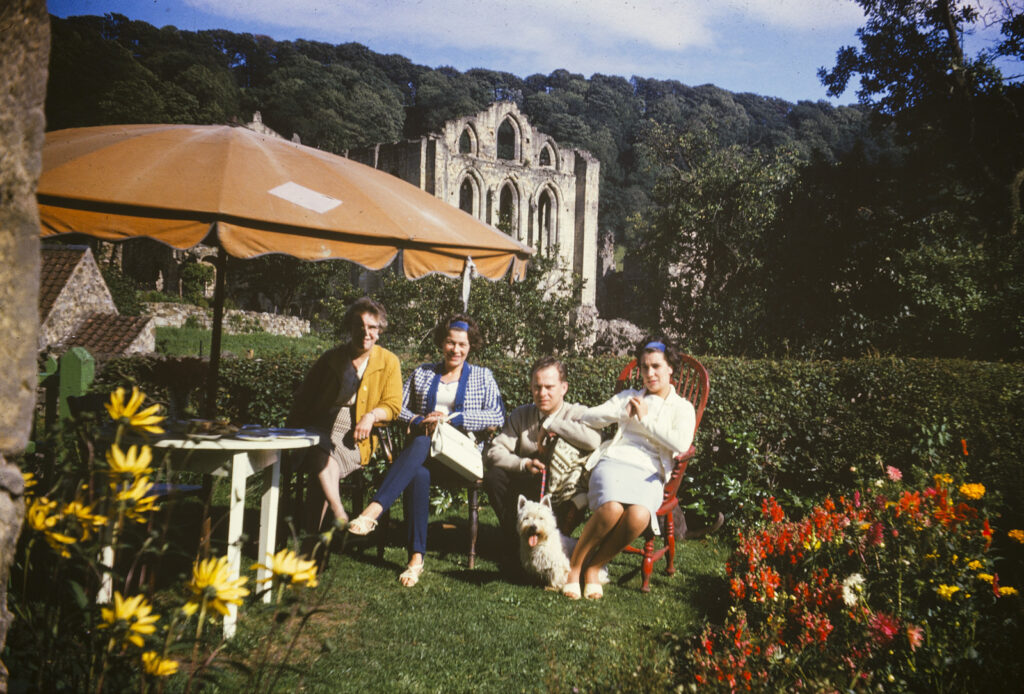
In the image above, our family are almost certainly sat in the garden of the house shown below and it doesn’t look like it has been any form of business, such as a tearoom, so I can only presume this was either a holiday let (possible but they lived so close by it wouldn’t make sense to need to rent out the place) or perhaps the house belonged to a friend, maybe even to the lady on the left of the picture. Is that woman the mother of Mary, second from the left? Sadly the focus is out and her face is half in shadow so I can’t tell – plus I’m useless at spotting family resemblance as it is.
If you spin the view above around by 180 degrees you’ll see that the little details match perfectly. There isn’t another house nearby so this is the right one. There’s no public information about it so it definitely hasn’t changed hands in a long, long time whoever owns it.
Back in Ravenscar, there’s just time for a quick swim down the Hall and a walk with some horses before we’re off on a seaside town tour of the East coast of Yorkshire.
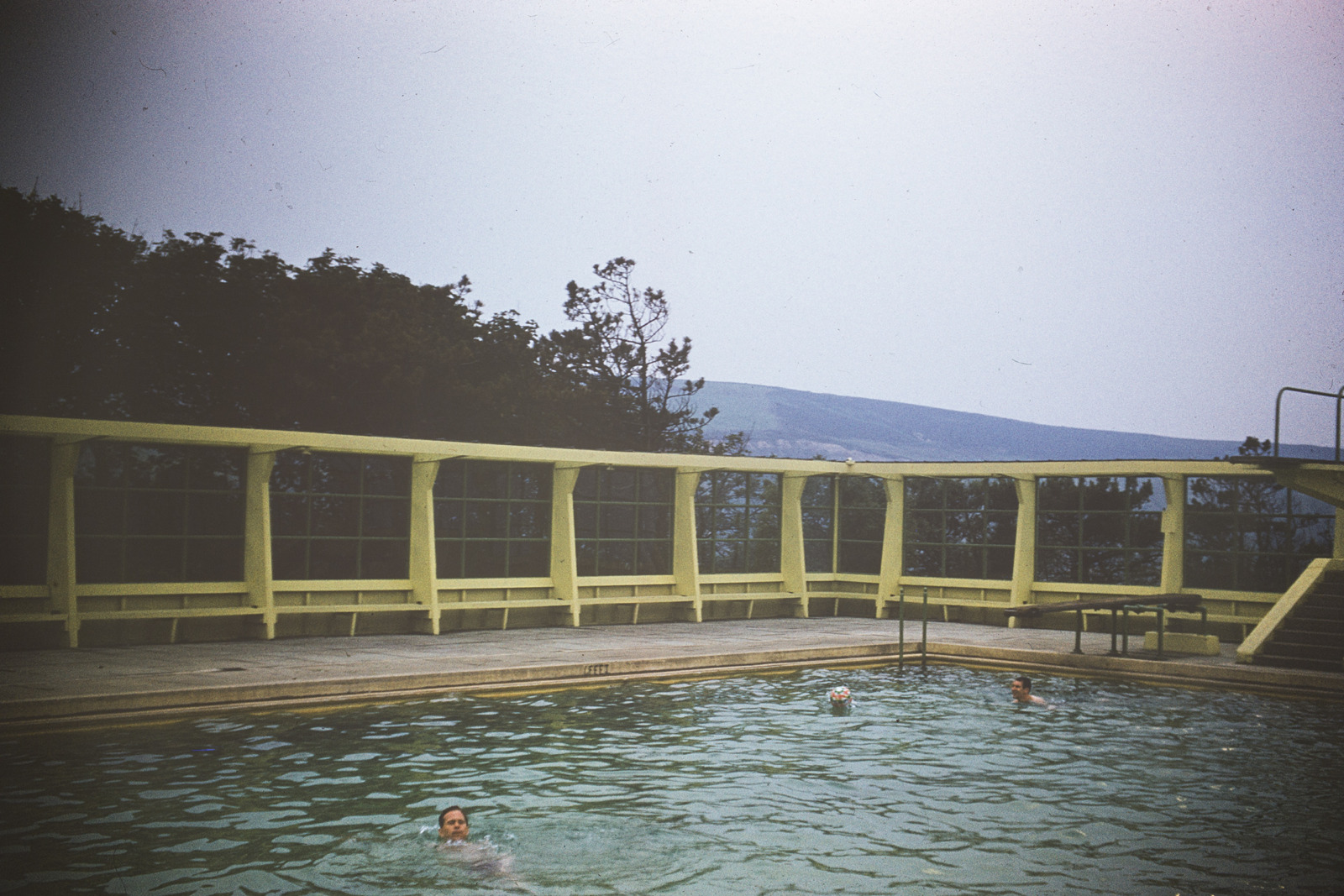
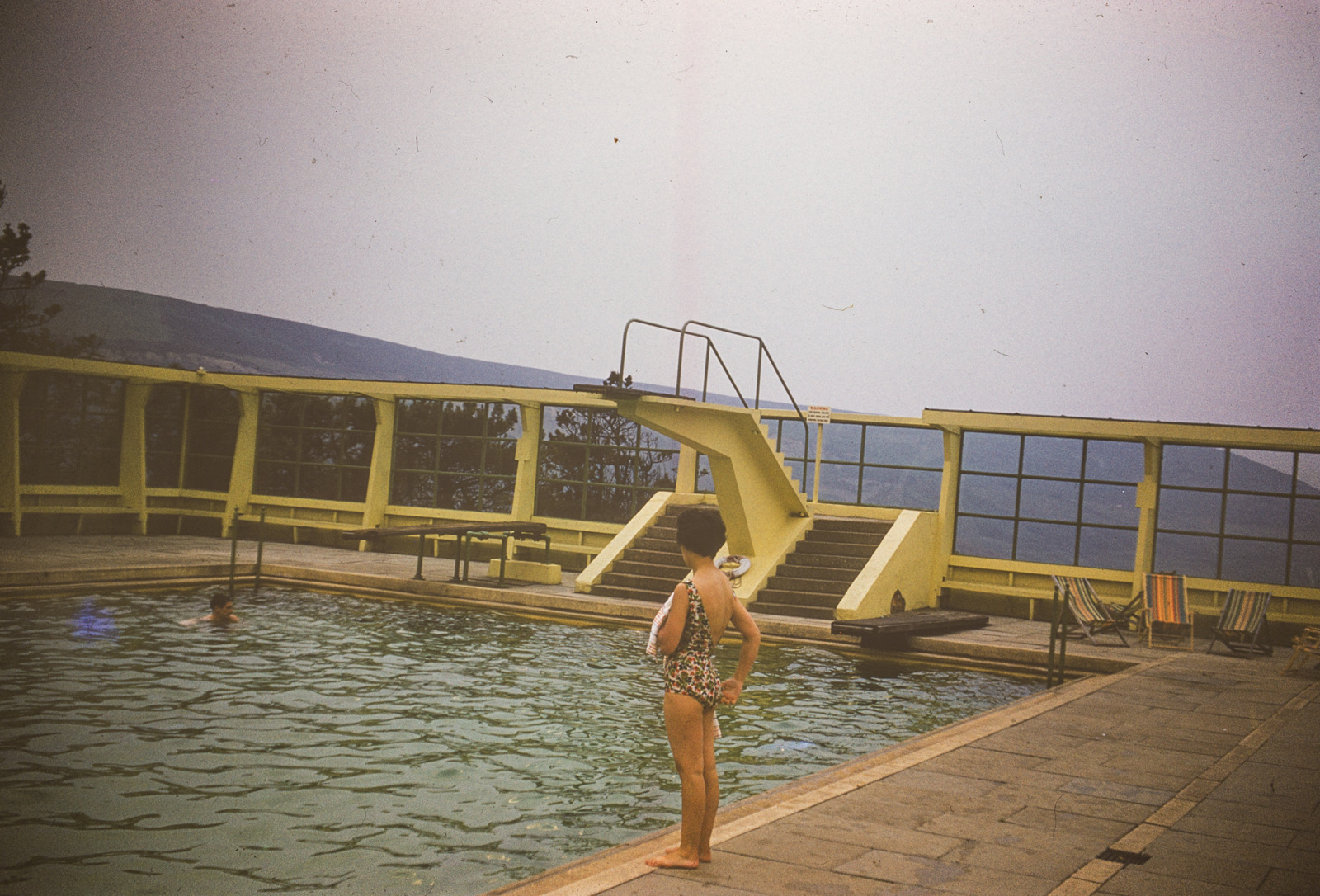
According to a local Facebook group for the area, this pool wasn’t heated and was freezing at the best of times. Still, it was a lot less freezing in these pictures than a few months prior when you’d have had a rude awakening trying to dive in at that point.
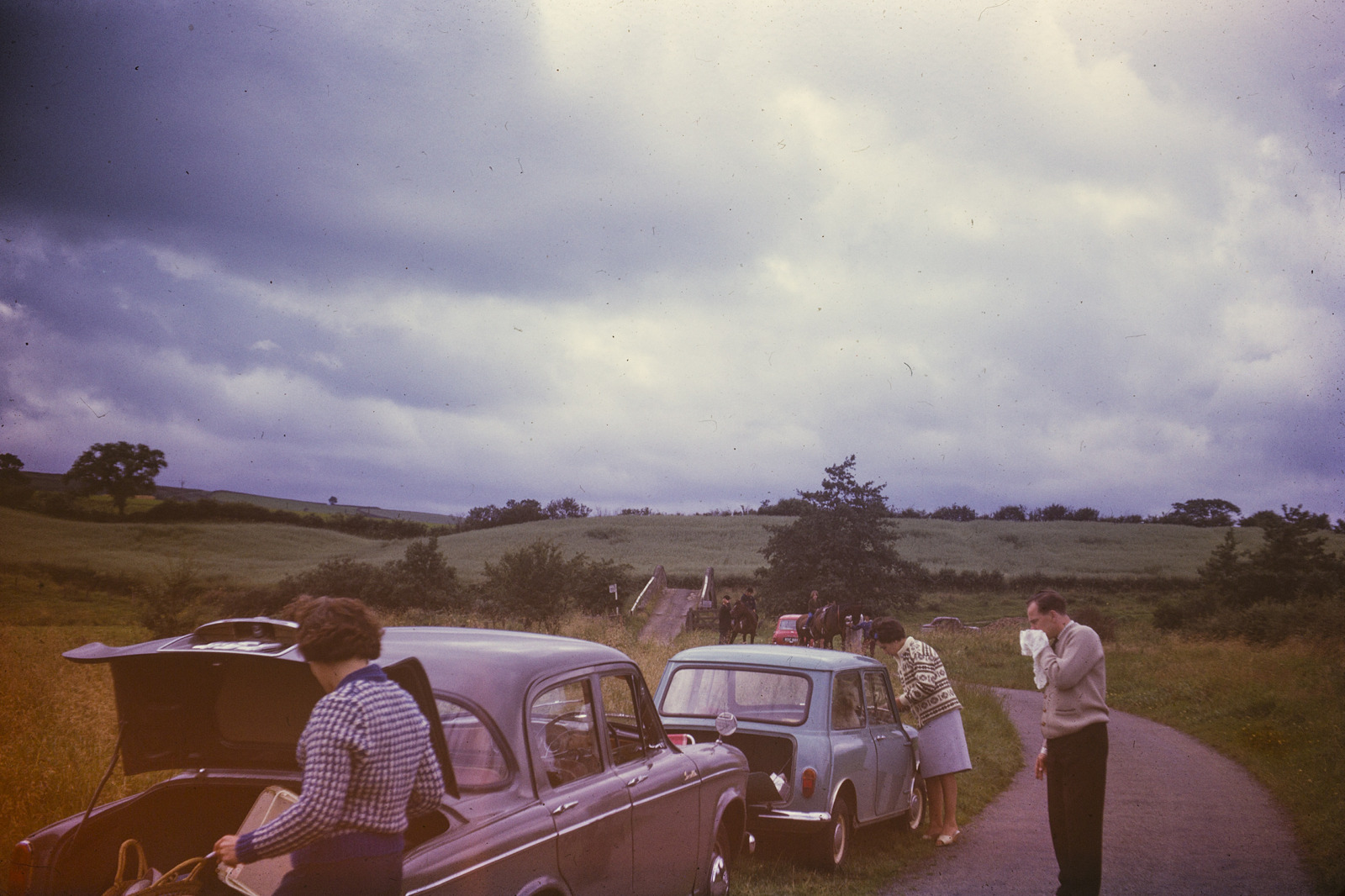
In 1963, Mary appears to be driving a Hillman Minx – a car with roots as far back as the 1930’s but by all accounts a reliable motor for the day. Jo is knocking about in a Mark 1 Mini, which will later be upgraded to a very shiny red, brand new Morris Mini Traveller with the decorative wooden framed rear.
Northern seaside town tour
1963 comes to a close with a series of visits to seaside towns and villages all within a short drive of Ravenscar. First up is the village of Staithes. Anyone with young children will probably be familiar with Staithes by accident as it is the home of “Old Jack” and “Salty Dog” in the CBeebies show Old Jack’s Boat featuring the magnificent Bernard Cribbins who famously starred as the Hotel Inspector in Fawlty Towers and Helen Lederer who, as far as I’m concerned, played her best role as Lady Natasha Letitia Sarah Jane Wellesley Obstomsky Ponsonsky Smythe Smythe Smythe Smythe Oblomov Boblomov Dob, third Viscountess of Moldova in the Bottom episode “Digger.”
Staithes certainly looks a lot more beautiful today than it did in 1963.
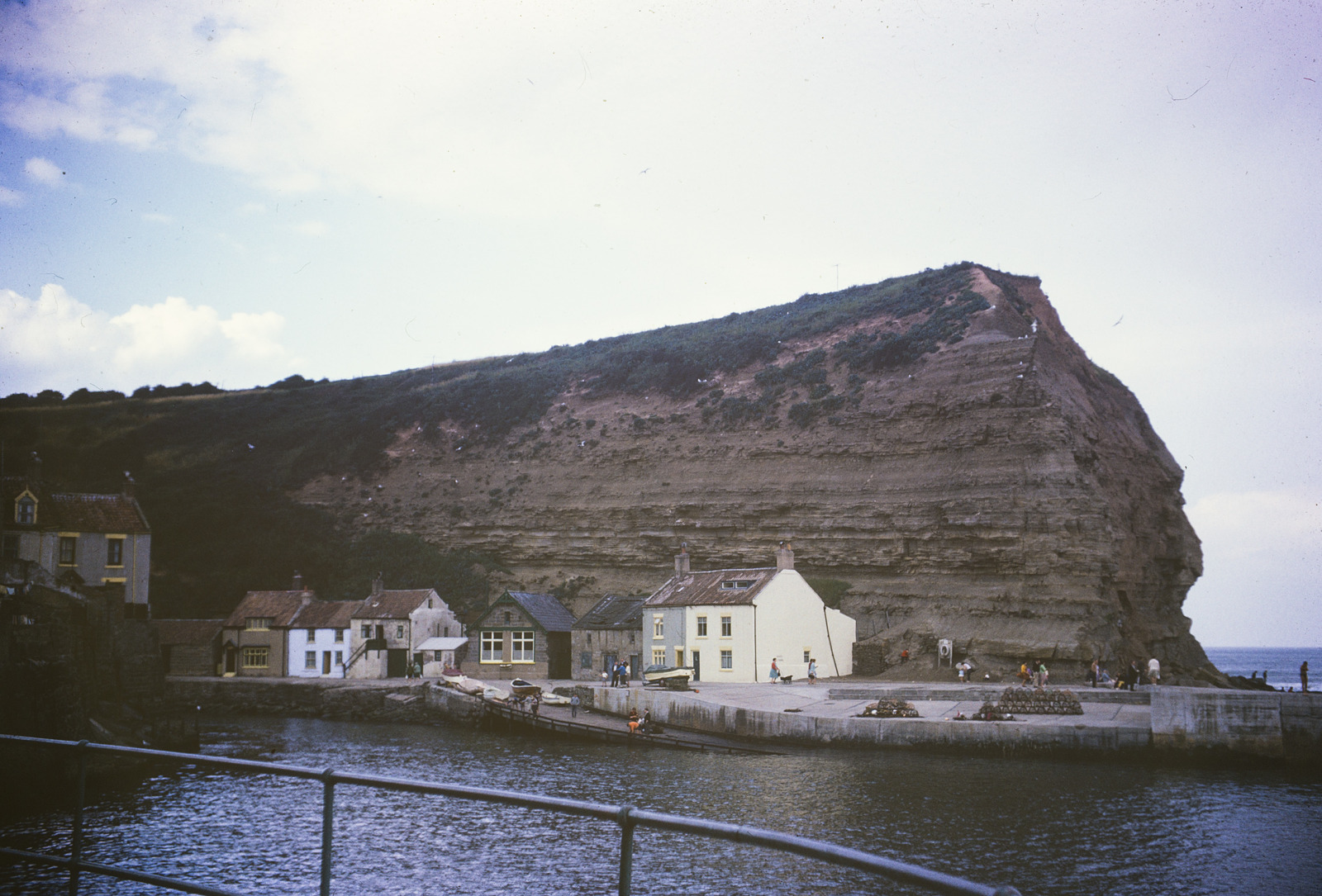
In what I hope is a wonderful Wikipedia hoax, the locals in Staithes have a superstition where they will not say the word “pig” as they believe it brings bad luck to the point where fisherman would refuse to go to sea if they heard it, lest they drown. My favourite quote from the Wikipedia article on Staithes is “…ironically, there is a pig farm overlooking the village.” It gets better, as the same paragraph ends with this gem:
“…eggs had to be referred to as “roundabouts” to avoid bad luck.”
– Superstitious locals.
There is a reference for this, an academic article which I urge you to read, authored by a lecturer of English at Liverpool university, no less.
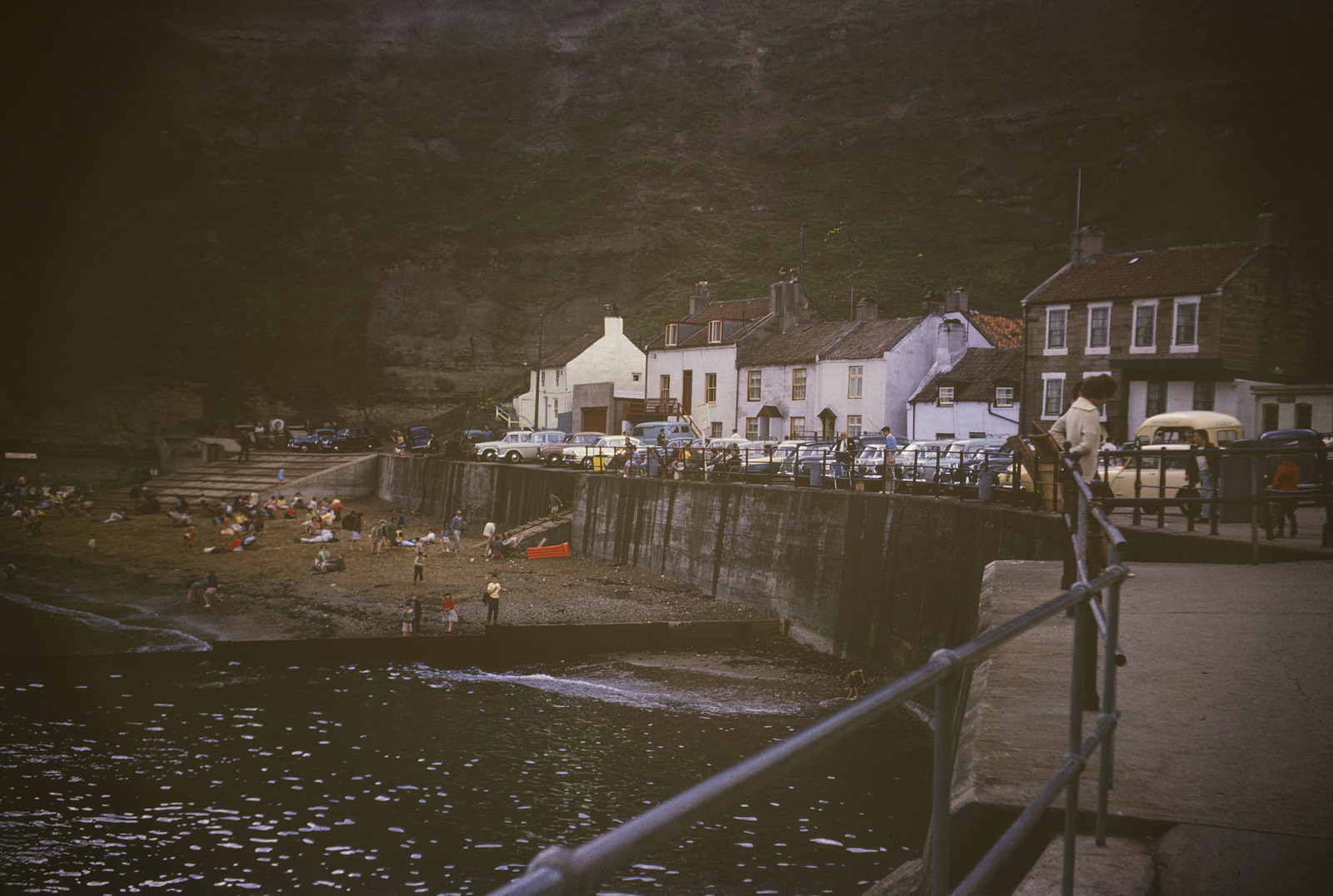
There’s a very limited beach area which looks rather rocky from this distance but the locals are making the most of it and the car park is rammed with an assortment of classics that would constitute a classic car rally commanding a sizeable entry fee these days.
They didn’t stay long in Staithes, or there wasn’t a great deal to see there worth photographing on that particular day because the next image is of Runswick Bay and it looks rather picturesque there to say the least.
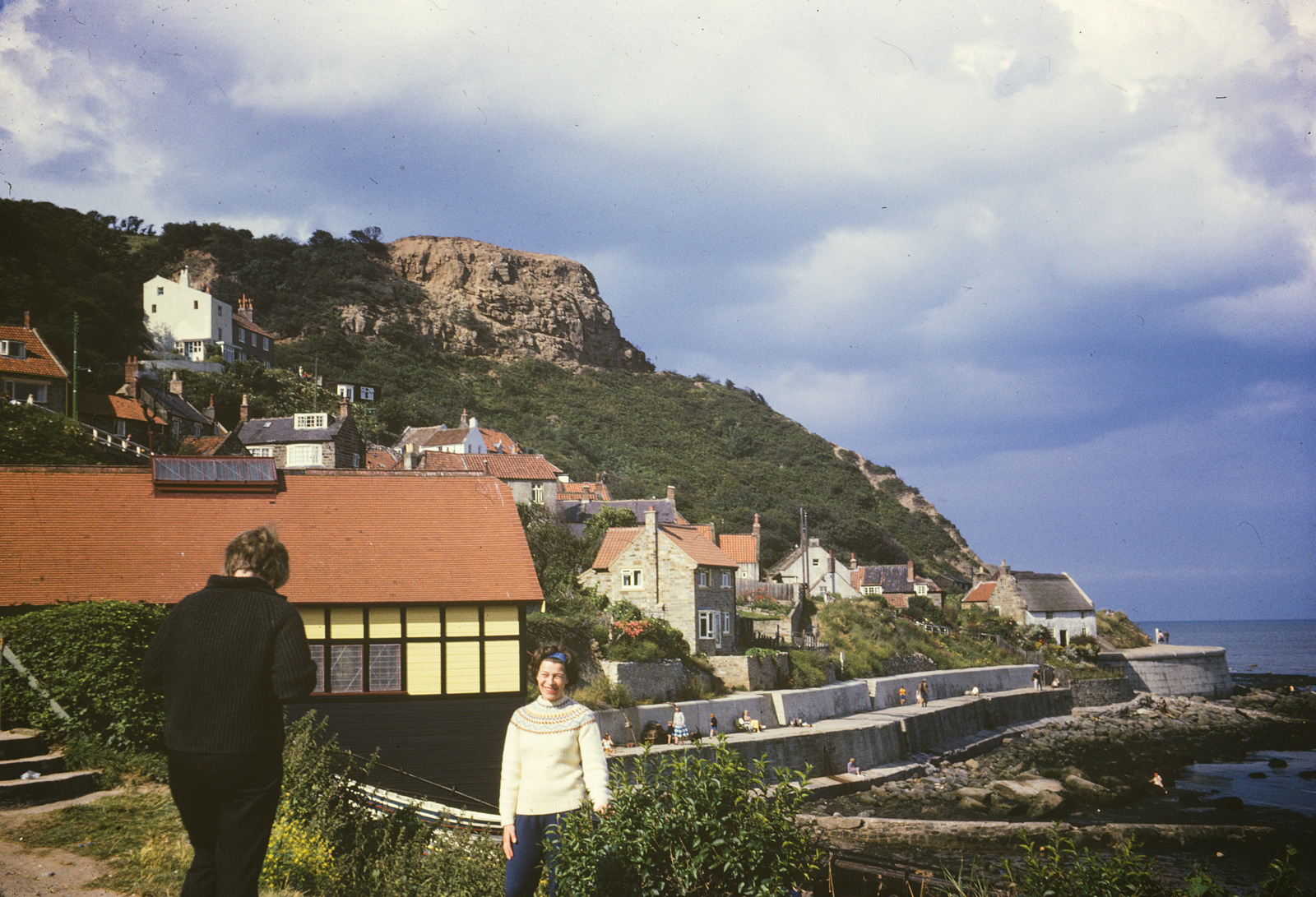
Mary is having her photo taken against the backdrop of the bay and I wish I could see what camera they’re using. I assume it’s some kind of box camera going on the use of a waist level finder by the photographer in the picture. Notice that Mary is wearing her blue headband – something she’s had on in all of these pictures so far. The next image is a proper classic 1960’s beach photo:
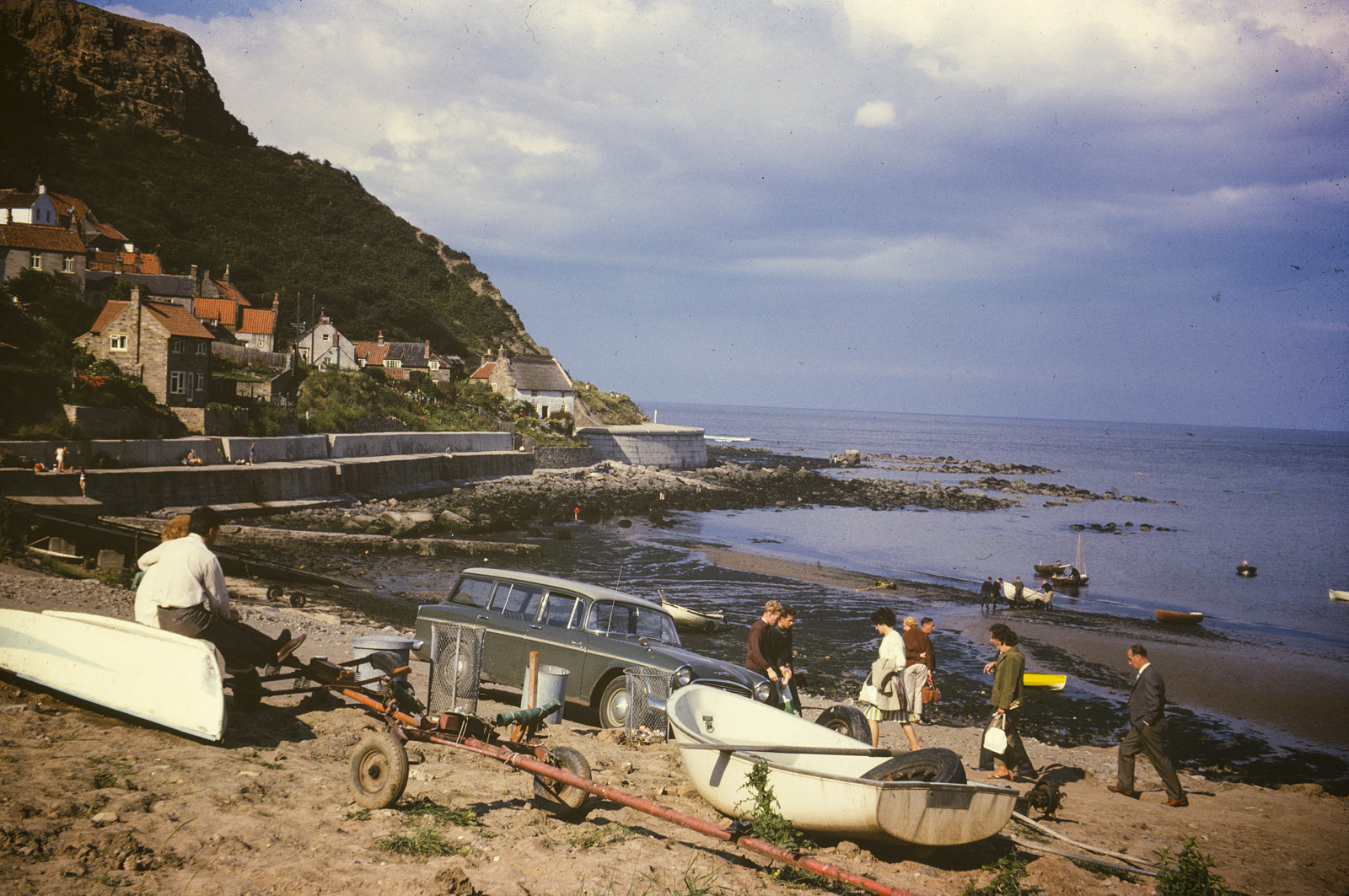
This is one of those photographs I can look at for a long time. There’s so much going on and so many period quirks that make it fascinating. Look at the beautiful cottage gardens in the houses, zoom in and spot all the couples dotted around the cliffs and beach and I love the couple sat on the upturned boat looking out to sea and the fact that back then you could just drive your car straight onto the beach and abandon it – maybe it was theirs? The car is potentially a “Humber Super Snipe Estate” which is one hell of a name for a car.
What really gets me is the way people dress back then, the gentleman (for he can only be described as such) on the right side just casually walking down the beach in… a full suit and tie with brown leather shoes. I mean… It was suit or nothing back then, for everything. Beach holiday? Suit. Clean the car? Suit. Going swimming? Suit. Painting the living room? Suit.
I cannot tell you how glad I am personally that this trend has died out. There is no more impractical and uncomfortable form of clothing than the suit and tie. Ties alone are stupid enough, but combine it with a suit and you’ve got the outfit from hell. The history of why we wear suits is quite interesting, and you should listen to the “Here for the History” episode which succinctly explains it all – and the reasons are silly. However, no one can argue that even your average Joe on his way to the shops looked bloody spectacular in 1963.
Finally, we finish the year with a visit to Scarborough and a picture that feels very much like a postcard candidate. There are more pictures from Scarborough in later years which are really well composed, but these 1963 images certainly act as a really interesting historic snapshot of the harbour as it stood then.
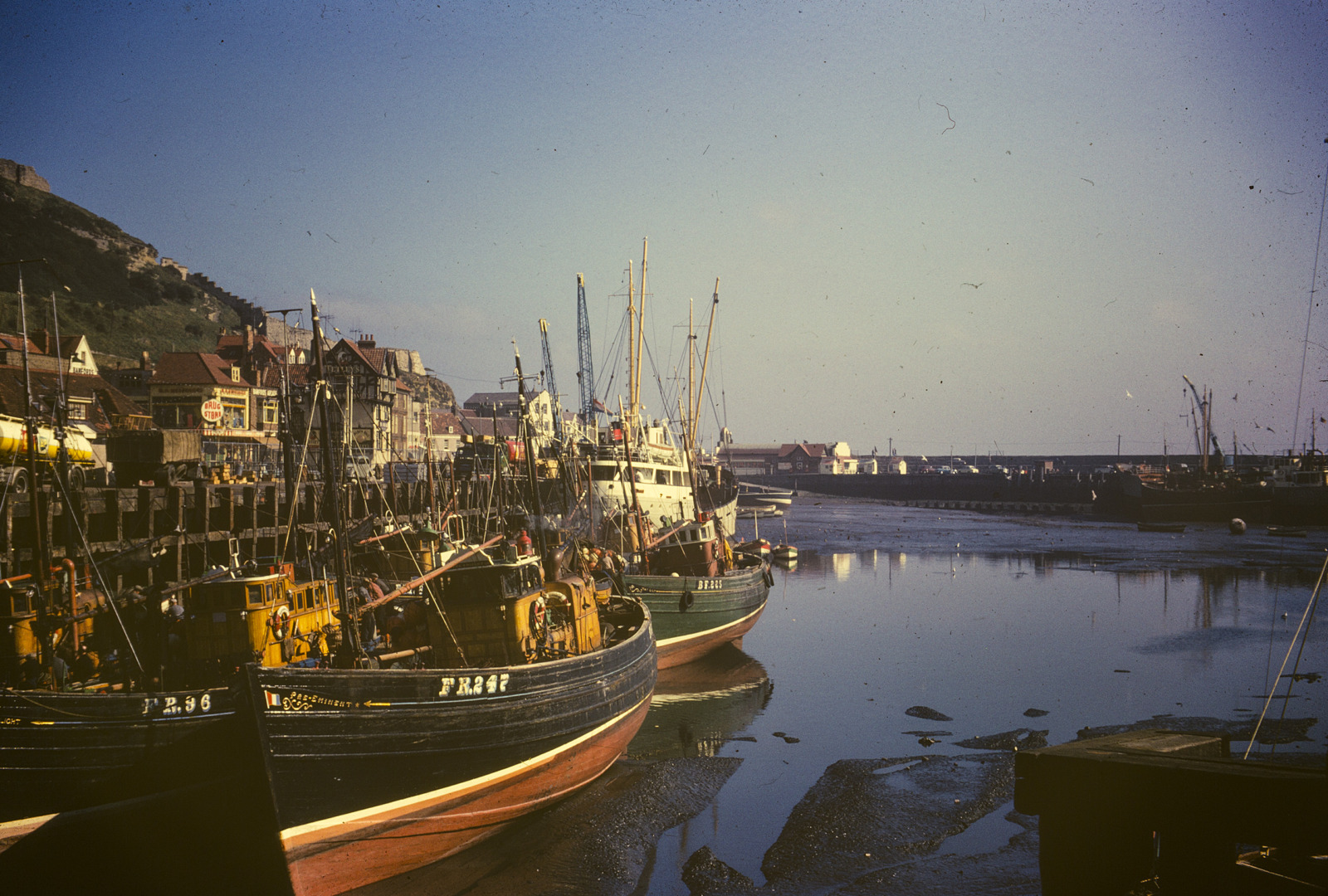
The image above is beautiful and I love the sunlight on the fishing boats. The “Golden Ball” pub you can see in the Tudor style building is still in business and, in a genius “we definitely won’t get sued for this” marketing move, the yellow building with the round “Drug Store” sign is now…
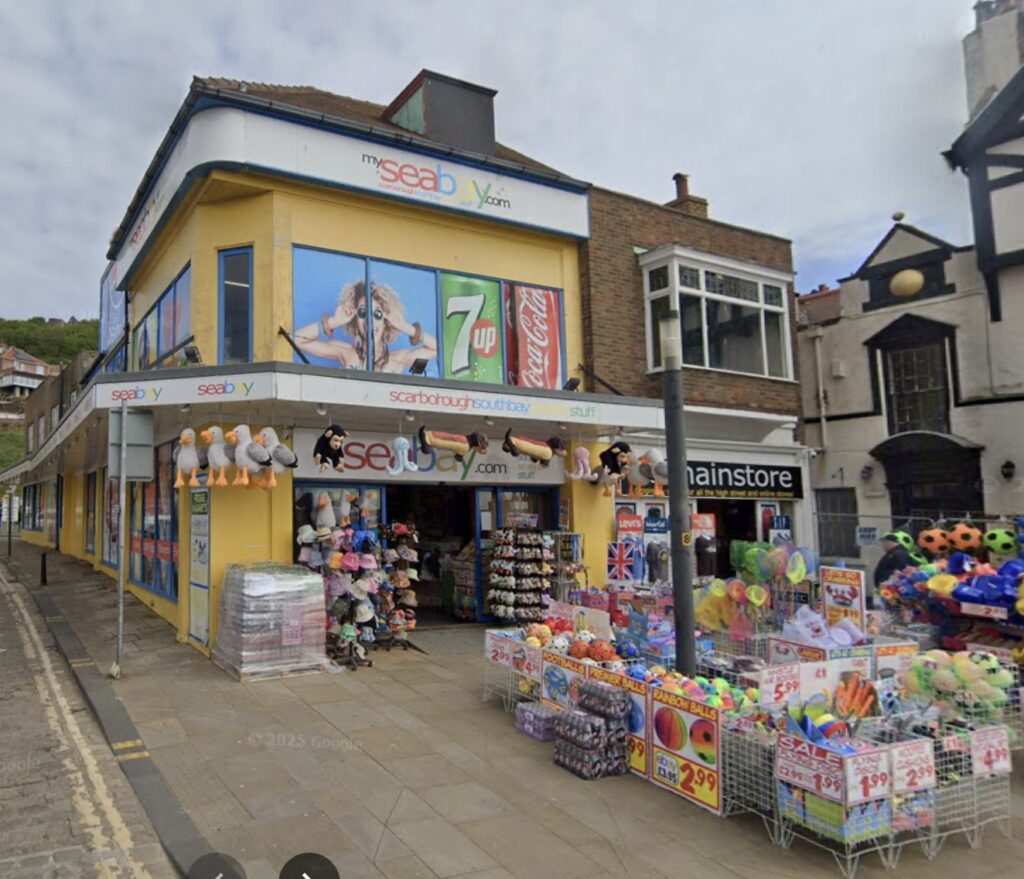
“Seabay.”
Incredible.
That they’ve not been served a cease and desist is beyond me. It’s up there with “Romino’s” in Minehead…
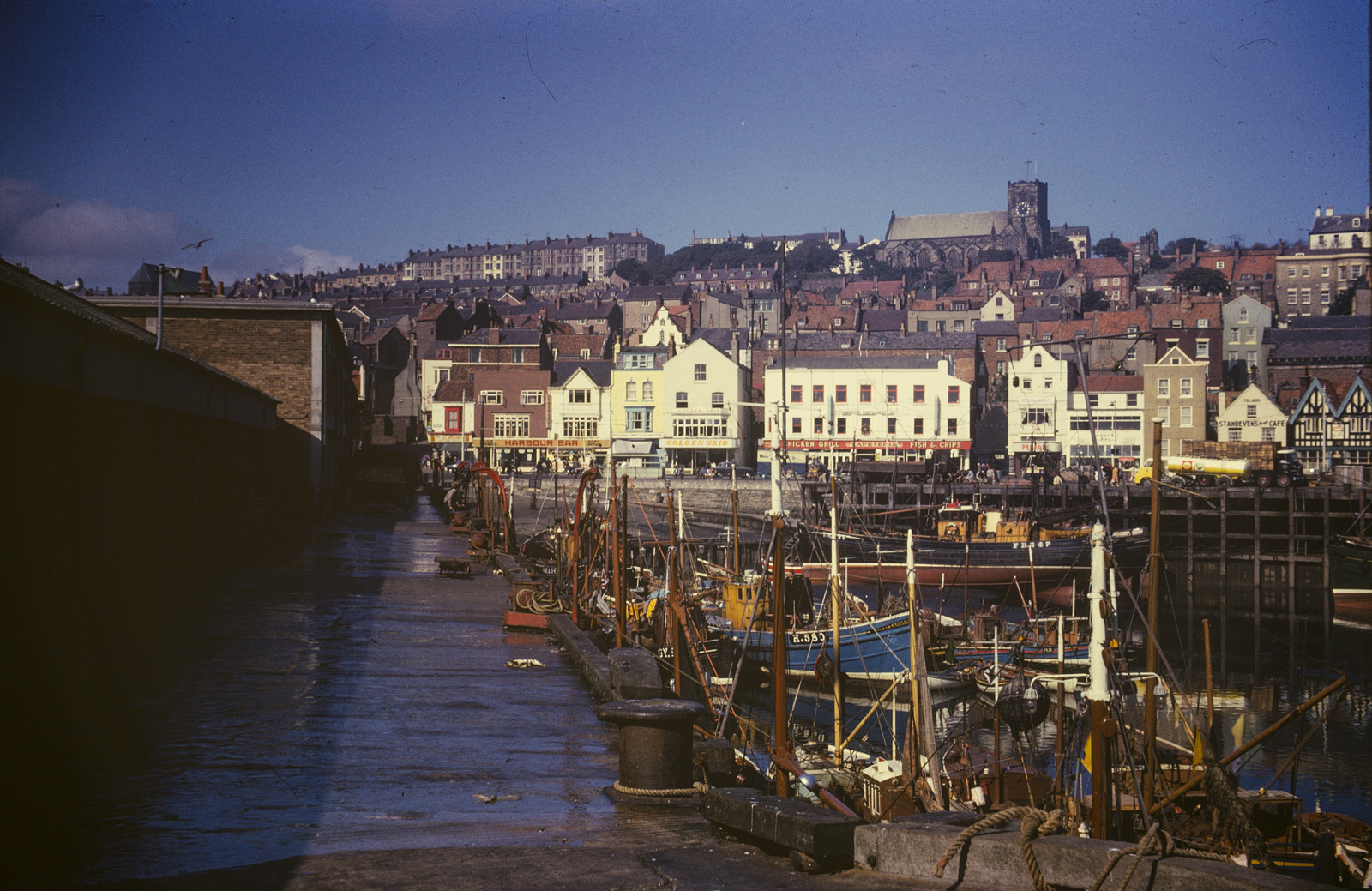
Scarborough has changed a lot since this photograph was taken and unfortunately Google street view goes only down the left hand side of West Pier (which are the buildings on the left). The frontages are on Foreshore Road and their distinctive shapes (such as the Tudor style building on the very right) are still obvious in their current forms. The massive chippy (Harbour Restaurant) is now “John Bull” who sells fudge, rock and gifts. It says his business was established in 1911, but not in that building it wasn’t!
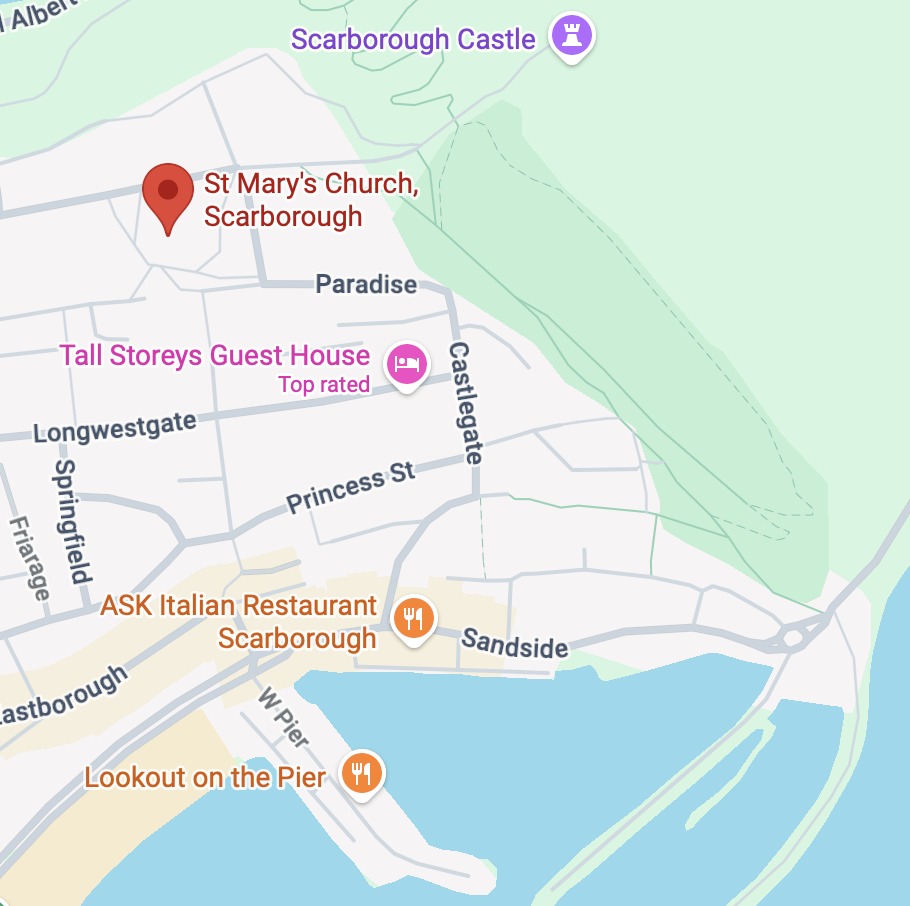
Quite remarkably, the Golden Grid and Harbour Bar survive to this day. Sadly, Parades restaurant is “Winking willy’s” a fish and chip shop and Standevens Cafe is the “Barisco Lounge.” Not everything can survive 60 years.
The picture was taken, at a best guess, from almost exactly where the “lookout on the pier” is on the map above, but the perspective is all off. In the slide image, it looks like a really steep hill/cliff top scenario but on Google maps the earth looks flat. No wonder the conspiracy theorists walk amongst us.
1966 – Holidays in jet planes and new arrivals
Apparently, nothing much happened for about three years and then all of a sudden we’re off to foreign lands in new fangled jet planes and having a baby, the timing of which confuses me. I think it’s fairly clear that there’s at least one roll of film here that has a significant gap between exposure and development which might explain a few things.
Were expectant mothers told not to smoke in 1966? If they were, I don’t think it’s advice that our Jo heeded very closely because if the dates on these slides are anywhere near their exposure dates, then she must’ve been in the every early stages of pregnancy when she went to Yugoslavia.
Why am I confused about timing?
There were two boxes of slides, clearly labelled “Yugoslavia 1966” and the dates printed on the slides were also 1966. I think it’s fair to say that you wouldn’t go on the holiday of a lifetime (they nipped over to Venice whilst they were there) and not develop your pictures almost straight away. However, there is a second set also dated 1966 which culminate with Jo pushing a pram with a baby in, but that baby looks several months old – it has a full head of hair!
But… it gets more confusing because I’m not very confident about who exactly went on this holiday.
I thought this was Jo, the woman married to the guy we met earlier digging out their house from the snow together, but that man doesn’t appear in any one of these photographs:
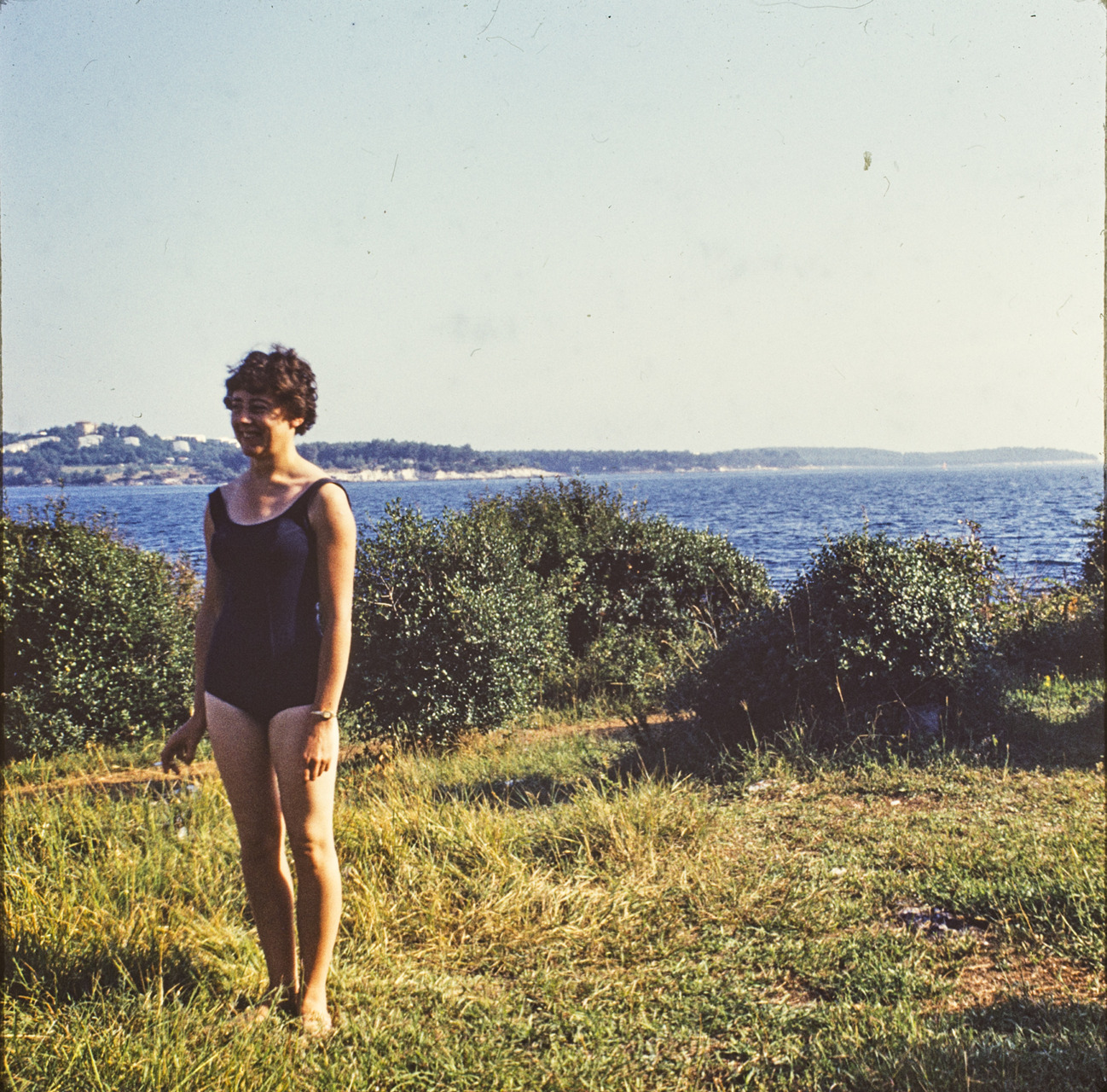
But, this woman is not pregnant, and if she is, not visibly so. She’s also, smoking a cigarette. But on closer inspection she doesn’t look like the previous photos of Jo on the right of this picture we saw earlier. Are these really the same person?
Mary was definitely on this holiday, the next photo in the sequence is of her without a doubt and they look alike in the photo above too.
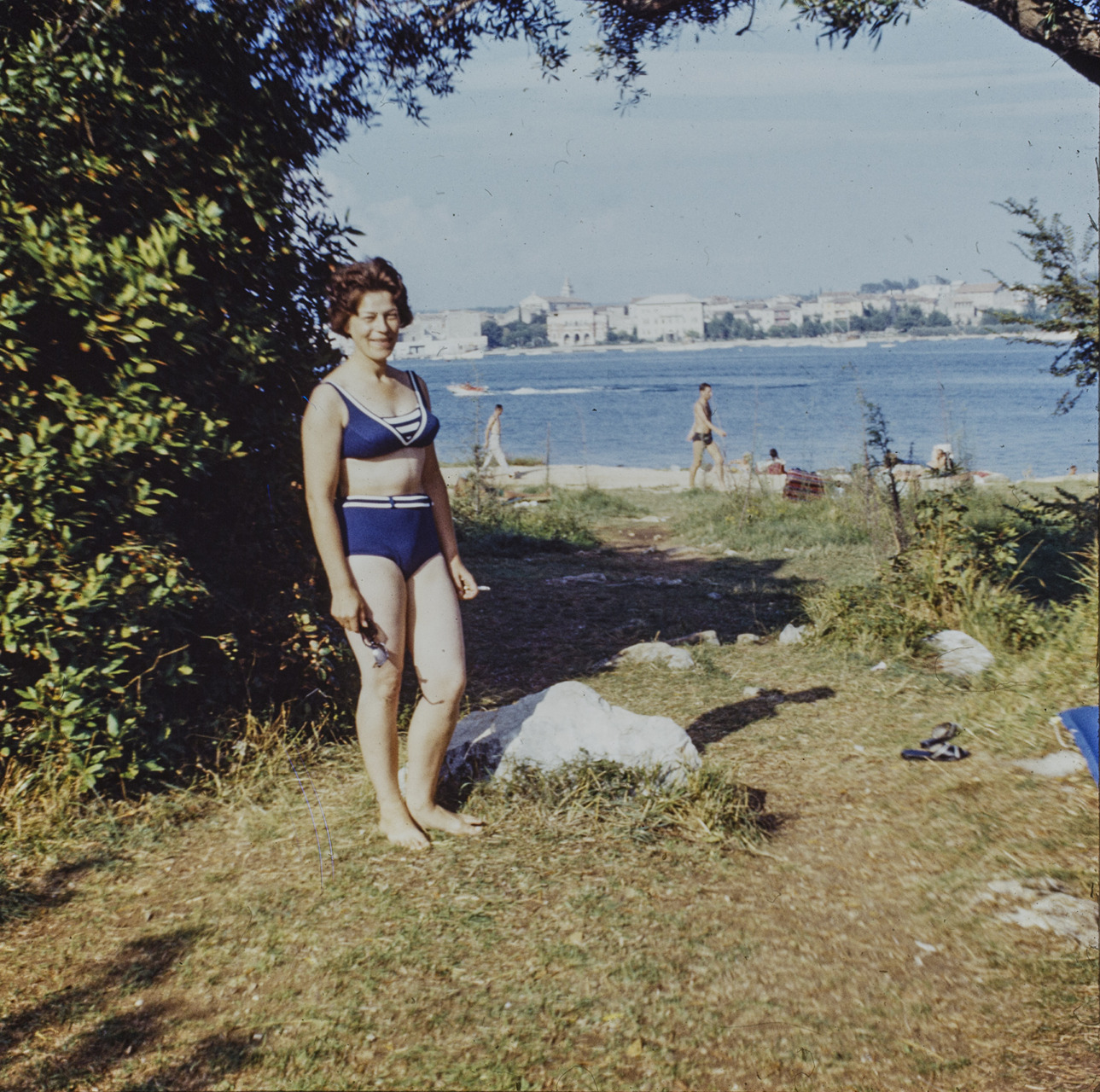
Why would it not be the same two women we’ve seen all along? I don’t know but to add confusion to things, this is what Jo looked like two years later:
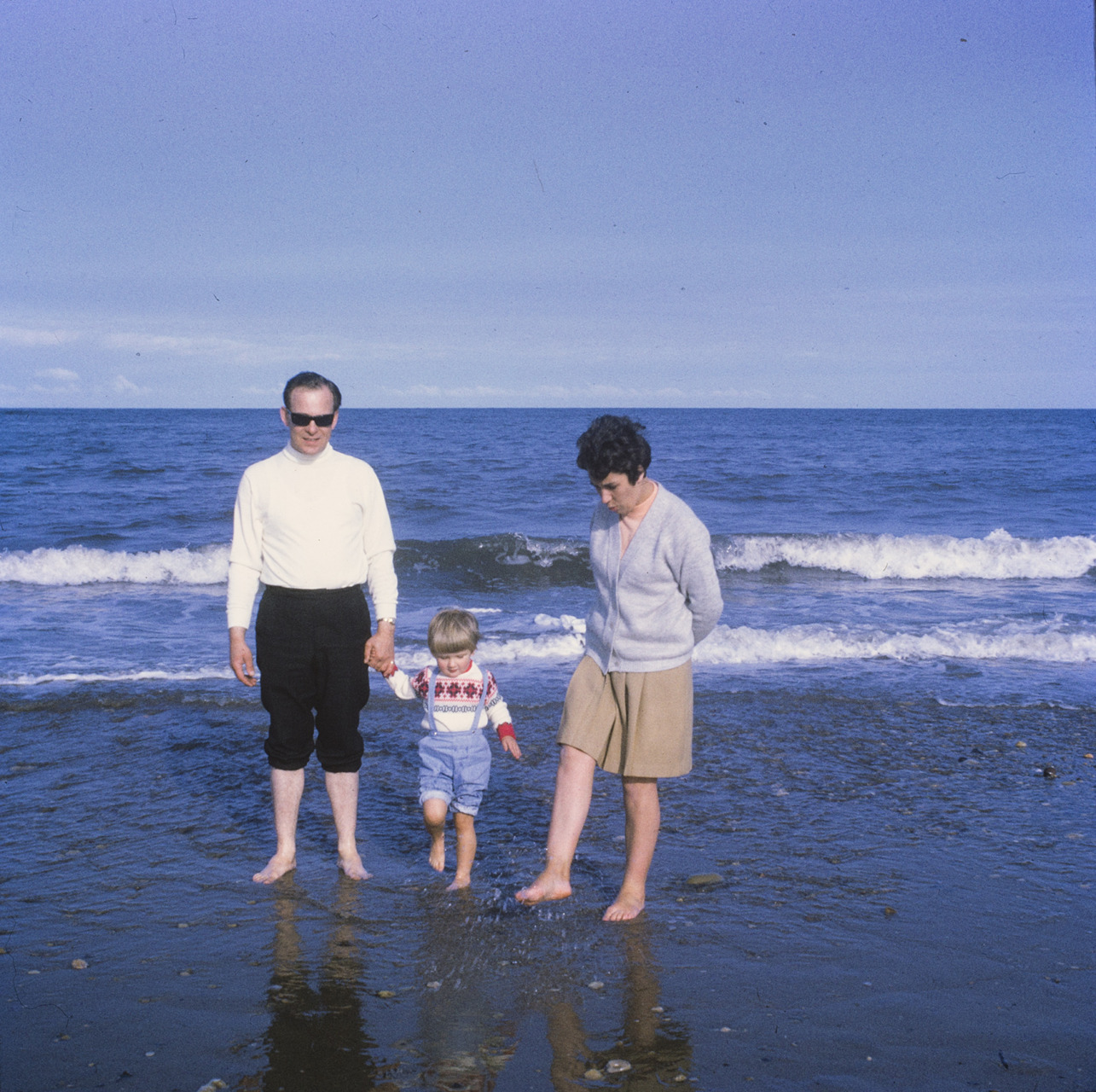
You decide – the same person or… a third sister? I’m so lost at this point. Whatever the case, the couple above without a shadow of a doubt go on to have two children.
Let’s go back to Yugoslavia. Their holiday starts out in a rather futuristic BAC One-Eleven jet airliner that was so new off the production line that I’m surprised the paint has had time to dry. These were second generation jet planes and whilst not exactly up to the same standards as the planes you or I might be used to, they were a lot safer than the first jet liners such as the De Havilland Comet which had a habit of spontaneously breaking apart in flight due to metal fatigue issues that were not fully understood at the time. Flying in the 50’s and 60’s was not for the faint hearted.
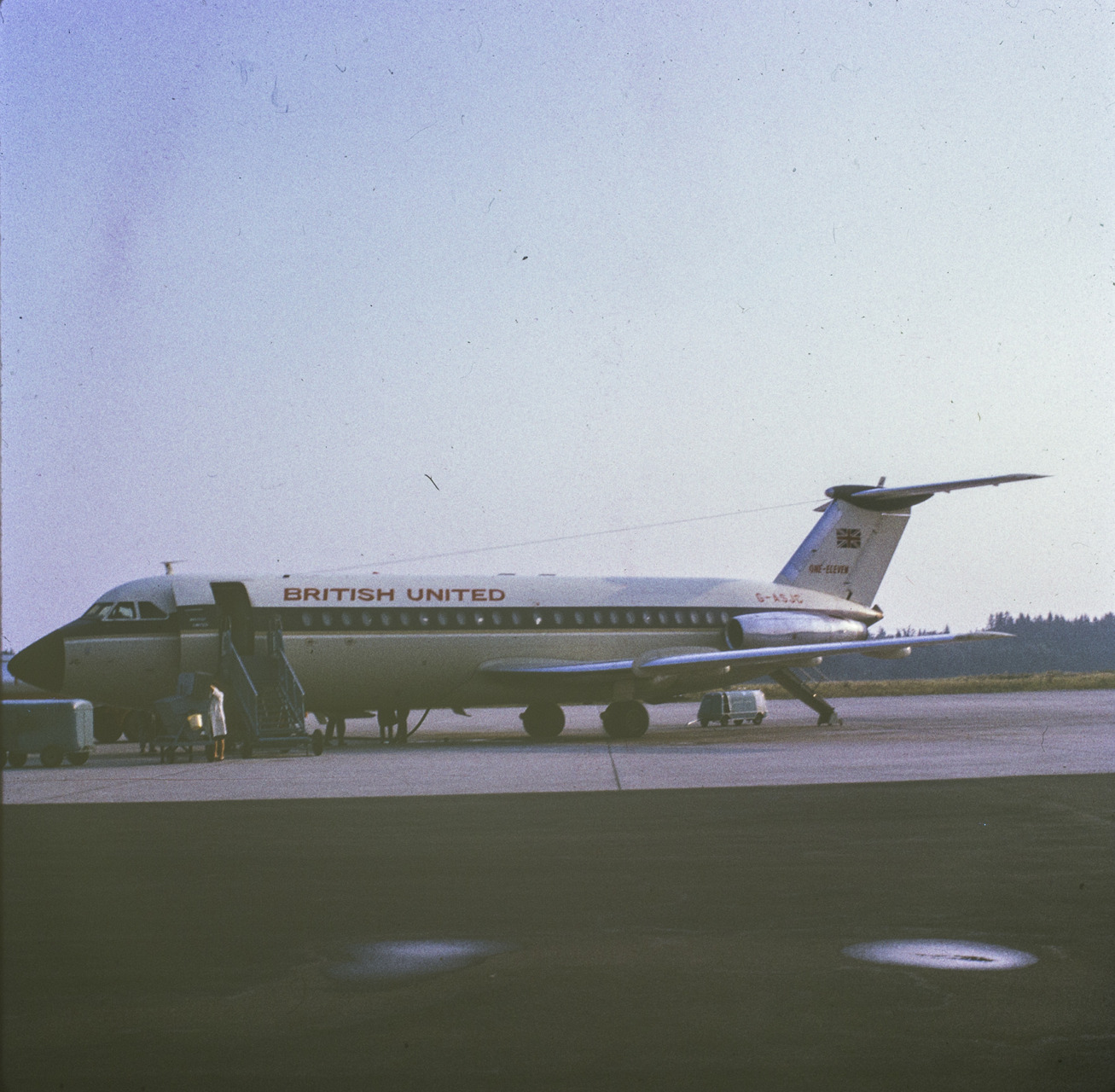
Flying back then was mad, you could just stroll across the runway to your plane, no air bridges, nothing. You could probably have a little walk around the plane if you felt like it. The plane above was only the third of its type off the production line and had a long life, flying for 25 years before being decommissioned. As far as I can tell, this is the oldest photograph of this particular plane on the internet anywhere.
They were picked up at the airport by this happy looking chap and his extremely shiny coach.
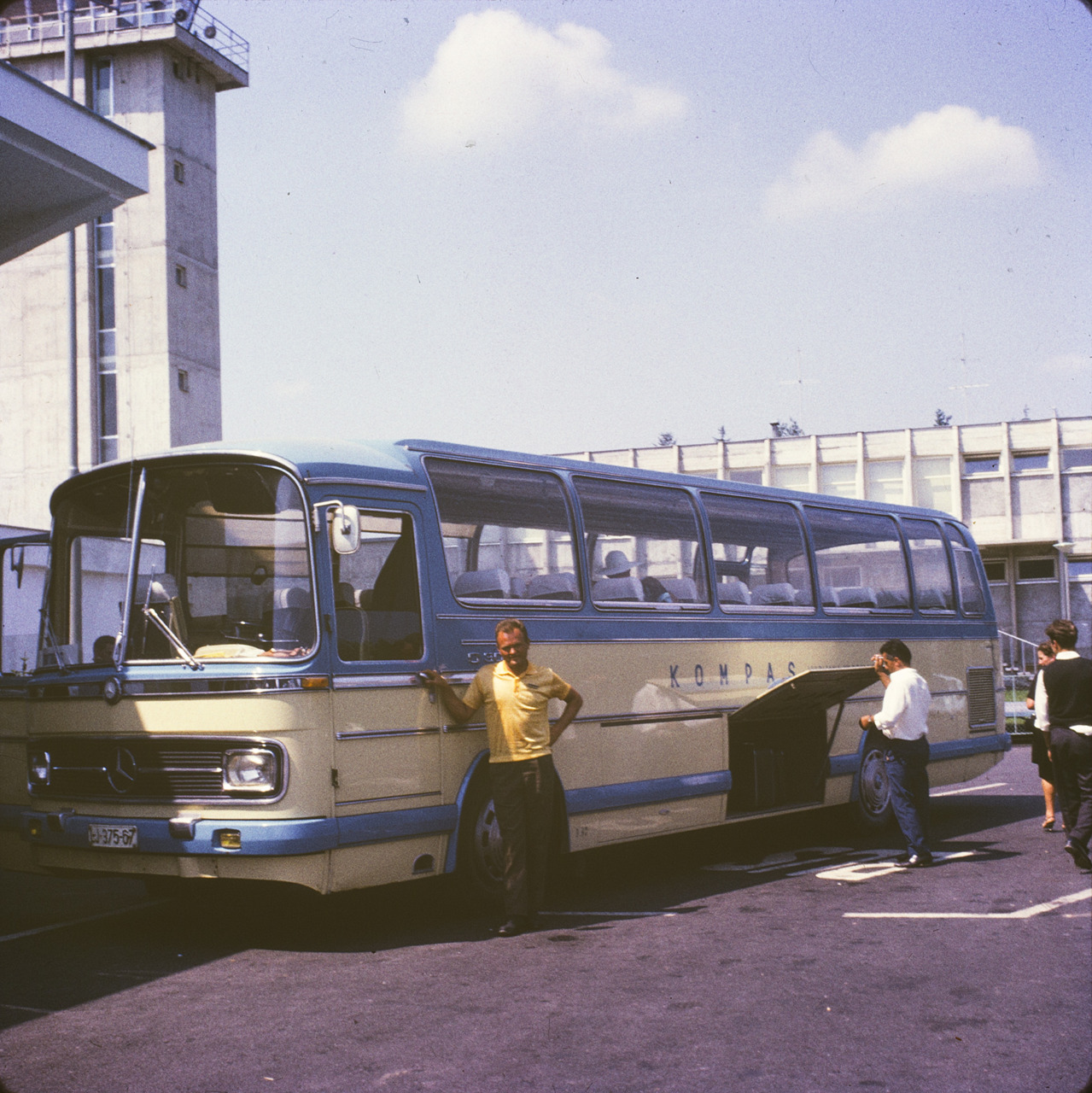
Just to be fair, I’ve gone into every other vehicle here so I might as well do the bus. This is a Mercedes Benz O 302 and in that picture it can be no older than 2 years old and could even be brand new looking at the state of it.
Our travellers stayed in a place called Poreč on the west coast of Croatia, facing Italy. Their hotel was one of the most historic and prestigious in the town, the Hotel Riviera, accessed along Poreč plaža. The hotel is the last building on the left.
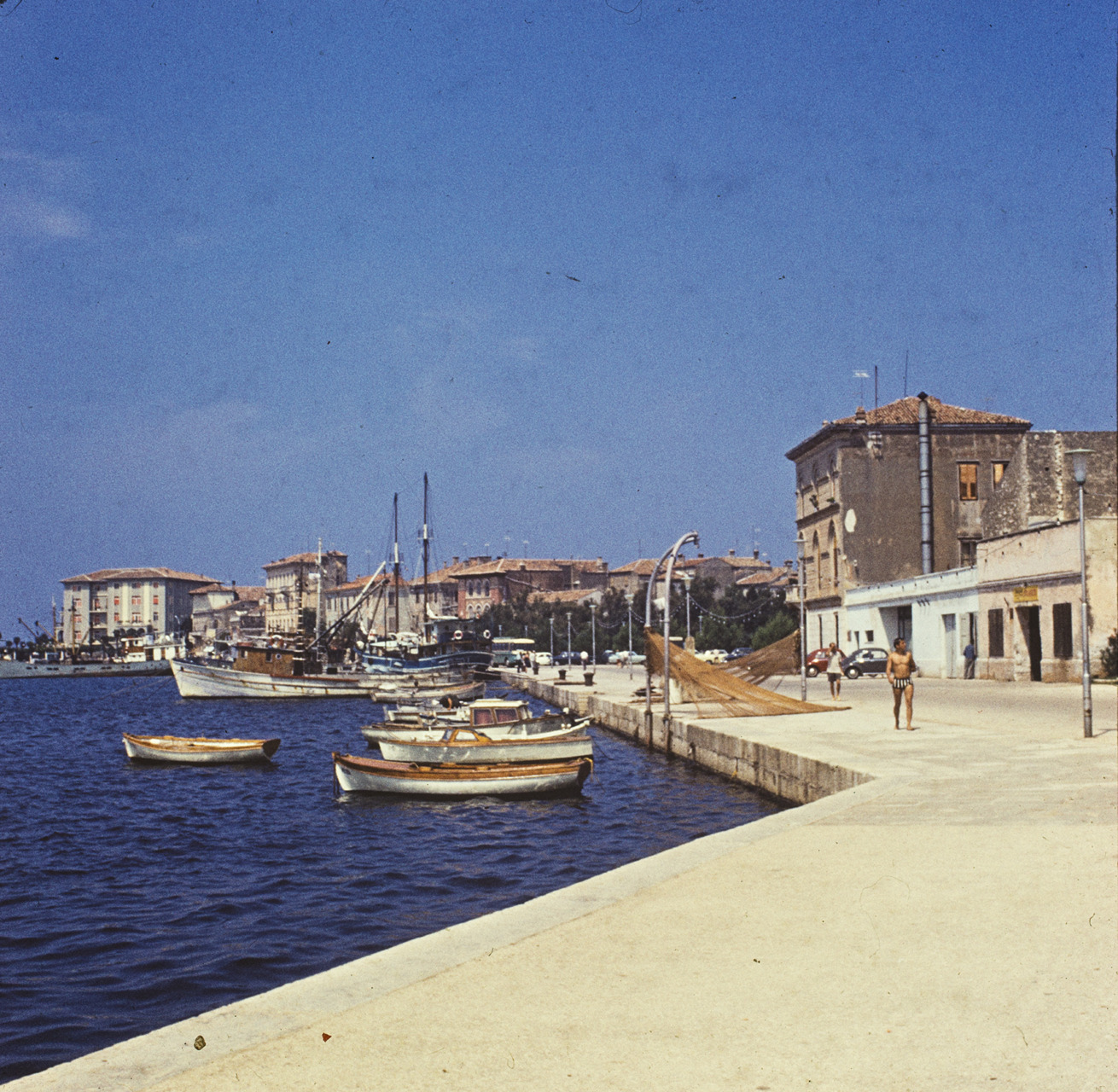
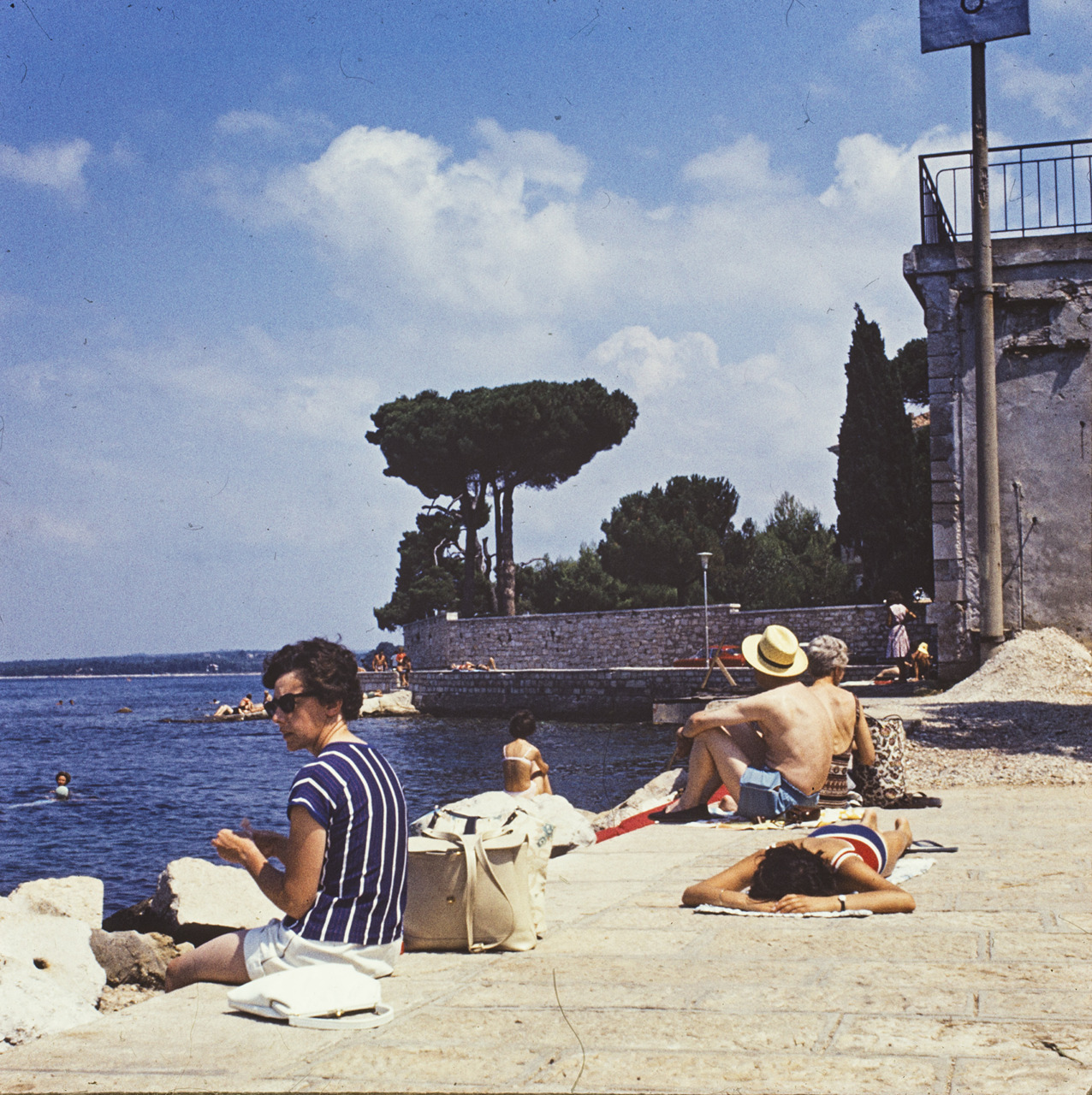
Check out the absolute Adonis just casually strolling down the waterfront in his Newcastle United swim shorts…
That plaza today is a very different story. Whilst it may look similar, according to Google Streetview, it’s now absolutely rammed full with tourists or attractions for them.
The photo above was take approximately here:
This is a long seafront walk which has these odd “city beaches” which is tourist speak for “a bit of mud and sand next to the water that you can sit on” or at best “a bit of concrete.” I think this is perfectly illustrated by this poor woman who is laying face down on the pavement like she’s been dropped from great height. It cannot be comfortable or relaxing to lie on hot concrete like this, surely?
I am, however, utterly disgusted by the man sat by the water not wearing a full three piece suit, tie and hat. Disgraceful.
Tourism in the 1960’s seemed to consist mainly of visiting churches and first stop is the Euphrasian Basilica. This cathedral is a Unesco World Heritage site and was built in 553 but contains history going back as far as the year 365 and is considered to be one of the best preserved Christian churches in the world. Not bad going at all. The building is covered in mosaics which date back to the 6th century and one, depicting Mother Mary is the oldest known example.
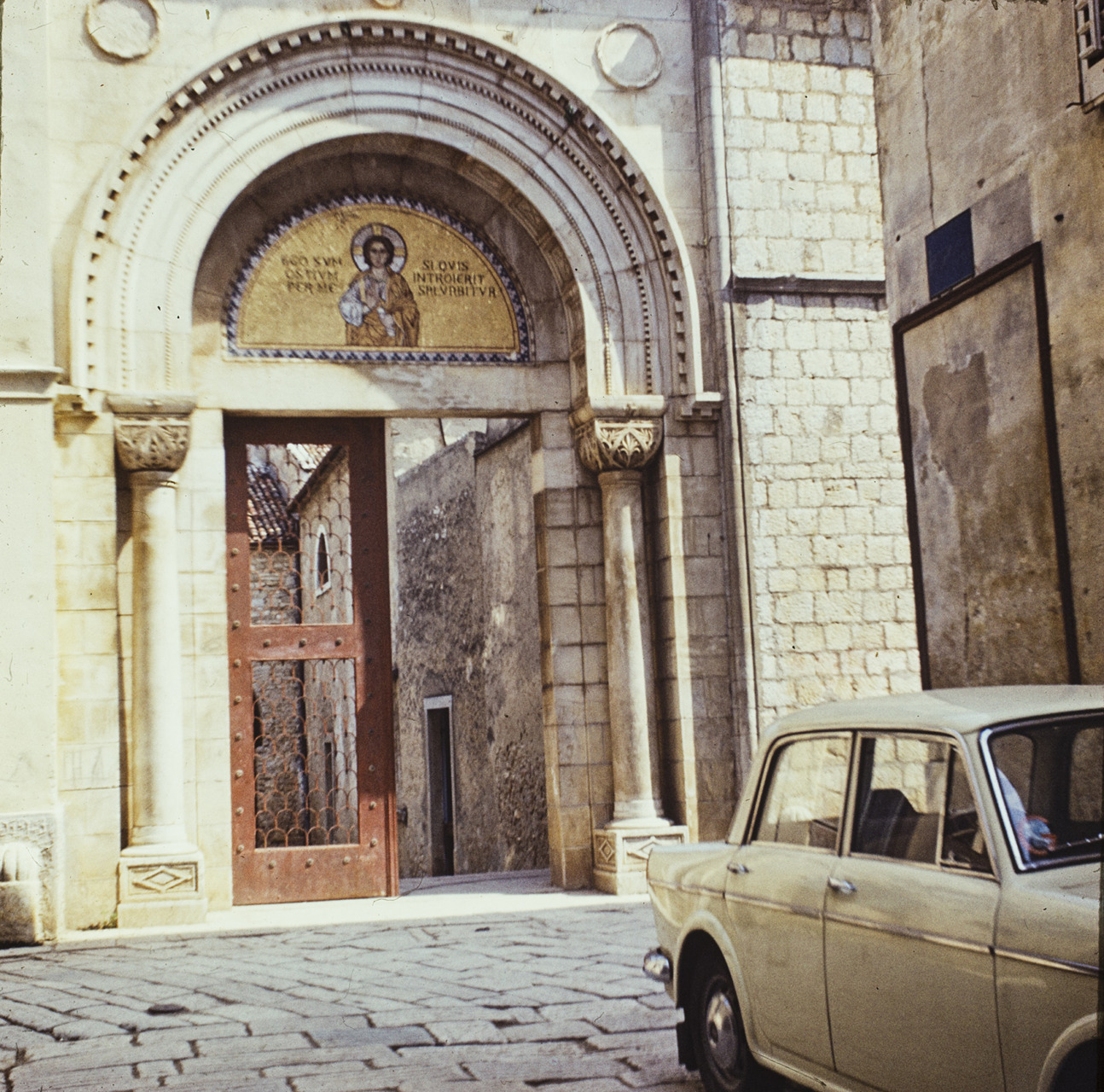
This is the main entrance and, as seems to be usual for the 1960’s, you can just drive your car right up to the front door. I’m surprised you couldn’t just drive right in and park inside. These days, as you may well expect, things are different.
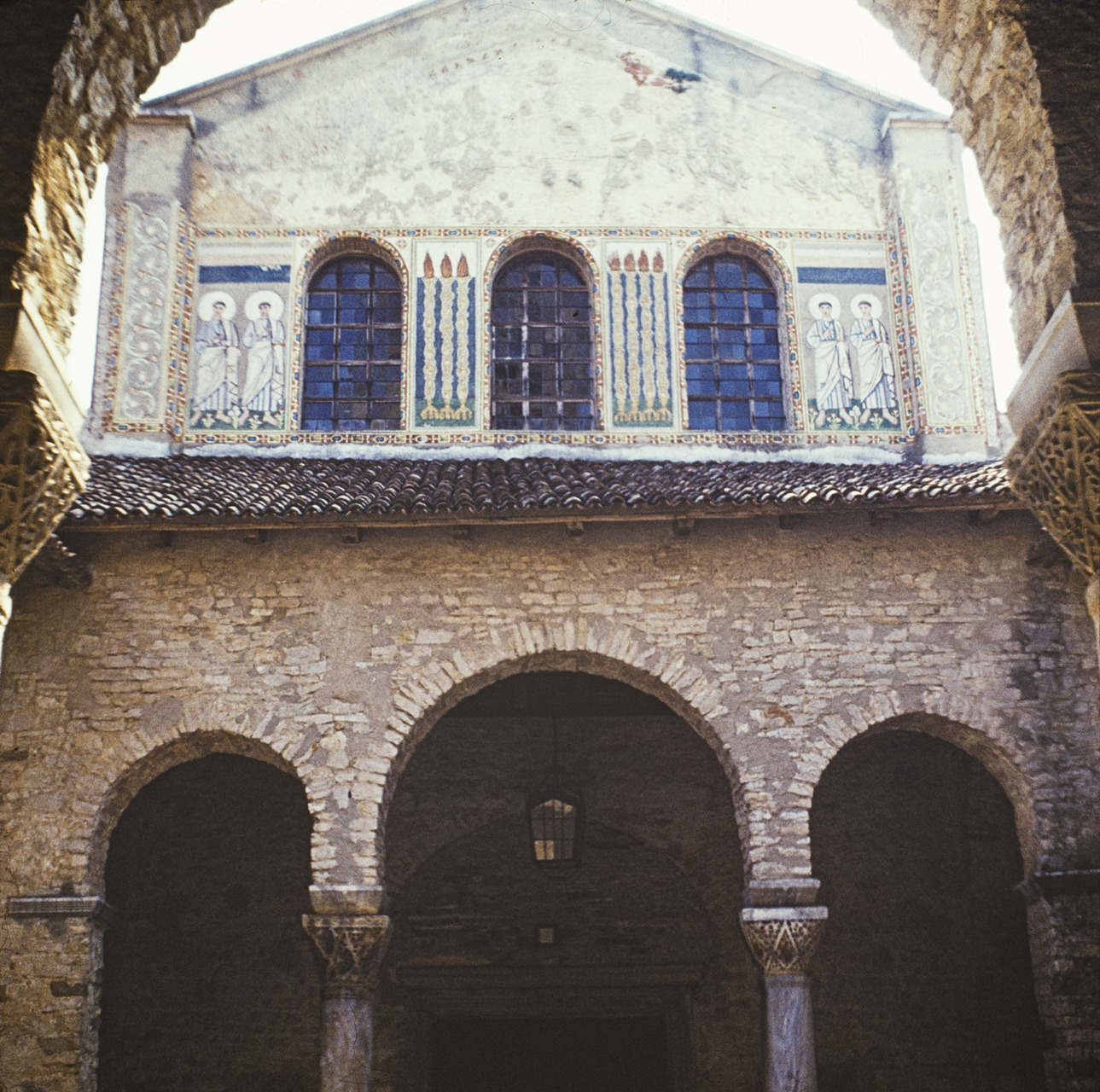
They apparently didn’t take a picture inside, or if they did they didn’t come out due to the unforgiving nature of slide film. However, looking at the slides, there don’t appear to be many, if any, missing from the set. Wikipedia has us covered here and this is the famous “mosaic with Mother Mary and Child.” As mosaics go, considering when it was made, it’s incredible.

I’m not religious, but I can appreciate the skill and also magnitude to those who are of such an artwork.
There was one more photograph of the Basilica which is worth sharing for completeness if nothing else.
The ladies then went out to dinner and took two of the most bizarre portraits. The framing baffles me, I can understand one being slightly off but both pictures have the women on the hard left of the frame and nothing but tables on the right. Why? Surely this was a deliberate choice, but what or who were they trying to avoid getting in the frame?
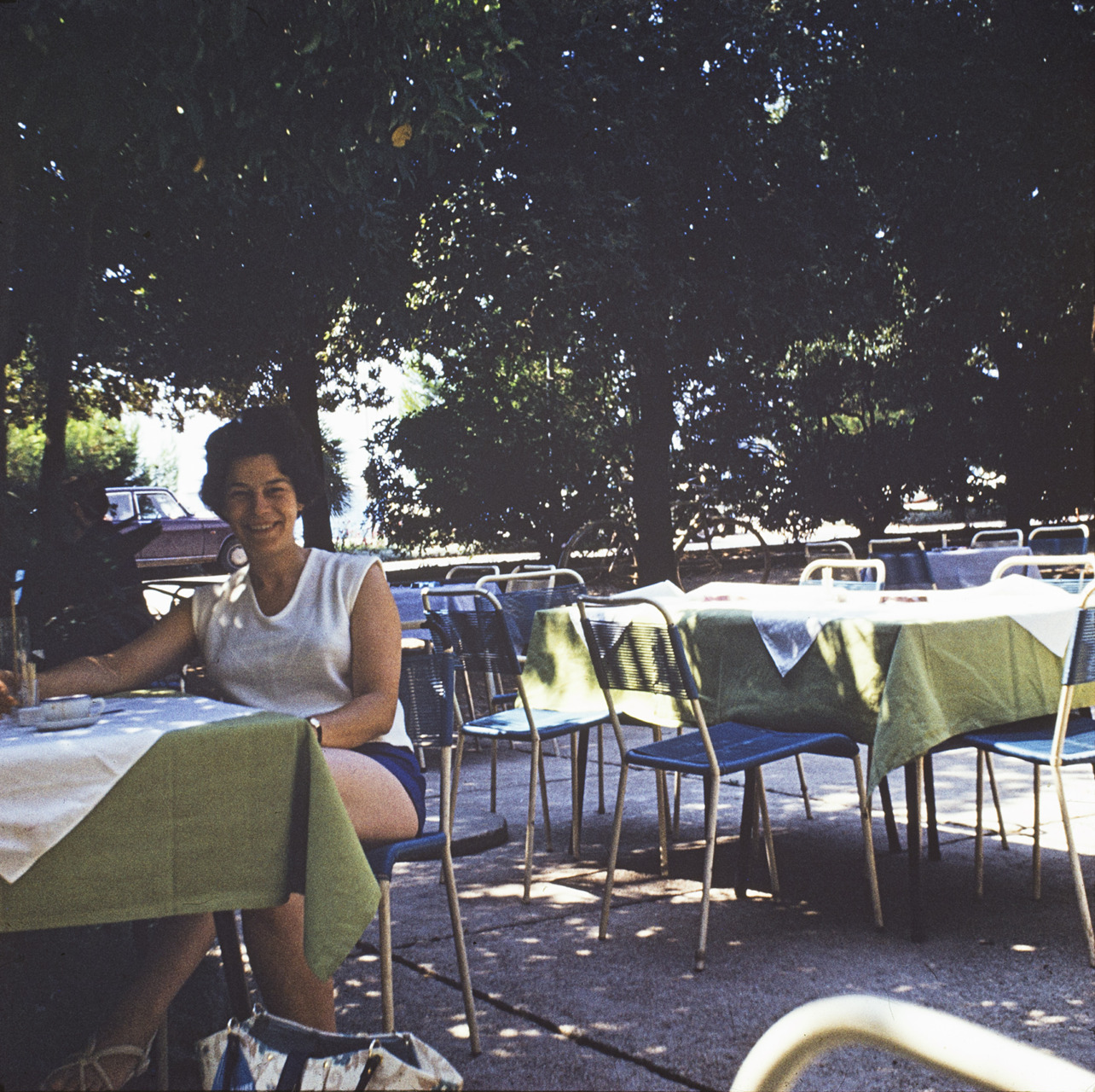 | 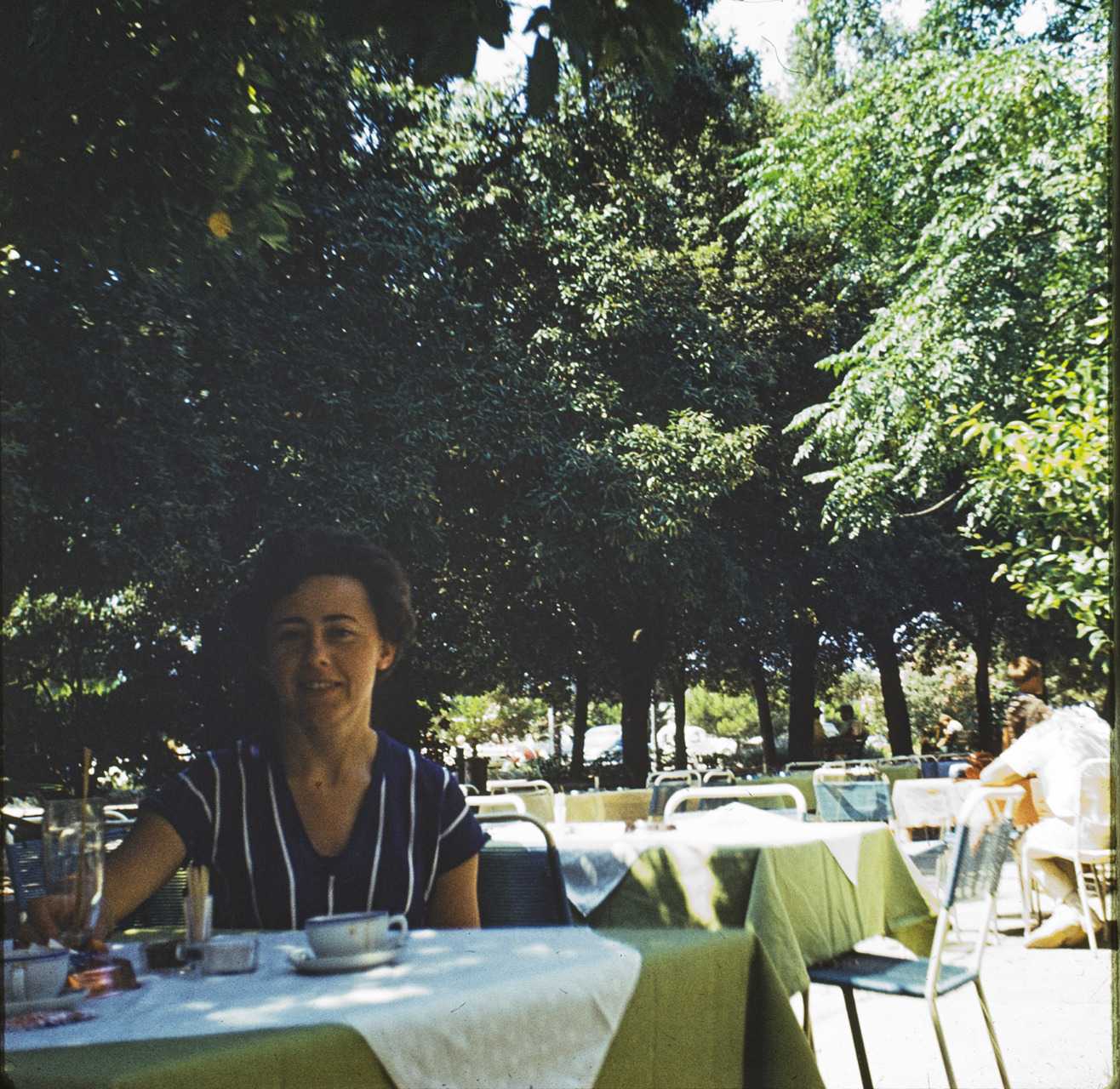 |
If you look closely you can see they’ve also swapped over and sat in the same seat for their picture to be taken. Look even closer and you’ll see they must’ve been taken one after the other. Nothing on the table has moved, the coffee cup is the same, with the same stains on the side and they’re both doing the exact same pose – holding the glass. Weird.
Who is behind the camera? Taking it in turns? Perhaps. Does this indicate they went on this holiday together with no one else?
The holiday comes to its conclusion with a visit to Pula Arena, about an hours drive from Poreč. The arena is a Roman amphitheatre dating back to 27BC and could apparently house 26,000 spectators. As you’re beginning to expect from Croatia by now, it’s one of the best preserved examples in the world and I’m shocked that it isn’t actually another Unesco World Heritage site.
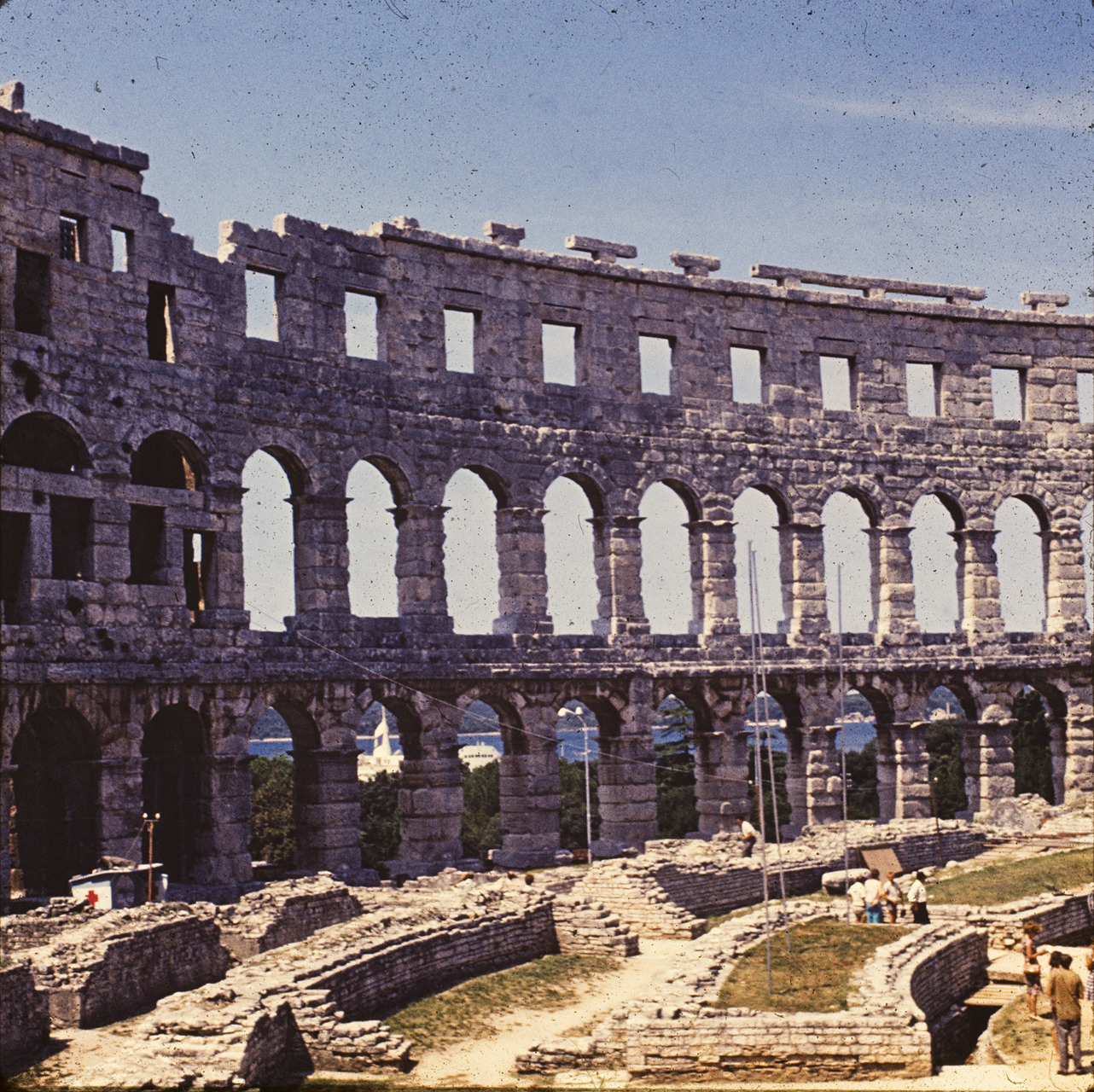
It’s obviously a massive tourist attraction today as it was then but is also used for concerts and has seen performances from the Foo Fighters, Pavarotti, Bryan Adams and….. Avril Lavigne. Of all people. Still, can’t win them all, eh?
They paid a final visit to the Temple of Augustus in Pula, a place which seems to be packed full of Roman history. Are you ready for your final history lesson of the day now?
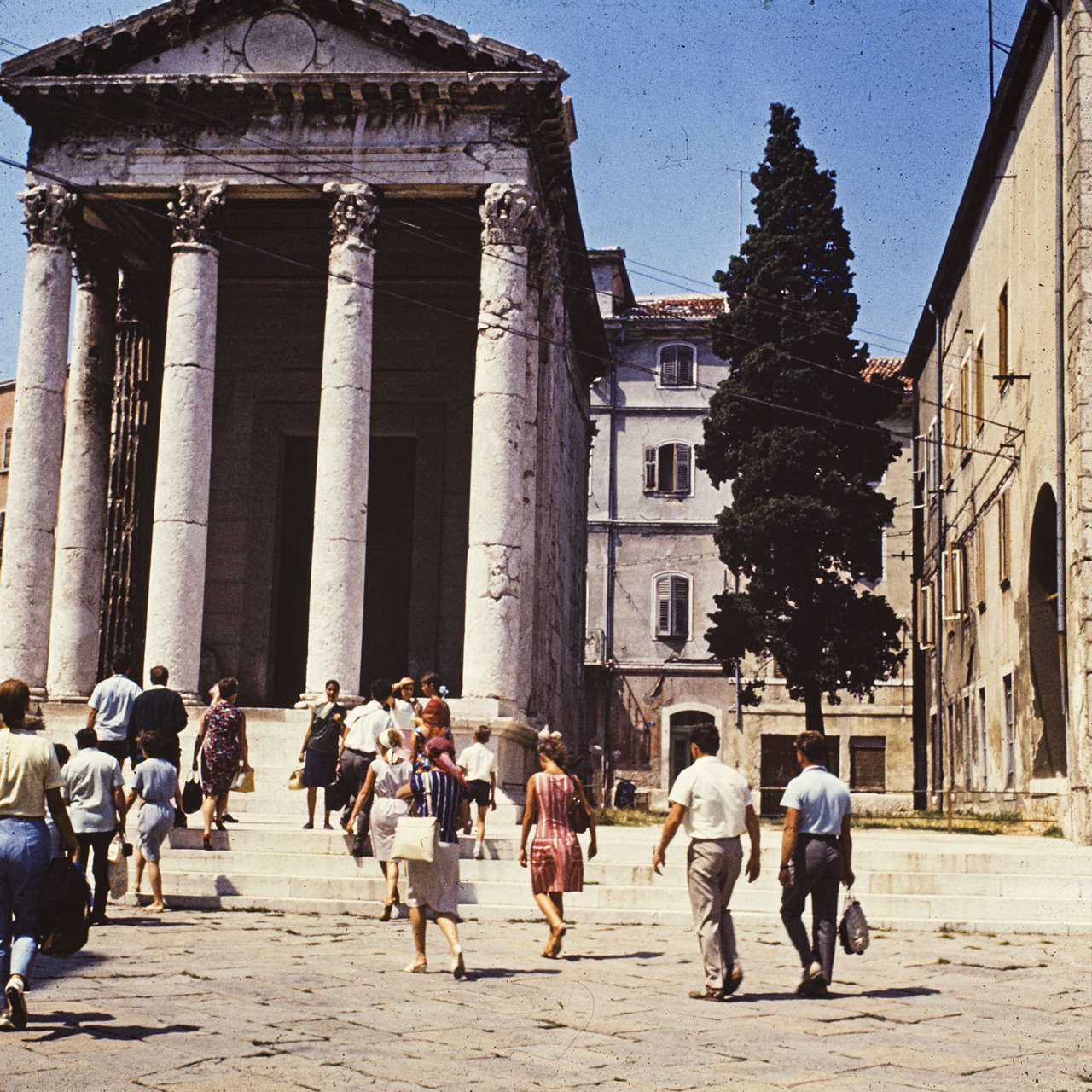
Built some time before 14AD, the temple was actually one of three. Rather unfortunately, we managed to bomb it accidentally in World War Two almost completely destroying it. Luckily it was reconstructed into its current state in 1947. The chances of accidentally hitting that particular site must’ve been very small.
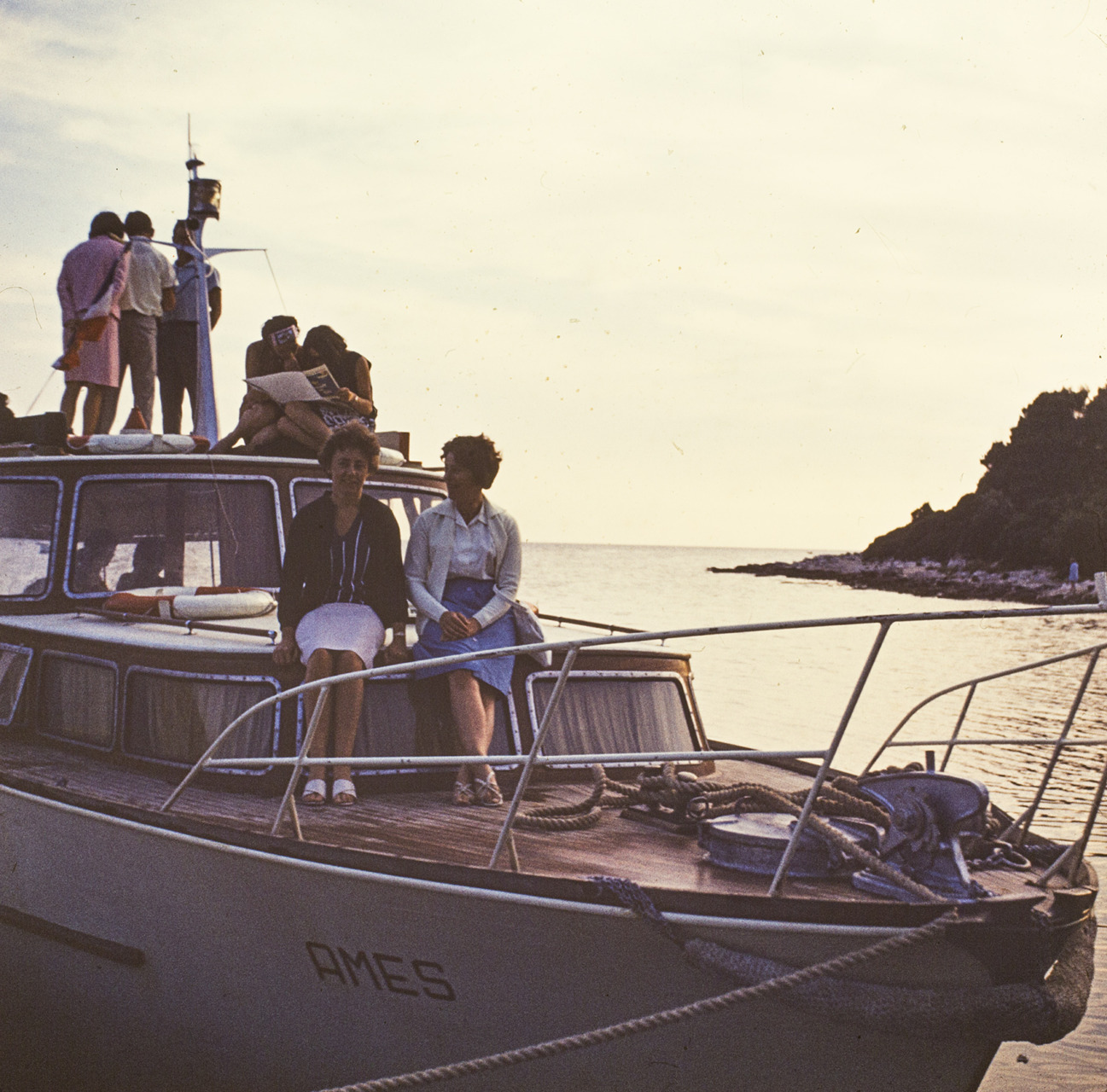
The final slide of the set was this, which shows the pair on a boat together, you can only presume at the end of the holiday. They’d been on a sight seeing tour on the water and taken a few photographs of a lighthouse but not a great deal else.
And that concludes the confusing holiday. It seems so out of place – who was there? Why aren’t certain people there and more importantly, how does this fit in with the next roll of film from the same year?
1966 has more to give yet.
Let’s cut to the chase. I’m lost in the timeline now. After the Yugoslavia boxes, there’s a set of slides dated October 1966, but the roll of film must’ve been shot months earlier because, and you don’t need to be a detective to work this out, all the trees and foliage has nice green leaves. This roll is a real mix of different places without any particular focus or theme.
It starts out with a return to the exact same previous trend of touring North East Yorkshires tourist and historic attractions. In no particular order we go to Killhope Lead Mine then Alston, Whitby, Sandsend Beach (Whitby) and then back to Scarborough.
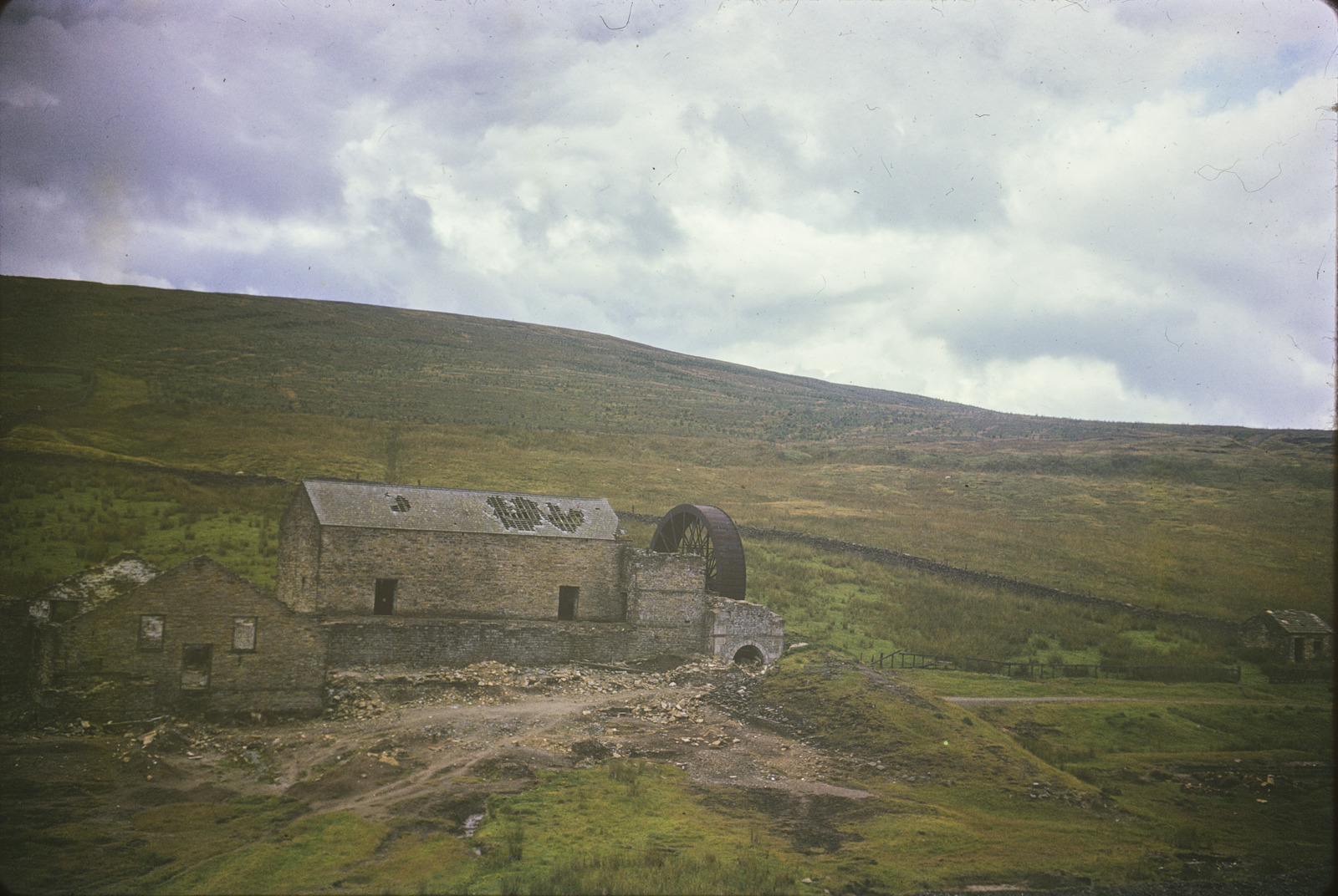
The building shown here is where lead ore was washed and processed, powered by the huge “Killhope Wheel” on the right. This was installed in 1878 and unfortunately coincided with a massive drop in the prices of lead. This meant the mine was no longer seen as profitable and resulted in it being sold to another mining company who ran the site until 1910 and its eventual closure. After a brief resurrection during 1916, the mine was left to go to ruin to the point where it faced demolition. Rescued by the council in the 1980’s, the site was fully opened as a museum in 1996 as it remains to this day.
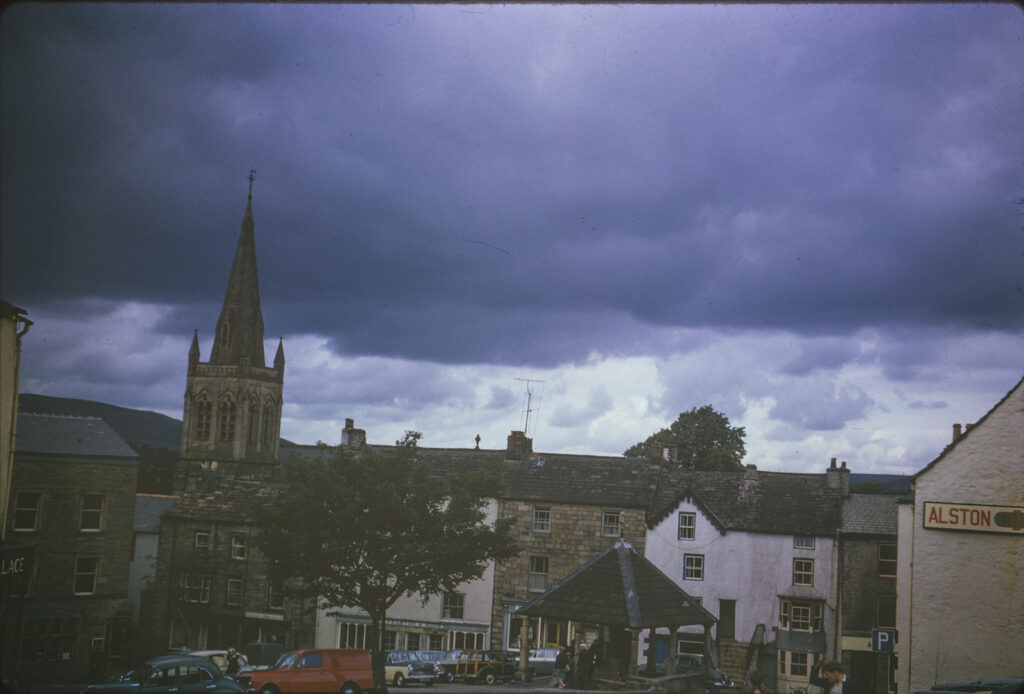
Alston doesn’t have a huge amount to say for itself, especially in this photo and they didn’t stay there long. In all honesty, the framing of this image is so bad I think they were actually trying to take a picture of the storm clouds rather than the high street.
Things get much better when we go to Whitby and probably my favourite photo of the whole collection:
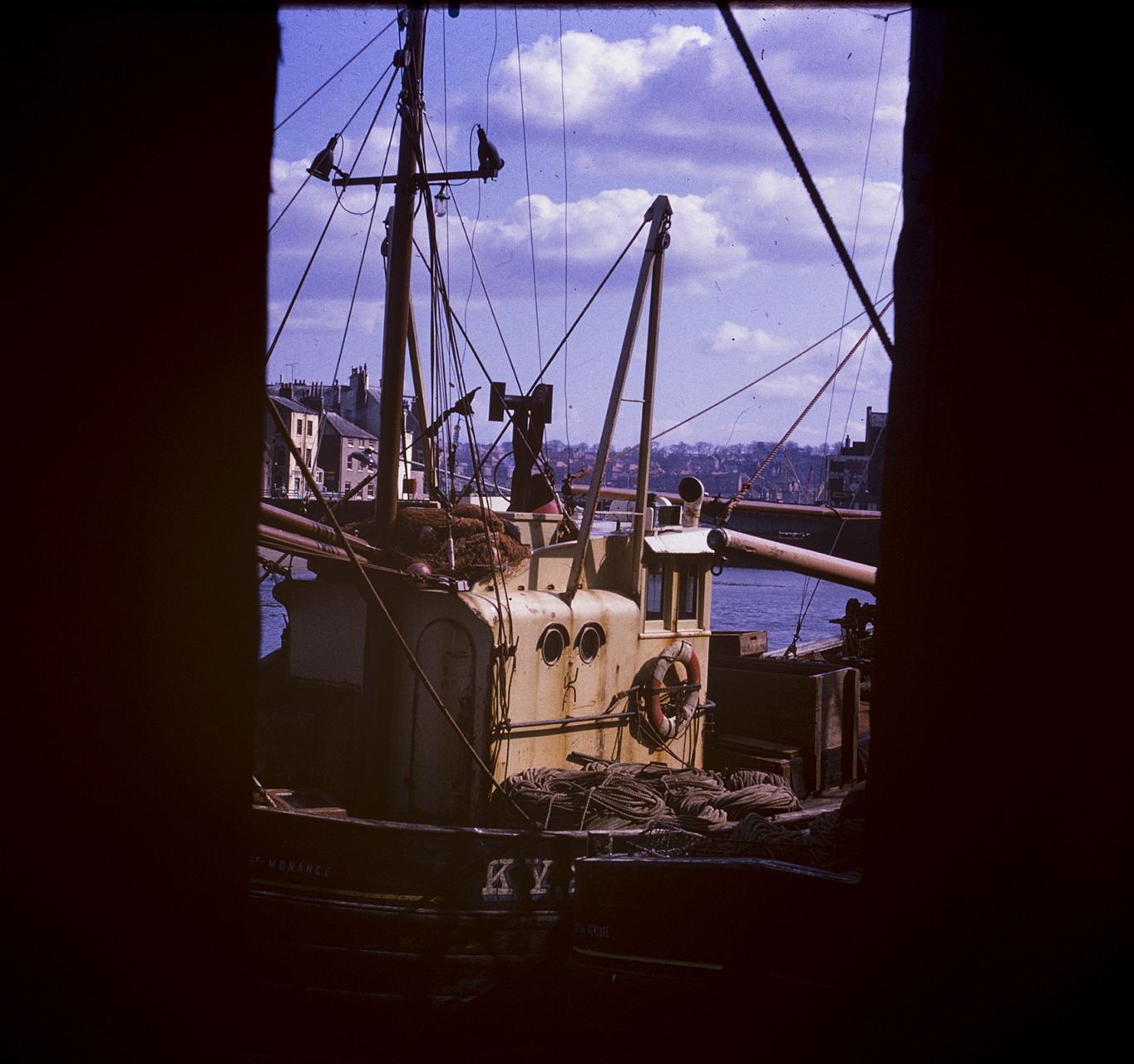
Texture? Warm colours? Rusty boats? All good in my eyes. This slide perfectly illustrates the difficulty of photo editing. On my PC monitor, the colours were corrected and it wasn’t overly warm or blue. On a colour corrected Mac display, it’s still too warm and blue. Which version you get will depend on your monitor!
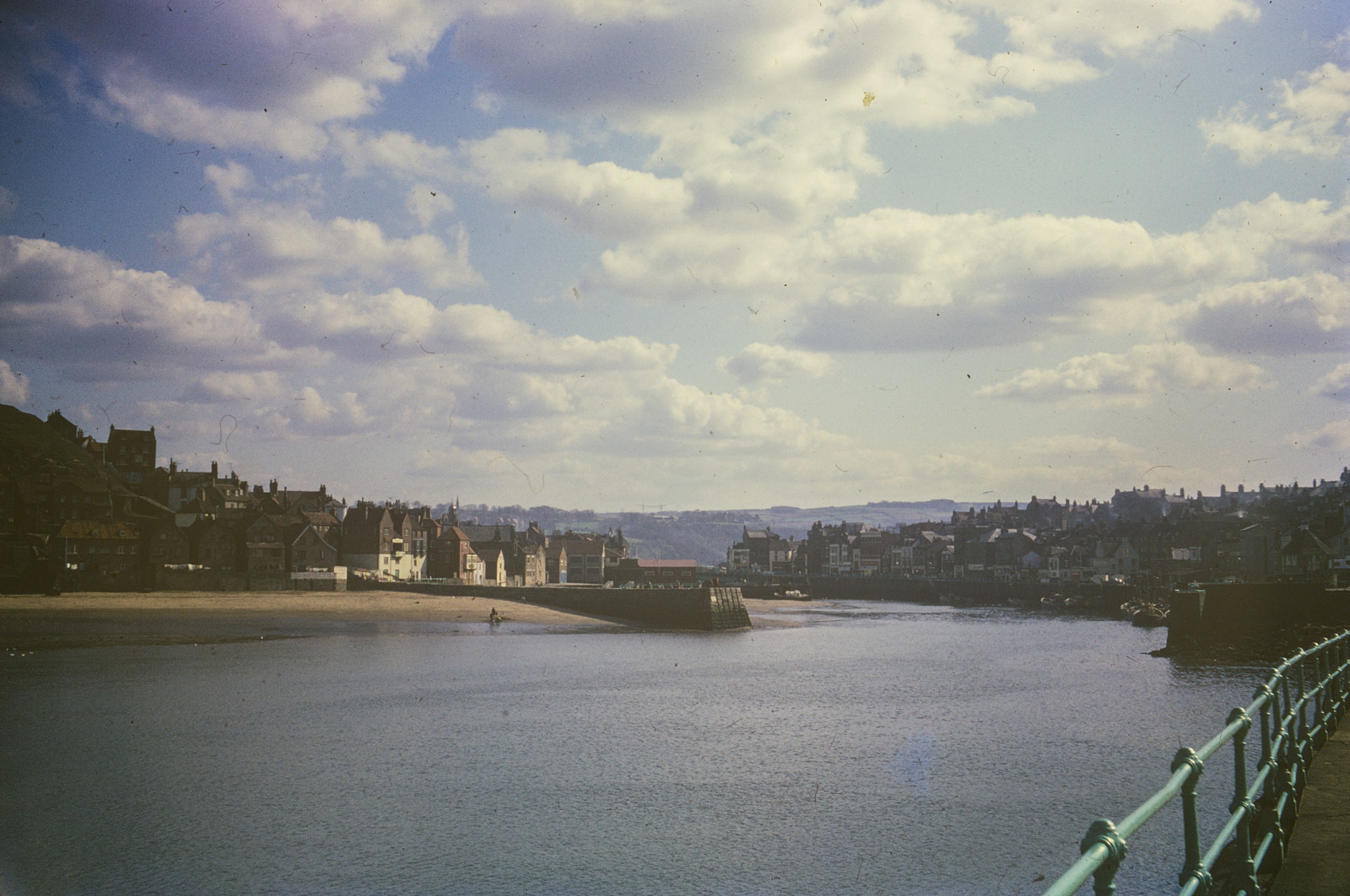
Anyway, back to Whitby, it looks like a nice place and has a great beach if this photo of Sandsend Beach is anything to go by:
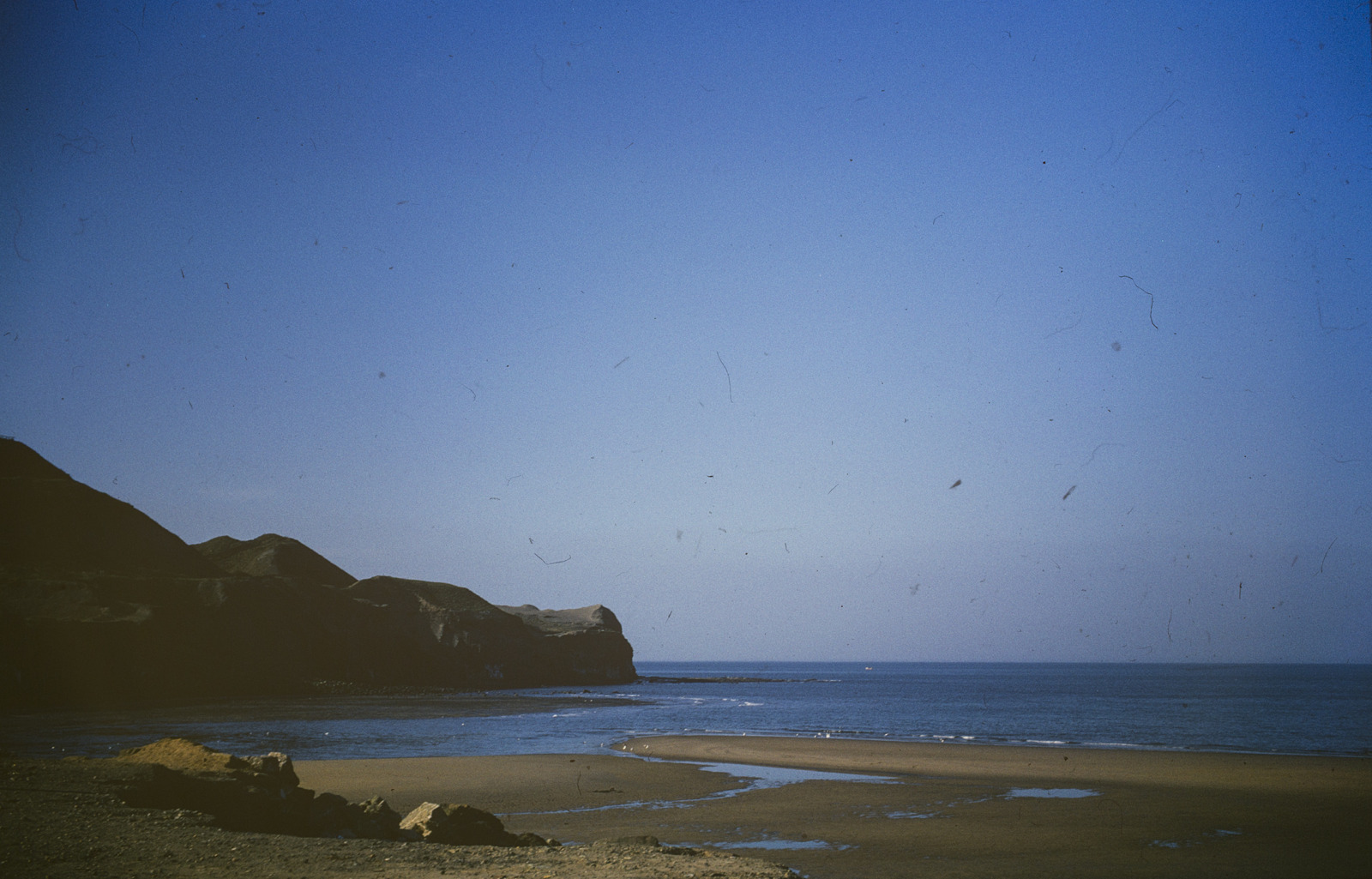
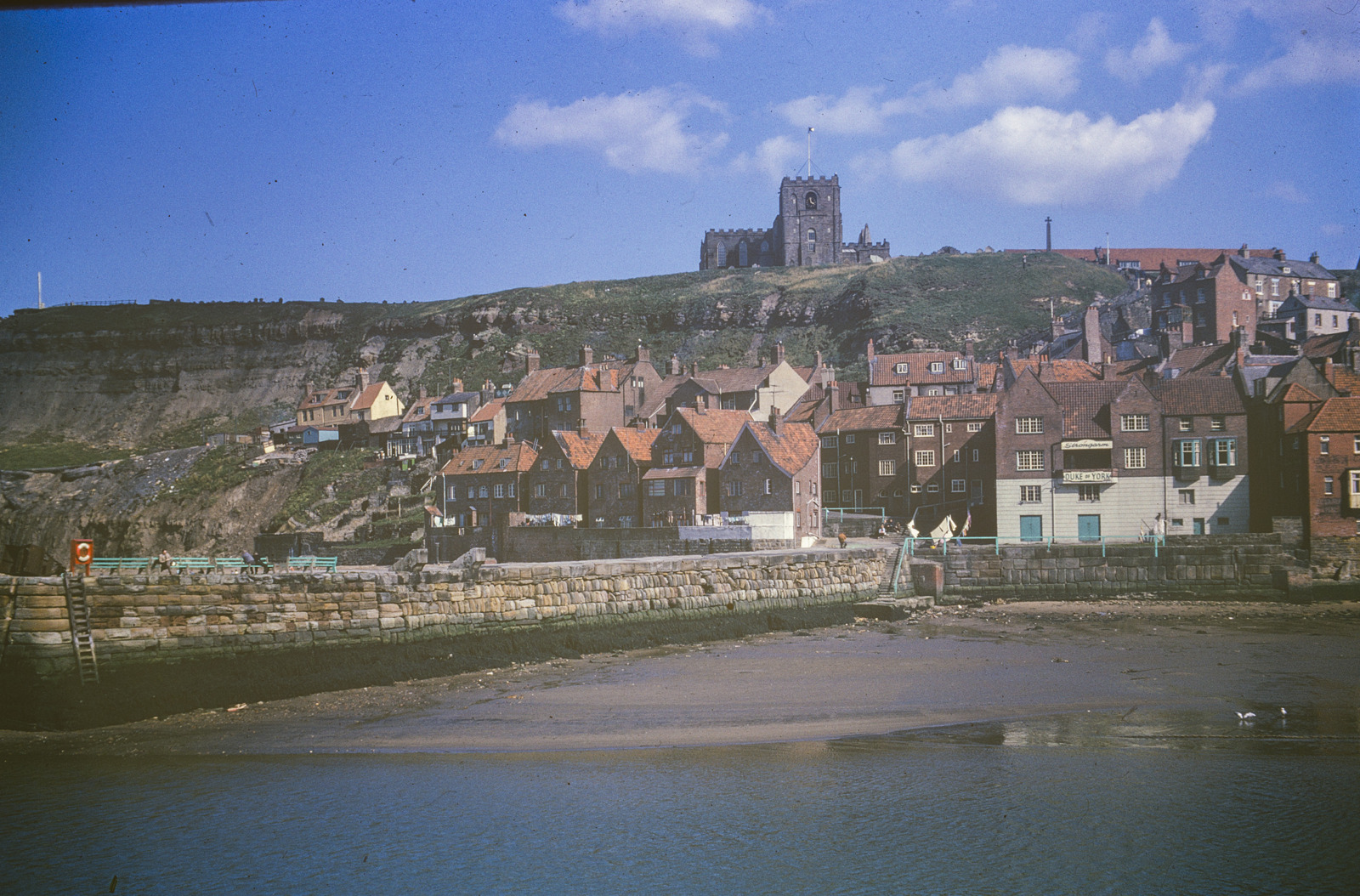
We have a view over a bay (above) and then a view down the River Esk below which is fairly well framed. I do wonder whether places were simply less busy back in 1966 or our photographer just managed to find these places on a quiet day. Everywhere seems… calm?
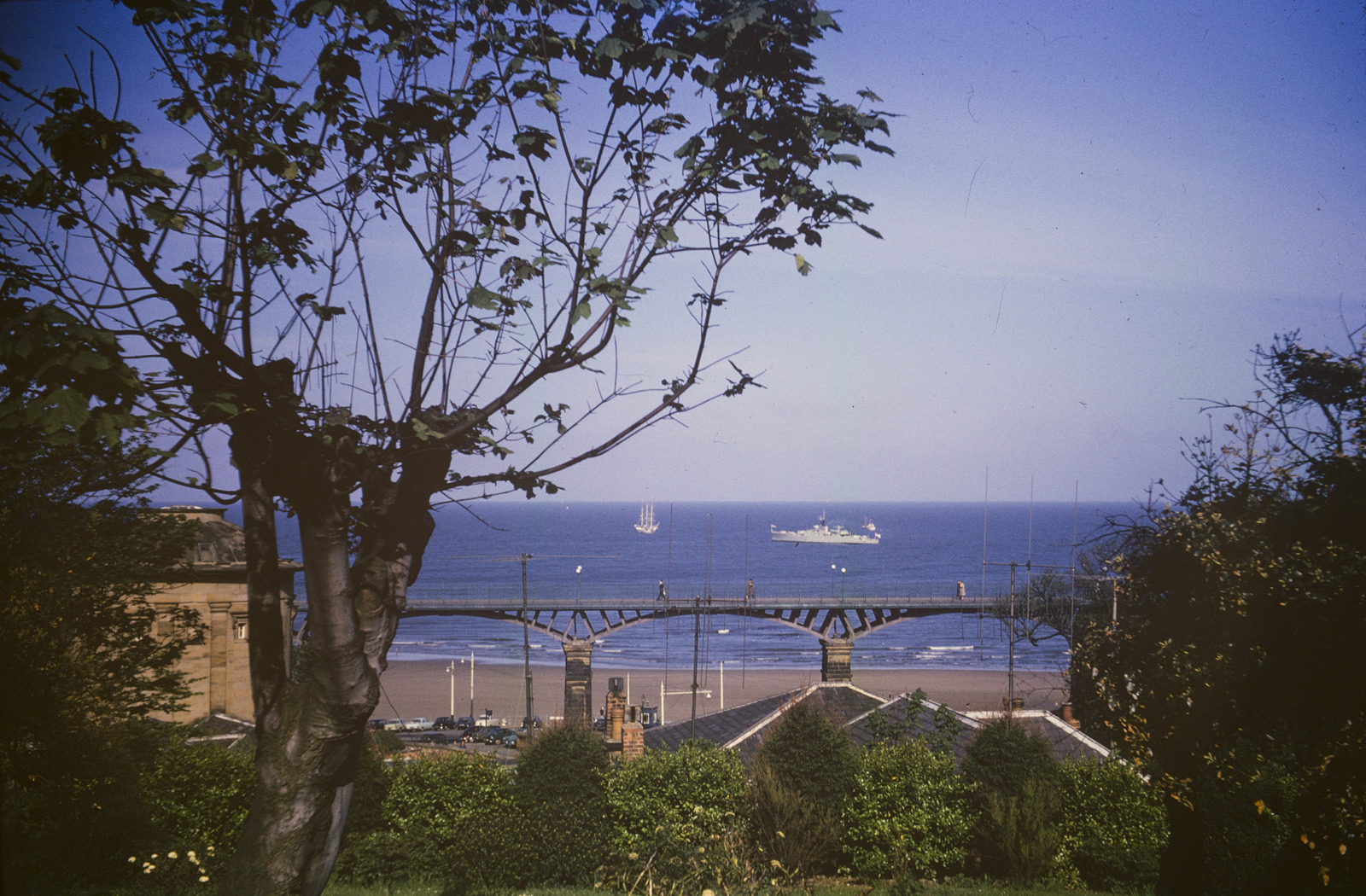
Finally, we return to Scarborough “Cliff Bridge” and what appears to potentially be a navy vessel on the water.
Cliff or Spa Bridge was constructed in 1827 to allow easier access to… a spa. Who’d have thought it? It’s iron construction is unusual in that it has multiple iron spans and was a toll bridge until the 1950’s when the council purchased it and opened it as free for all.
And finally, the bit we’ve been waiting for, a sudden baby:
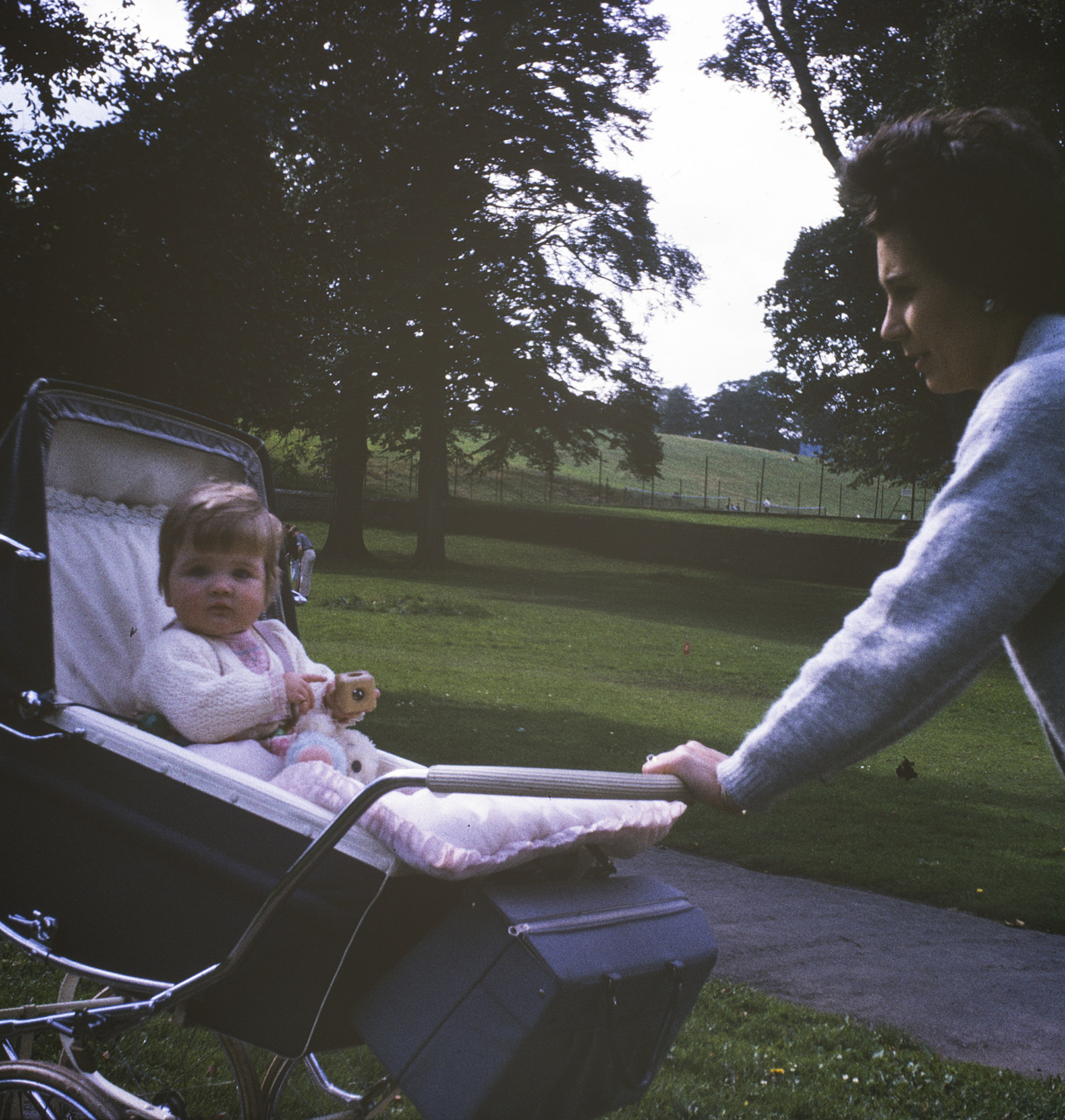
What is going on here? I’ve double checked. This is from 1966, but that child can sit up in its pram. It has a full head of hair! It’s months old if not coming up for a year. Unless the holiday photos were left in a camera and not developed until 1966, then… the woman in the Yugoslavia photos isn’t the same one as in the photo above?
I just don’t know. They share so many similarities, hair styles, types etc… but. Well. Who knows.
It is definitely the child of the couple we met earlier, and there is definitely another child on the way.
The family years – 1967- 1971
In 1967, our child went to the beach. That’s it. That’s all that happened in 1967.
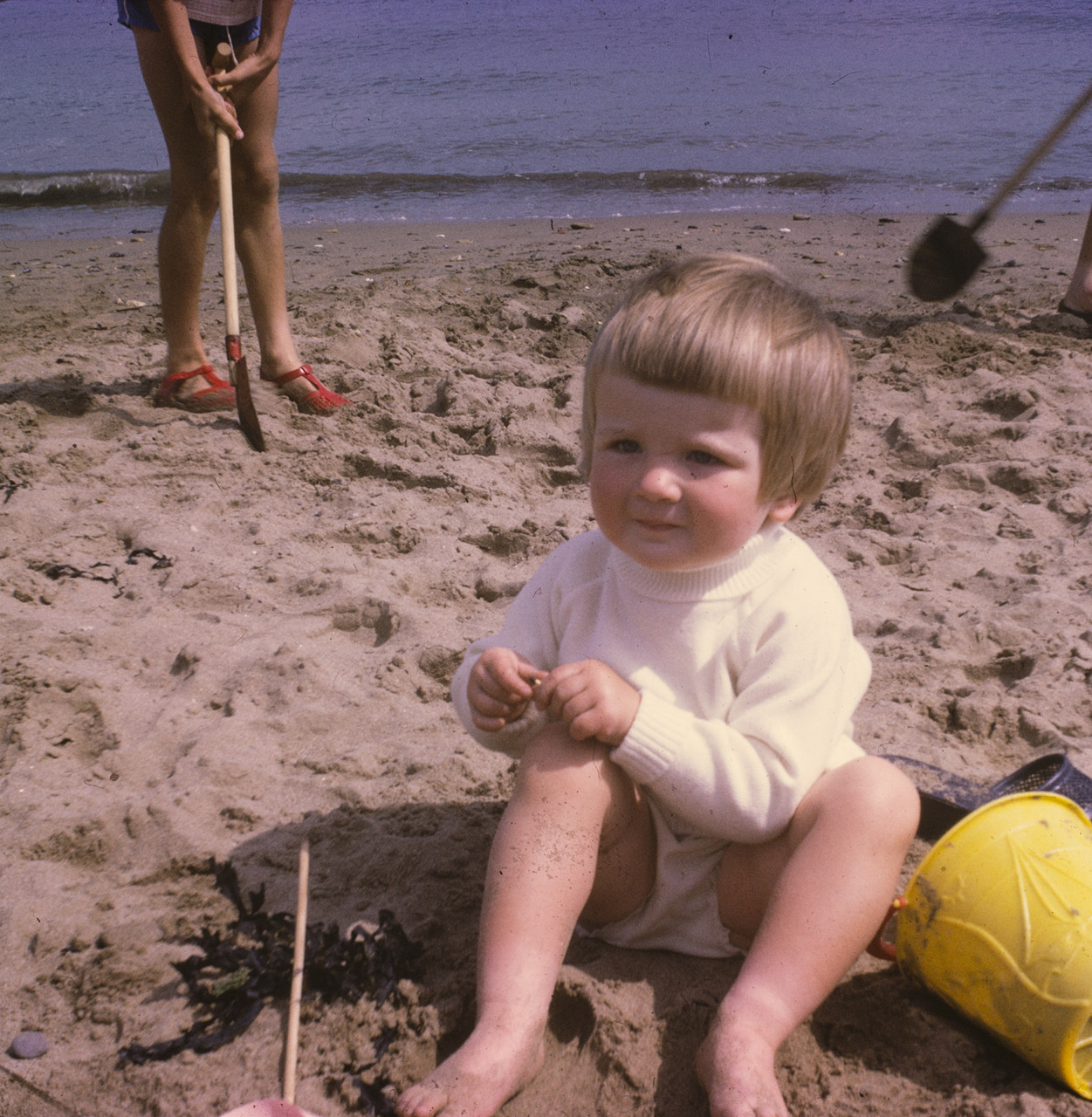
So, to jazz things up a bit, in 1968, they went to the beach.
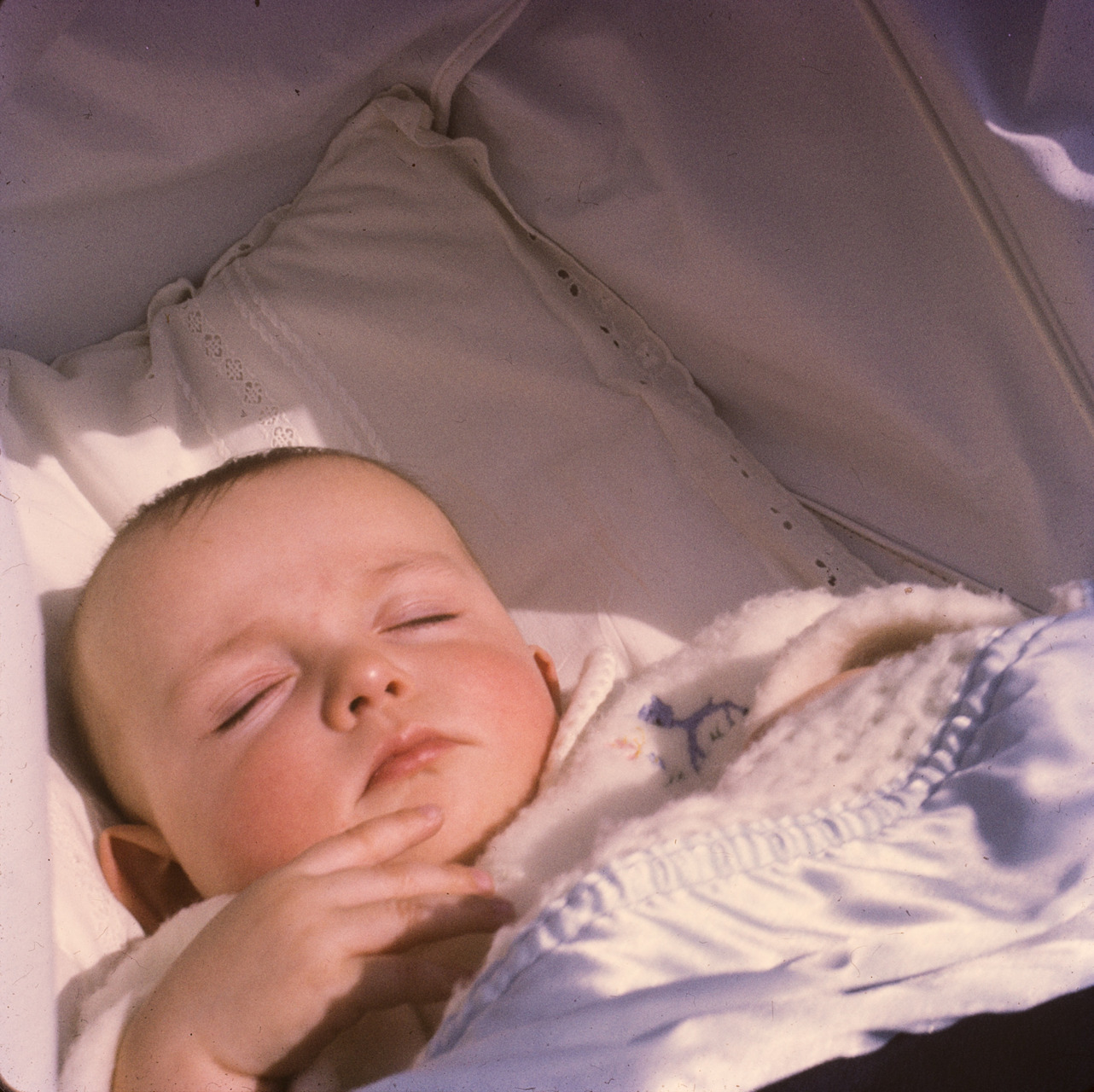
No, only joking. In 1968 they welcomed their second baby into the world and, honestly, is this not one of the most beautiful baby pictures?
Well, his sister certainly doesn’t seem so sure or impressed at this new arrival, check out the facial expressions in the obligatory “sit with your new brother!” picture…
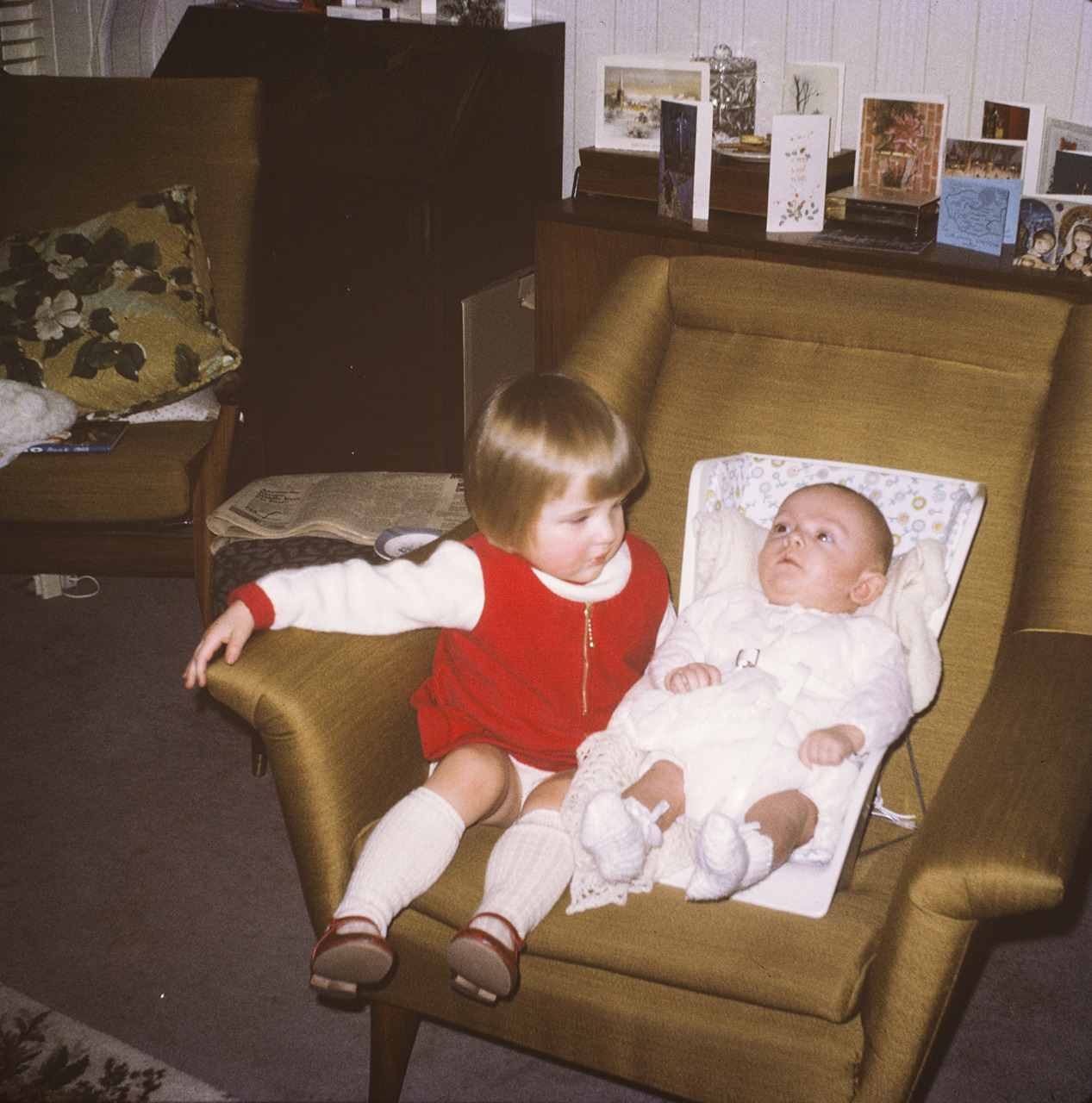
Those kinds of chairs have made a come back, you’d pay a fortune in trendy shops to buy that armchair now. Looking around the room there is the obligatory writing desk, now probably languishing in an antiques store for £20 and on the sideboard with all the cards what looks like a very expensive cigarette box. It is the 60’s after all.
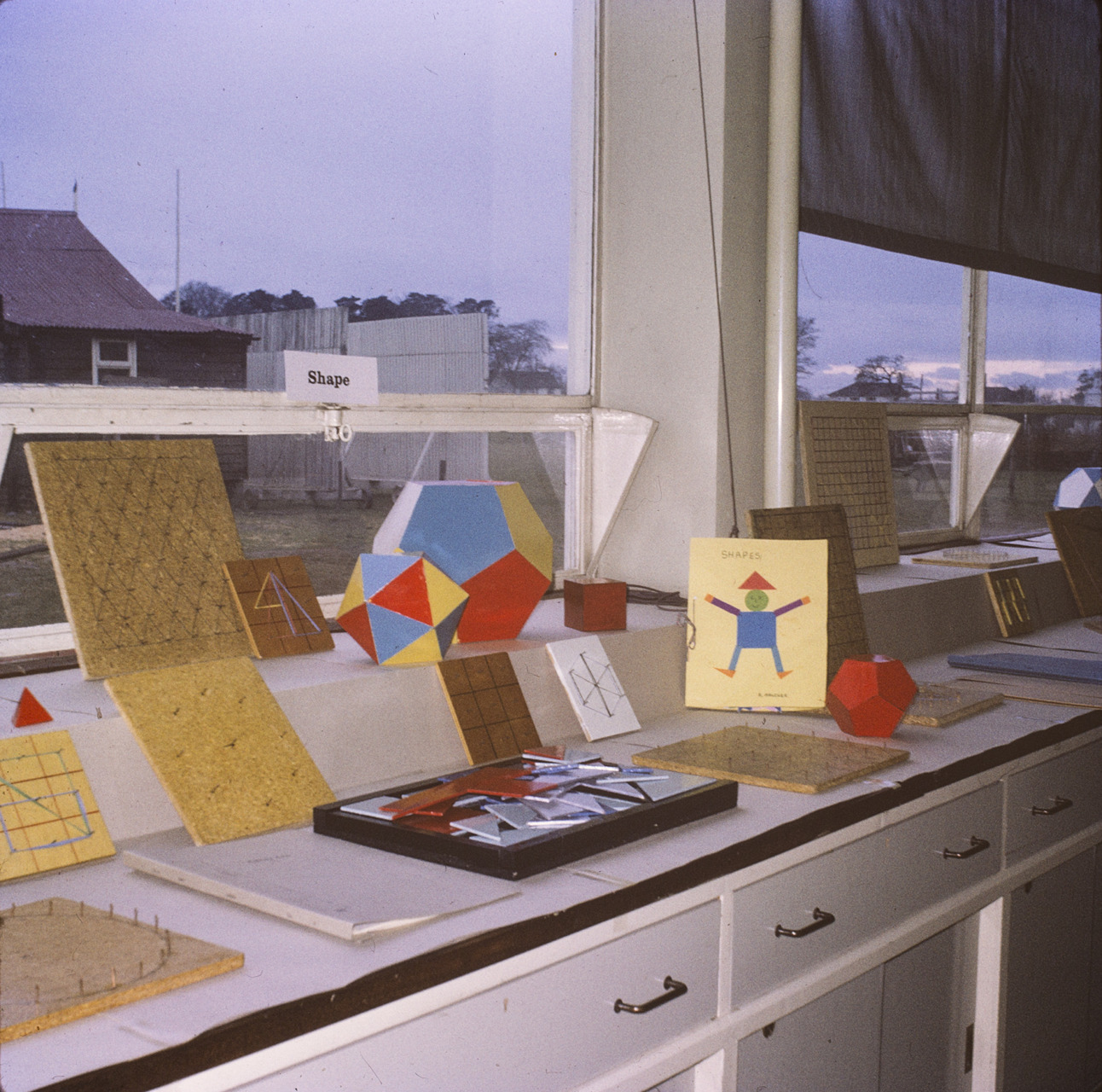
This all happens in April 1968 and it seems to add up – the girl looks about 2 ish, maybe knocking on 3. I really wish the newspaper had been a little closer and we could’ve dug up some information from there. Anyway, it appears that one of the parents ran a maths course in a local school because there’s a series of photos of various displays or stations in a classroom and this absolute gem:
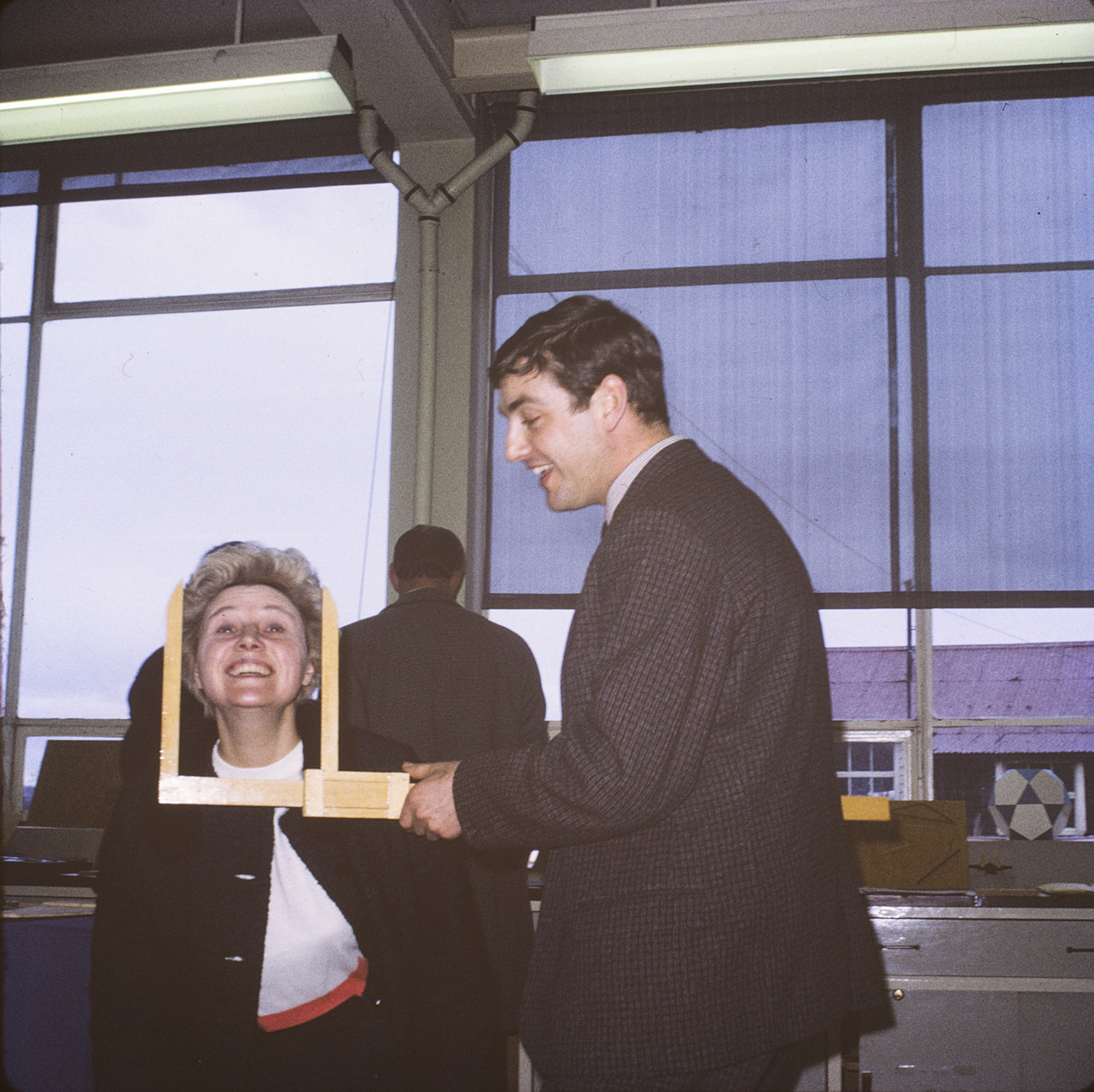
Oh they knew how to have a merry jape back then. Anyway, looking at these classrooms is both interesting and depressing. If you think they look old or old fashioned then (when they were likely not that old at all) just think that hundreds of schools up and down the country still look like this because they still haven’t been updated since the 60’s. That’s investment in education for you.
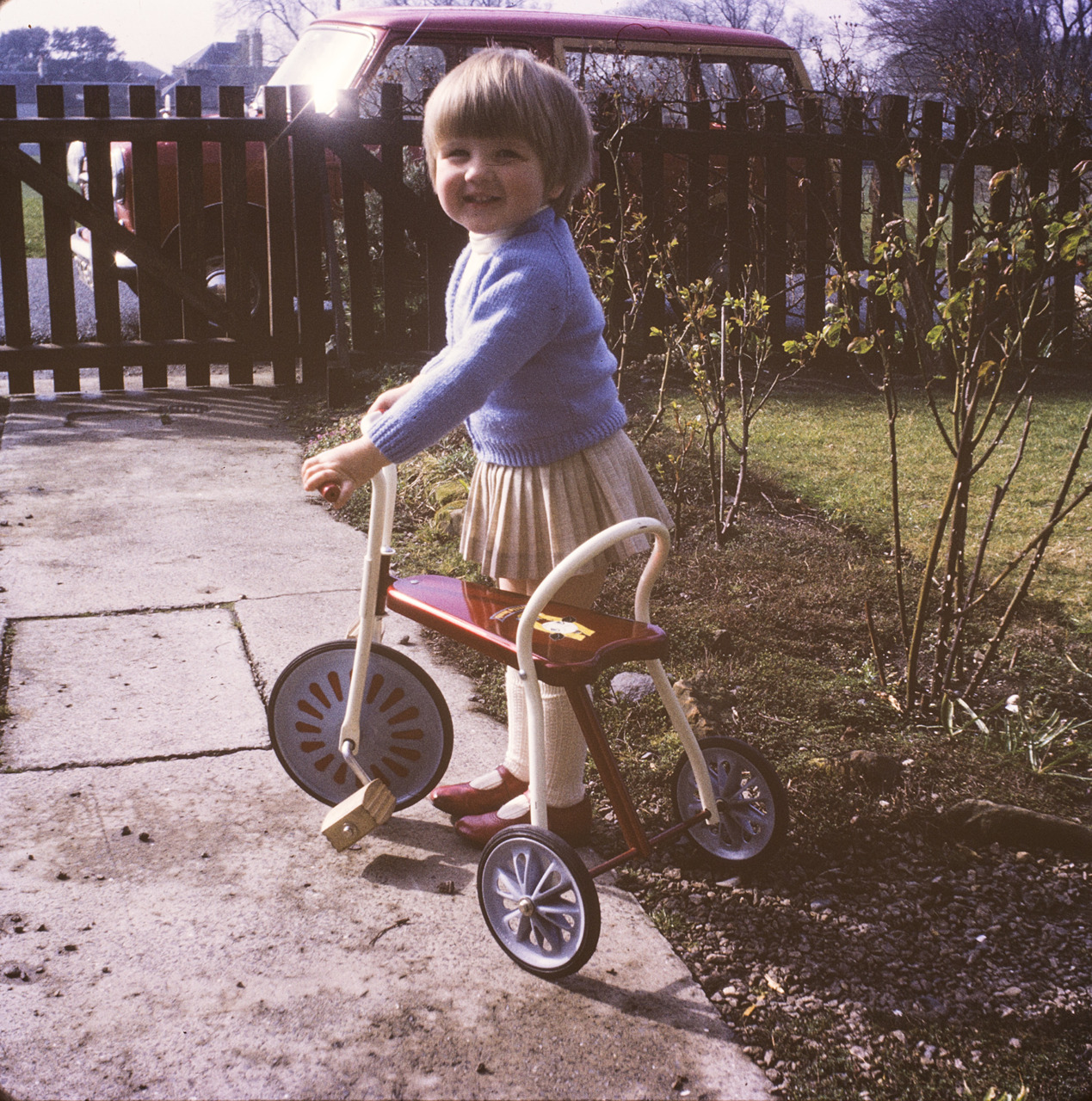
I think this film lingered in the camera for quite a while because the next few frames show the little girl looking even older and very, very happy with her new trike. It might not be that long because she still has the same or similar red shoes on but it’s anyones guess at this point. Notice the car – it’s not a Morris Minor as your instincts would first tell you but a Mini Traveller – very similar ideas, though.
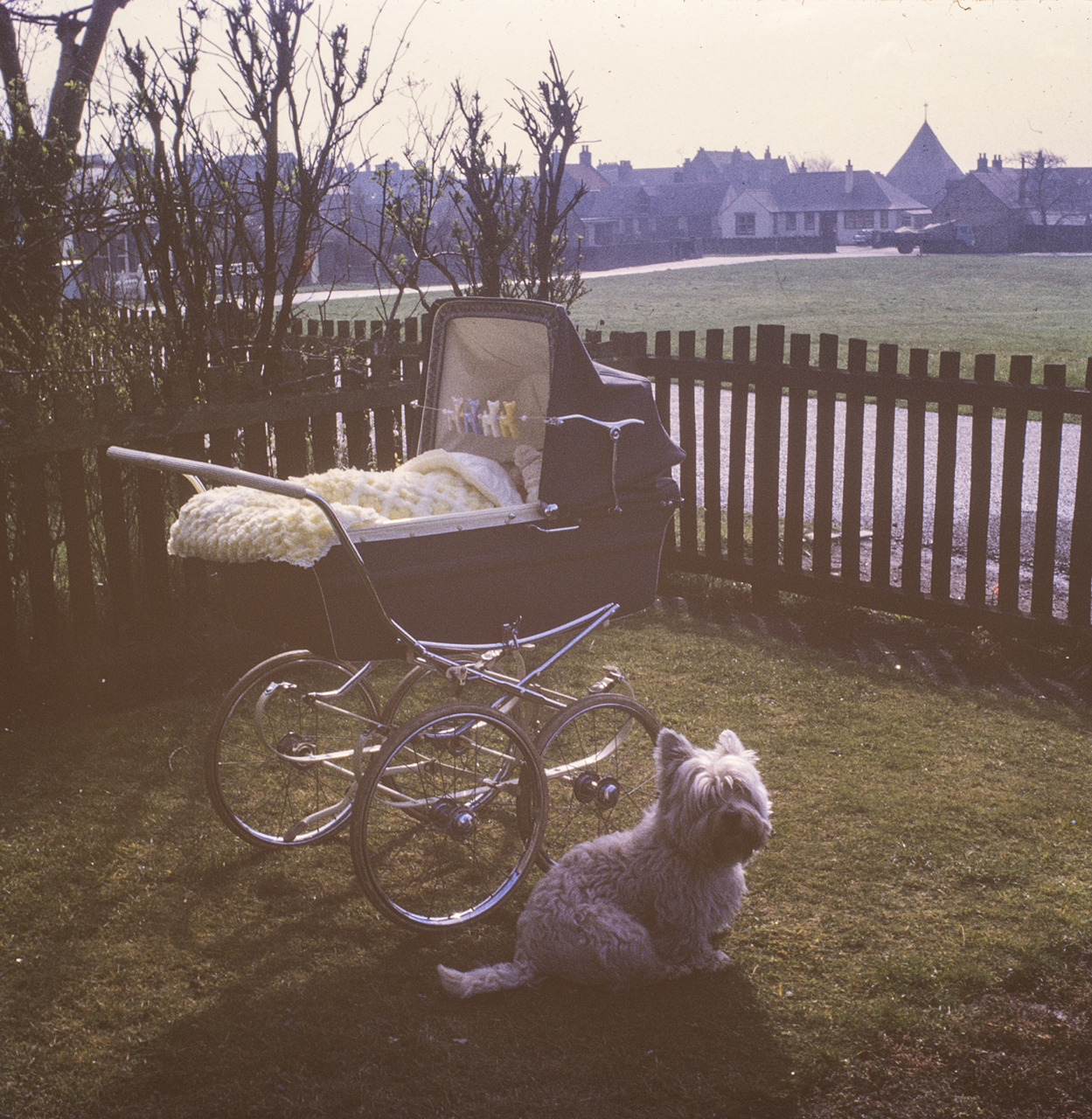
Our little girl is out playing in the garden of a house that I haven’t the faintest hope in identifying and nor does it match any house or place in any other photo in the collection. Her little brother is enjoying a sleep in the pram opposite her whilst the dog we met in 1963 is back and keeping guard.
If you can identify this location, please do fill us all in.
We finish 1968 with a bit of walking around with the family and grandma – perhaps this is her front garden above?
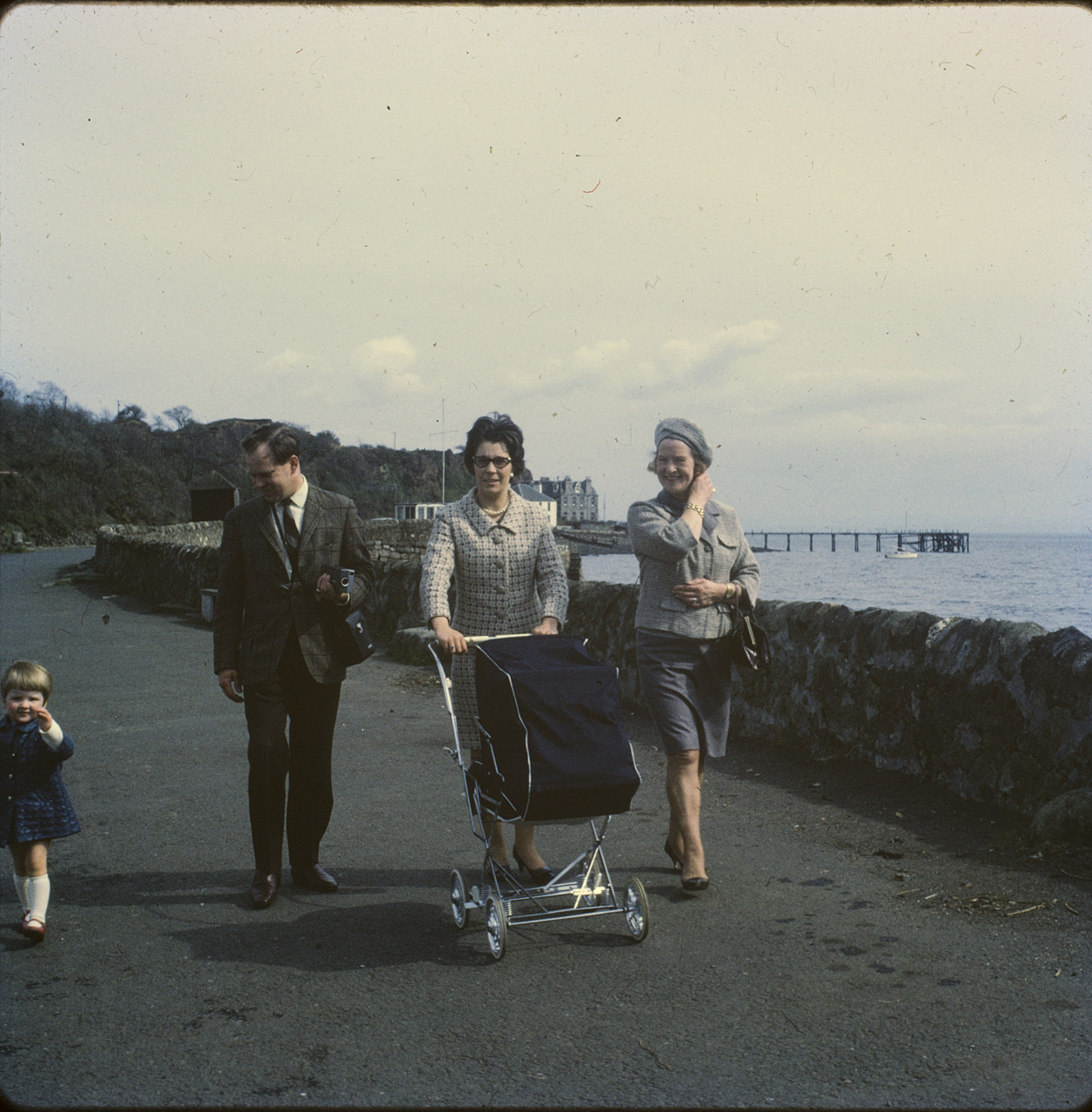
In the picture, dad is holding a camera that he also took along on a beach trip that I’ve not shown here. It’s not a stills camera, but a Kodak Instamatic M2 8mm Cine camera. It took “super 8” film cartridges, shot at 18 frames per second and would give you a whole 3 minutes of recording. I imagine that the processing costs were extortionate and you’d have also needed to invest in a Super 8 projector to view your footage.
Somewhere, I am sure, there are films of this family enjoying their days out to the beach. Sadly, they’re not with this lot of slides. One memory that does remain is this rather poignant walk home:
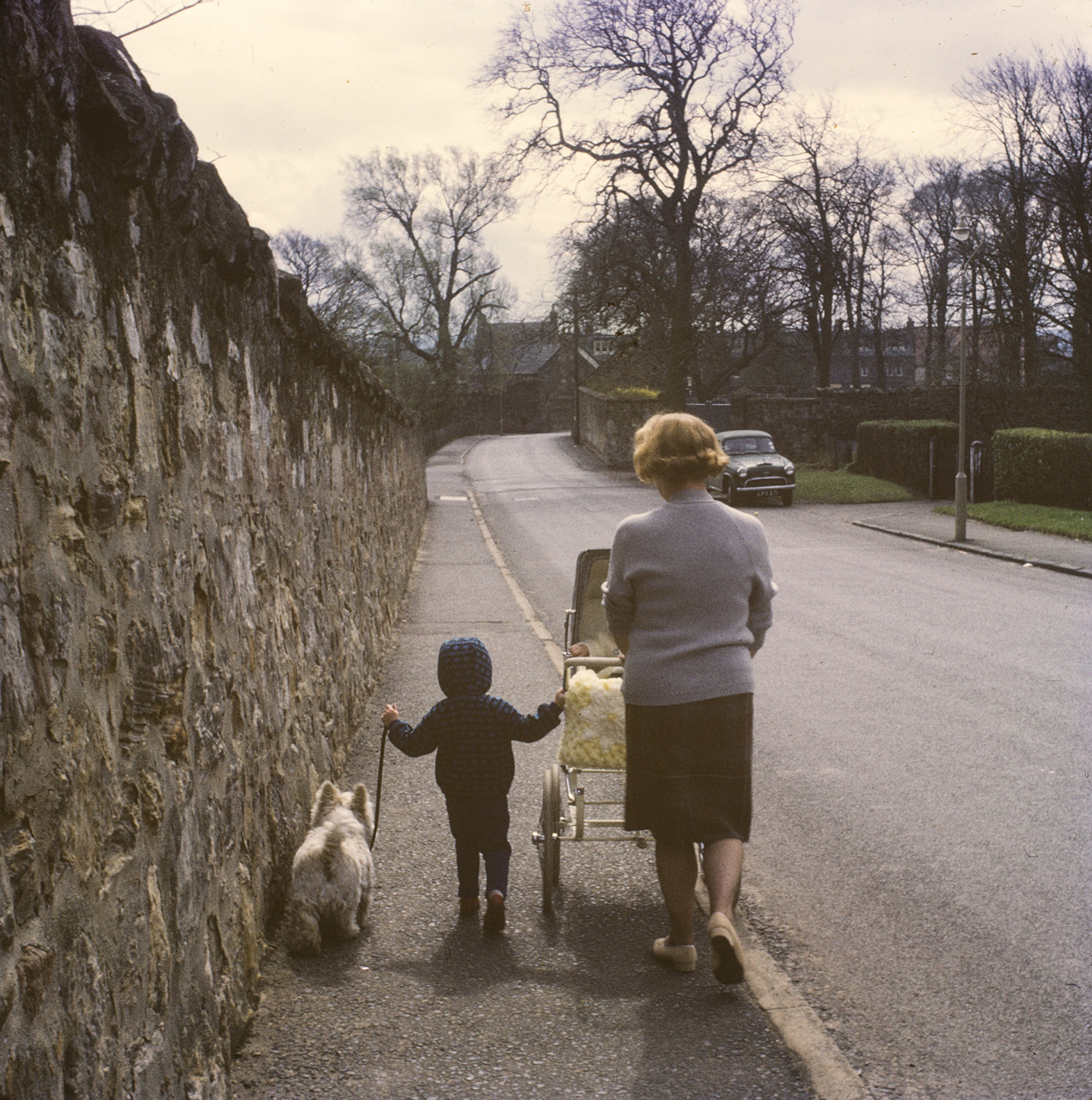
Pause for a moment and take it in. You’ve got the cute side of things with the young girl being allowed to walk the faithful family dog, holding on to the pram with her brother in. The classic Gran walking the grandkids home image, two generations apart, a completely normal every day scene, but one that is genuinely beautiful.
And now what of them?
That girl now would be 60 to 61 years old and her brother would be only 58 at worst. Why don’t they own these photographs? How did they end up at an auction rather than in their family album? If you were going to scan them in and then discard them you’d do just that – discard them. It’s weird. Perhaps they simply didn’t know they existed? Paid for a house clearance and thought they’d picked everything up of sentimental value? Are they still with us? Surely one of them at least is.
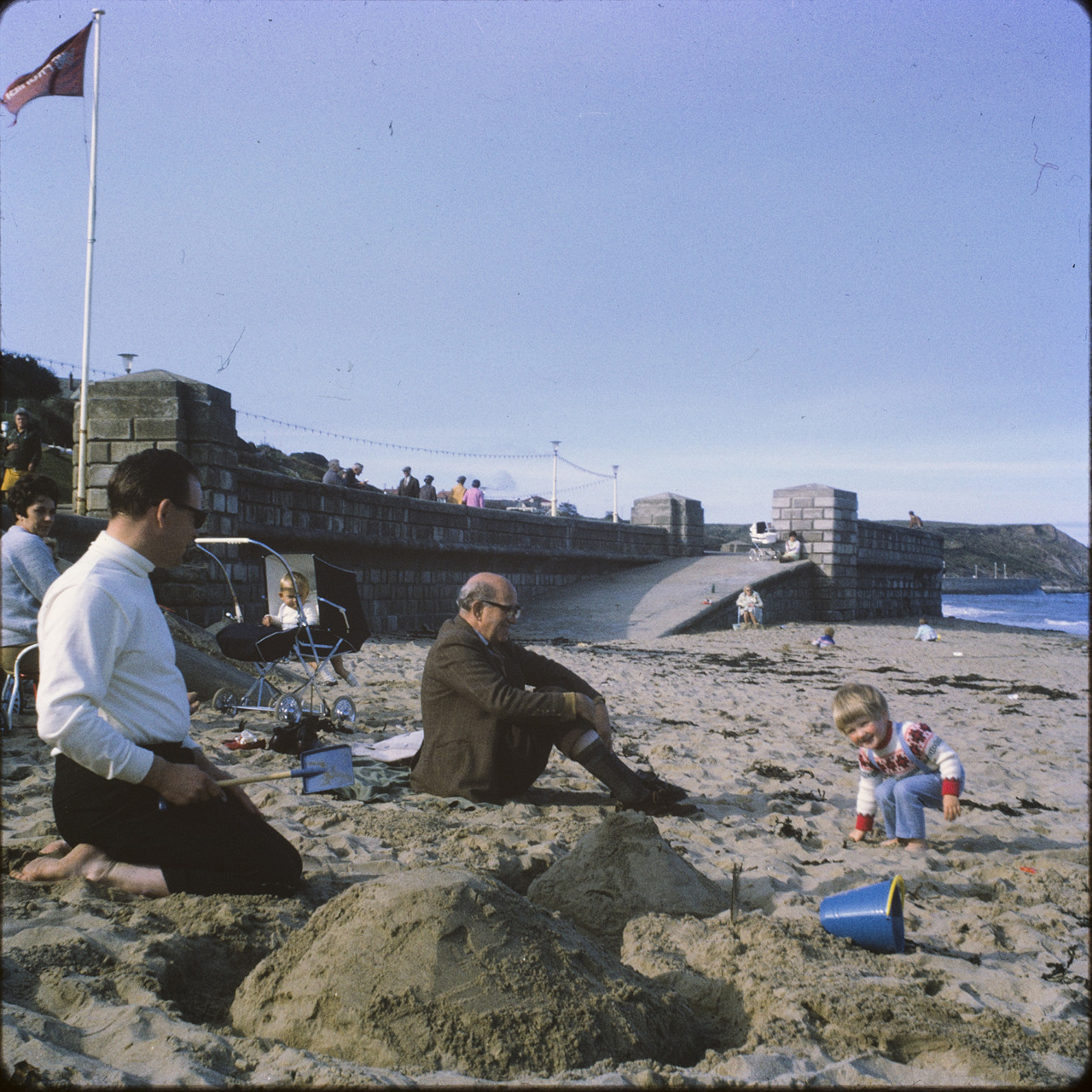
1969 is our final family trip to the beach and the whole crew are there and I’m heartily relieved to see that we’ve regained some dignity. Full suit, jumper and tie are all back in full force on what looks to be a beautiful day. It must’ve been unbearably sweaty inside those bloody outfits, why did they do it to themselves?
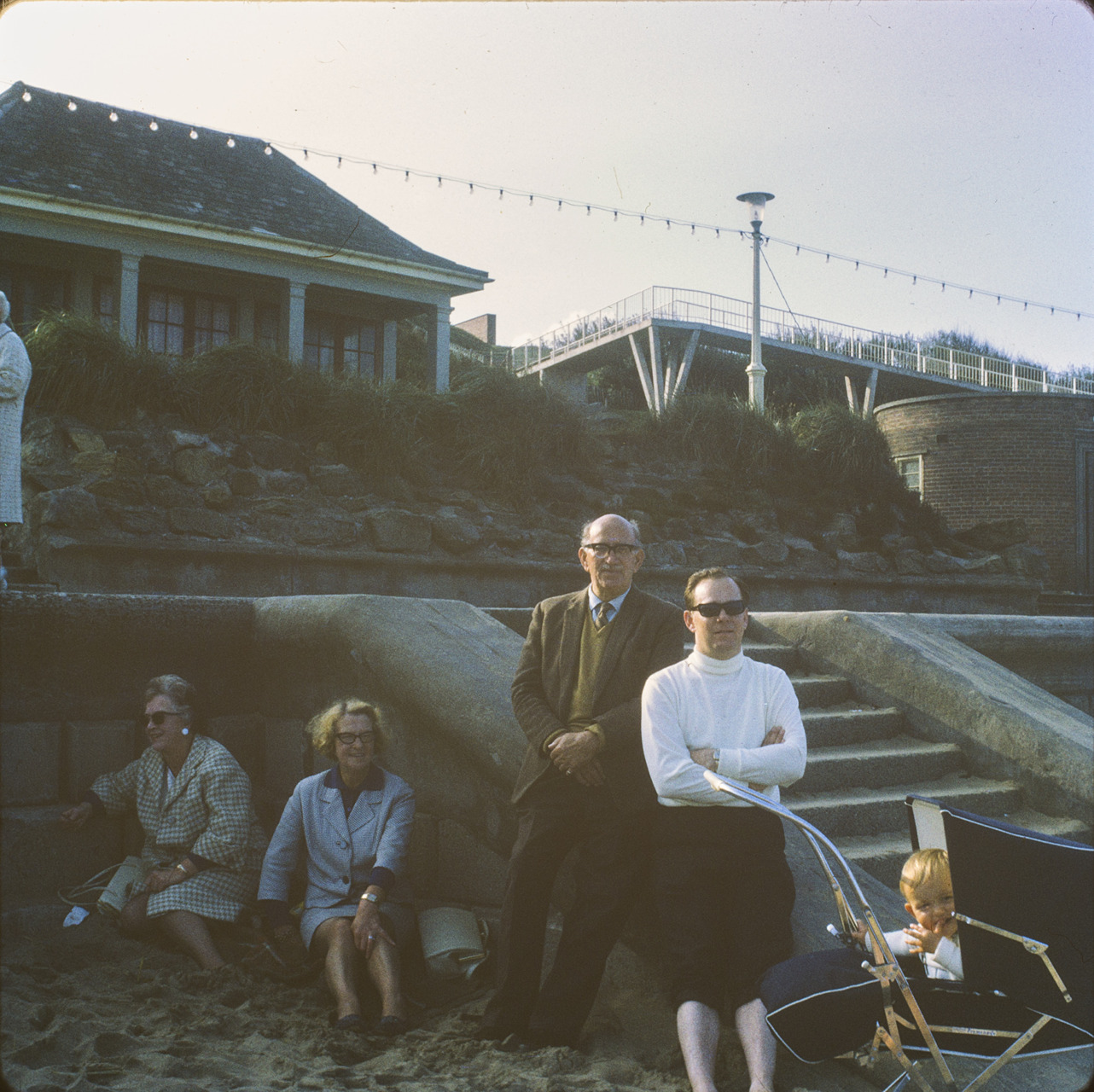
This brings us full circle because this is the same collection of family members we met back at Ravenheath, on that sunny day before, I think, the kids came along.
The closure of another story
This is where the photos die down.
1970 consisted of one single family shot amongst a few nondescript landscapes:
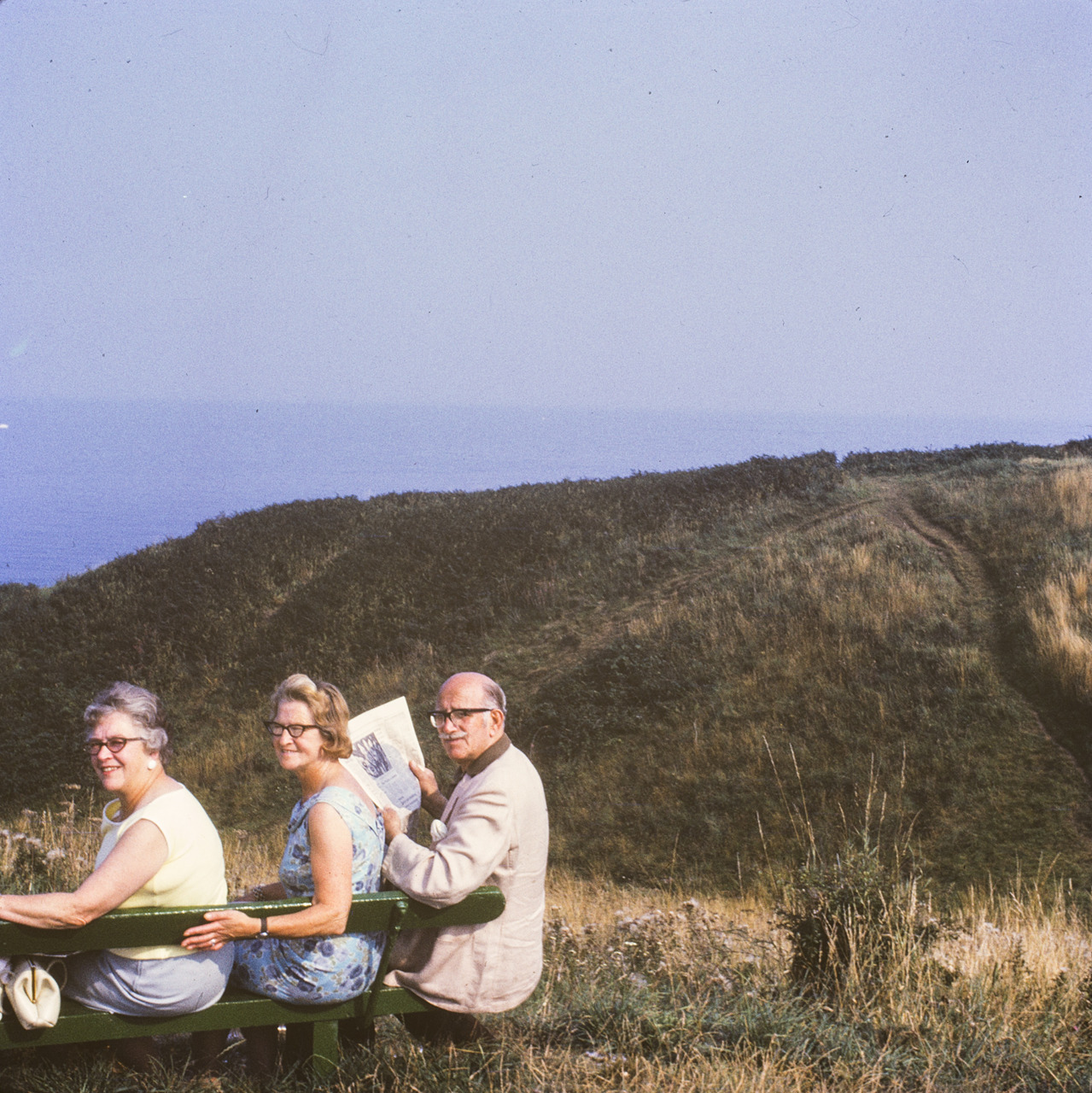
They at least labelled it, this is Cloughton Newlands and thank God, Grandad has finally seen sense and ditched the suit. There is almost nothing to say about Cloughton Newlands other than it’s a hamlet included in Cloughton which itself only has a population of about 680 people. There are a few sites of special scientific interest of which this is probably one of them. A lookout over one of the many clifftop bays.
We finish this epic journey feeding the ducks in 1971 with Gran.
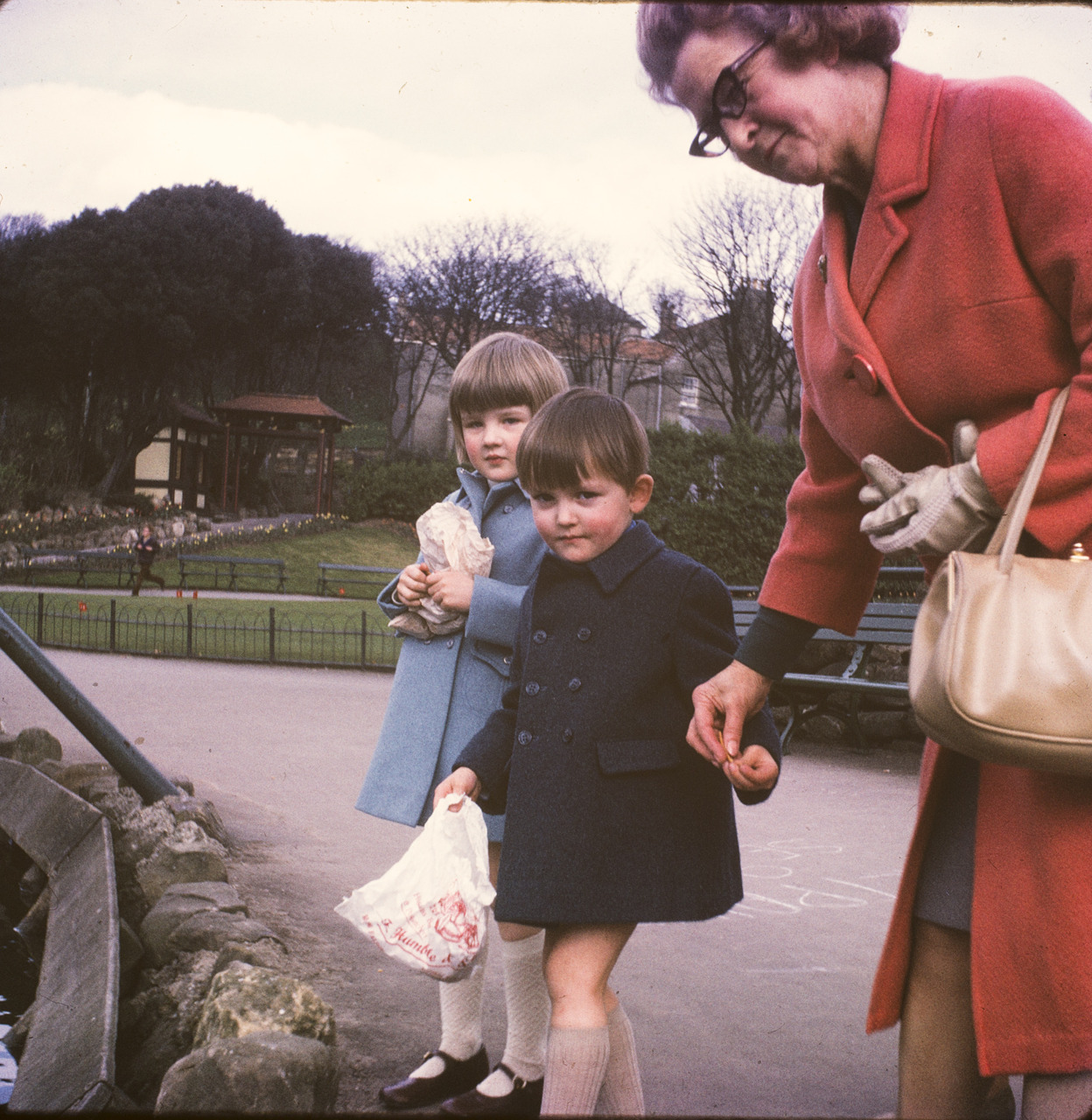
Brother and sister in their matching duffel coats. Those things were a kids worst nightmare, the itchy, scratchy cloth they’re made of is enough to drive you round the bend.
The end.
So what have we learned?
This family lived a good life. They had their family close by, regularly went on outings together and lived in an absolutely gorgeous house in a scenic, historic Yorkshire village. That, to me, is the dream.
I presume they had a comfortable life, good jobs and their children looked so happy. They grew up in Ravenheath, probably played their lives away on endless summer days in that massive garden where, in a place like that, they’d have lived without a care in the world. They were safe, happy, how could they really have been anything else?
One of the parents perhaps worked in education. If they didn’t, they certainly worked with children in some capacity because there are a set of photographs of scout camps that they kept.
And then what became of them? Their parents, if they survived, would be knocking on 90 at least today. Mary and Jo, if that was their names, seemed to spend their lives together even in adulthood. They shared their big holiday abroad together, sight seeing in Venice and the historic towns of Croatia.
Life couldn’t have always been easy. It isn’t for anyone, but if it was difficult it wasn’t evident in these photographs. There’s perhaps only one pair which have an air of atmosphere about them.
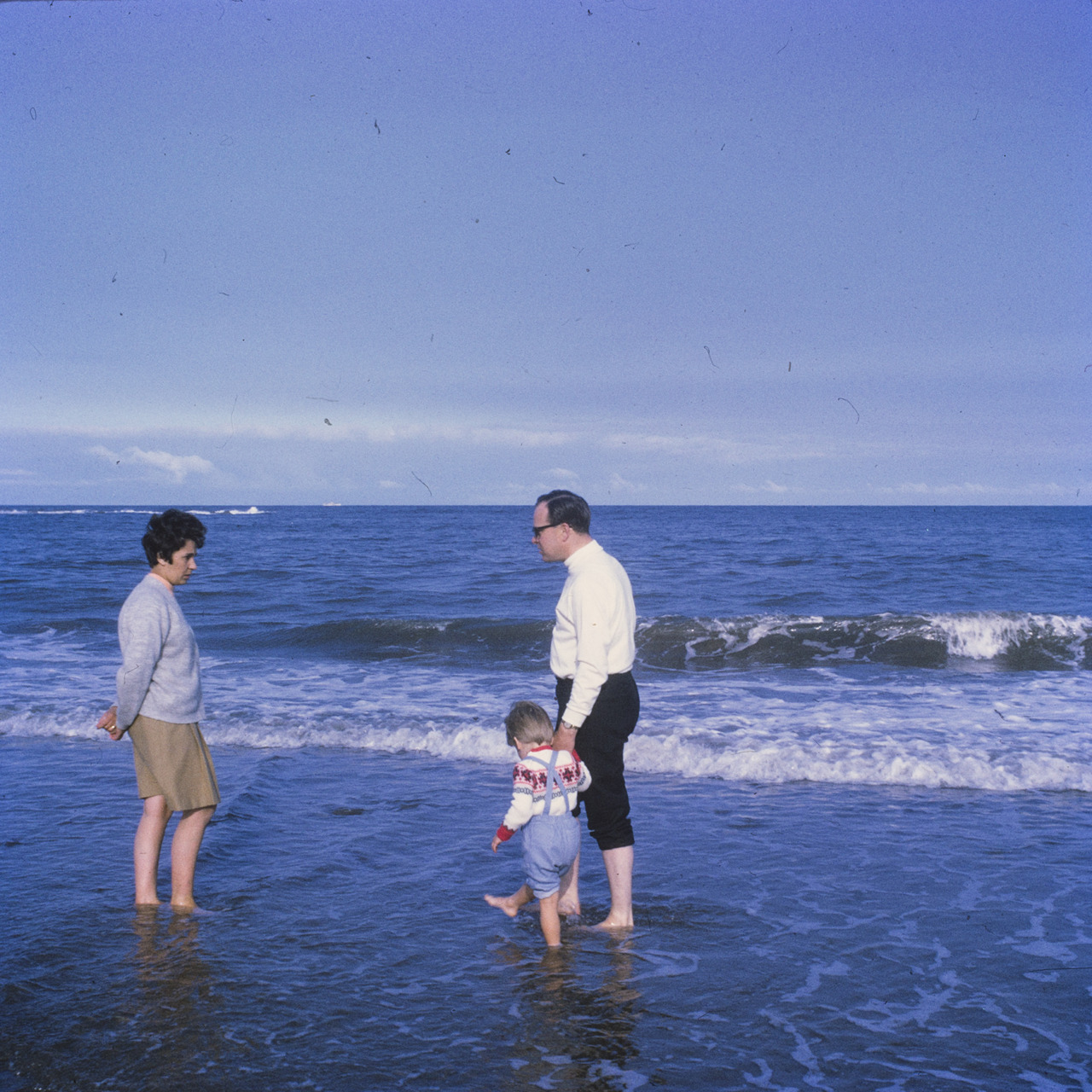
Seen in sequence with this one next, (they were taken one after the other) she seems to have a lot to think about. The kick of the water says something. or nothing. That’s the wonder of a photograph isn’t it? You’re free to interpret that snapshot of history in your own way.
Whatever their story, this is where it ends. Whatever happened to them, I hope they lived (and are still living) long and happy lives.
One final thought. All of our lives, our memories, they are now digital. These memories may have been lost, abandoned, sold at an auction but they remain real. They are tangible objects that tell a story, we know what they are. Digital photographs and videos are anonymous, hidden inside a device that can easily be discarded in an instant. The chances of someone finding, or gaining access to our digital legacy to carefully, lovingly preserve it for another generation to see is far less probable than for these photographers of the 1960’s.
There’s something to be said for physical content, isn’t there?