

The world was a fantastically optimistic place in the year 2000. Back then, AI was a cute dog called Aibo that cost £2000 from Sony and we were only a decade away from those flying cars we’d been promised in the 1980’s. When the millennium bug failed to kill us all, the tech world continued to focus on pumping out advances in computing power at an alarming rate. In photography, however, things had seemingly hit a ceiling once cameras had advanced past the magic megapixel marker to a whole two megapixels of resolution.
This was seen as something of a watershed moment because manufacturers and reviewers alike were at pains to point out that two megapixels was enough resolution to provide you with a detailed A4 sized print and, back then, who was printing anything other than 6×4, 7×5 or perhaps the odd A4 print on photo paper using an extortionately expensive HP inkjet printer? They were all HP printers back then…
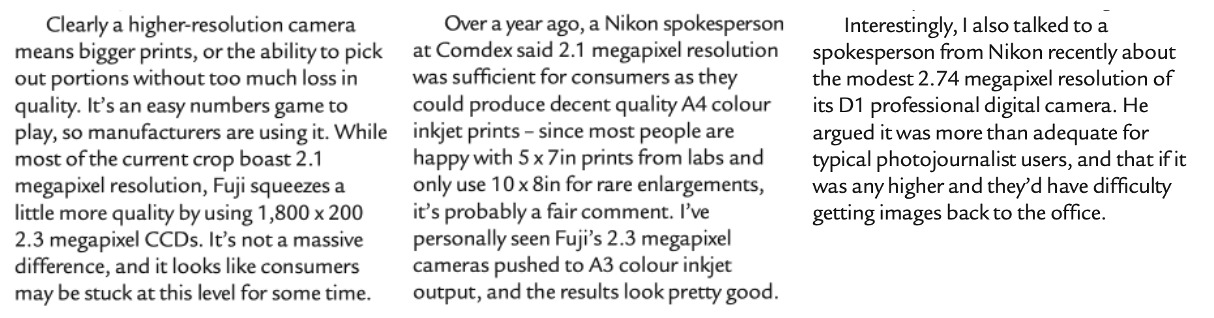
Part of me loves the fact that marketing executives and customers alike were still so focussed on printing their photographs as the digital revolution began to take hold. In the age of film dominance, prints still mattered and what was the point in having a camera if you could only see the images on a tiny LCD or your whacking great big PC monitor and tower combination that had its own trolley (yes, these were very popular back then) and took up half of your living room?
By 2000, we were already well into the second or third generation of digital cameras and compact offerings were now beginning to morph into something which resembled a competent, useful tool that could replace your film camera once and for all with all the benefits that memory cards could bring. That was, of course, if you could afford a memory card big enough as most cameras came with an 8mb card capable of storing as little as two to four images. A larger 32 or 64mb card would’ve set you back three figures.
Don’t get me wrong, you needed deep, deep pockets to join the compact digital revolution, but if you’d saved your pennies, the dawn of the new millennium certainly seemed like the right time to take the plunge. I’ve dabbled in this era before with the formidable Canon Powershot S10 and it was a genuinely capable camera, albeit one which ate batteries in seconds. Superb though the Canon was they didn’t own or rule the digital camera market at the time and people were very excited by the cameras being launched by Nikon and Olympus – two companies that were forging their own design directions and creating class leading cameras whilst doing so.
With no expense spared (above about £10) I jumped in the Delorean and picked up two (or four…) iconic, innovative and well regarded millennial marvels, which were the absolute peak of desirability in the year 2000.
In this post:
Buying your first (of many) digital camera
Back in the year 2000, the de-facto standard for consumer information was without question magazines. I think our perception of time can become quite compressed but let me assure you that in the UK, even though some of us had been early adopters of the internet and had connections since 1997 or thereabouts, the country was still using dial up 56k modems in 2000 – broadband was the stuff of pipe dreams.
Therefore, unlike today, you would not spend hours on end browsing online reviews of products on your shortlist and there was quite literally no such thing as customer reviews at the bottom of a product page on an online store. There was obviously no YouTube to demonstrate a product before you buy and very few reliable, authoritative review websites to rely on. Indeed, nearly all purchases were still made on the recommendation of magazine articles which carried huge gravity with buyers or word of mouth. Sales were either mail order (over the phone!) or through the high street in big name stores such as Dixons, Jessops or Argos and businesses were still coming to terms with the idea of operating online and the complications that would bring.
Whist reading through some old copies of “Personal Computer World” – a well regarded and authoritative publication on all things computing and digital, I’d initially been researching early digital compact cameras that had been launched in or around the year 2000 for an entirely different project to this. This had culminated in me ordering the rather fancy looking Olympus Camedia C920 which was to be my camera of choice for another article.
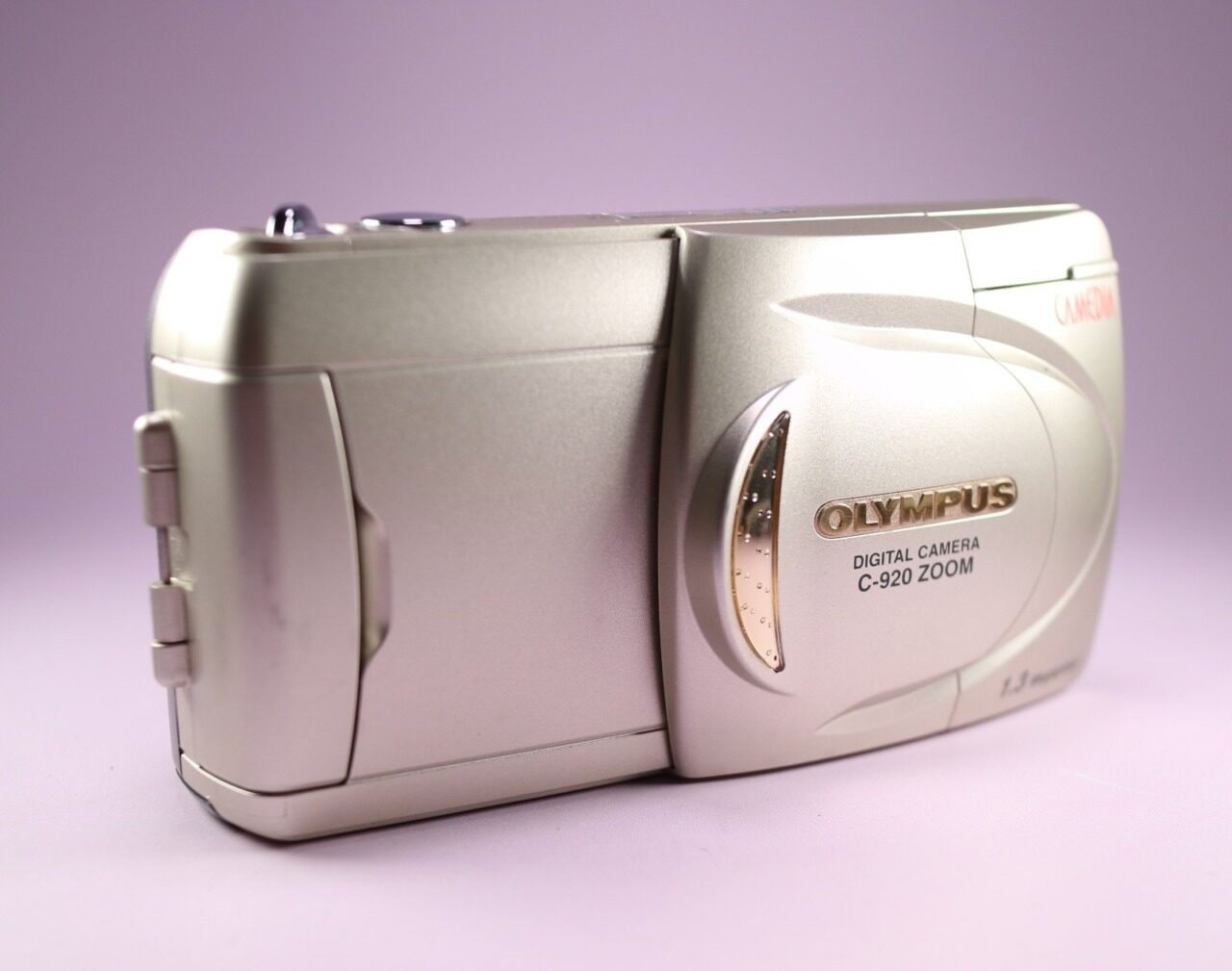
This really is a beautifully designed compact that was supposed to feel like a drop in replacement for your 35mm film compact that you’d faithfully been taking on holiday with you for the last few years. It was the latest in an evolutionary process that Olympus seemed to be going through, trying to squeeze every last penny out of their megapixel sensor which, in one form or another, had been in a series of cameras – one of which we’ve seen here before as the Camedia C860L. At 1.3mp the C-920 was not a resolution monster but it was spot on for 1999.
The camera arrived, I played with it a while and then in between moving house and picking it back up again, the inspiration just wasn’t there (plus I couldn’t lay my hands on the computer equipment I’d have needed for my original plan). Then, completely by coincidence, I landed upon a review of it in a January 2000 group test of digital cameras:
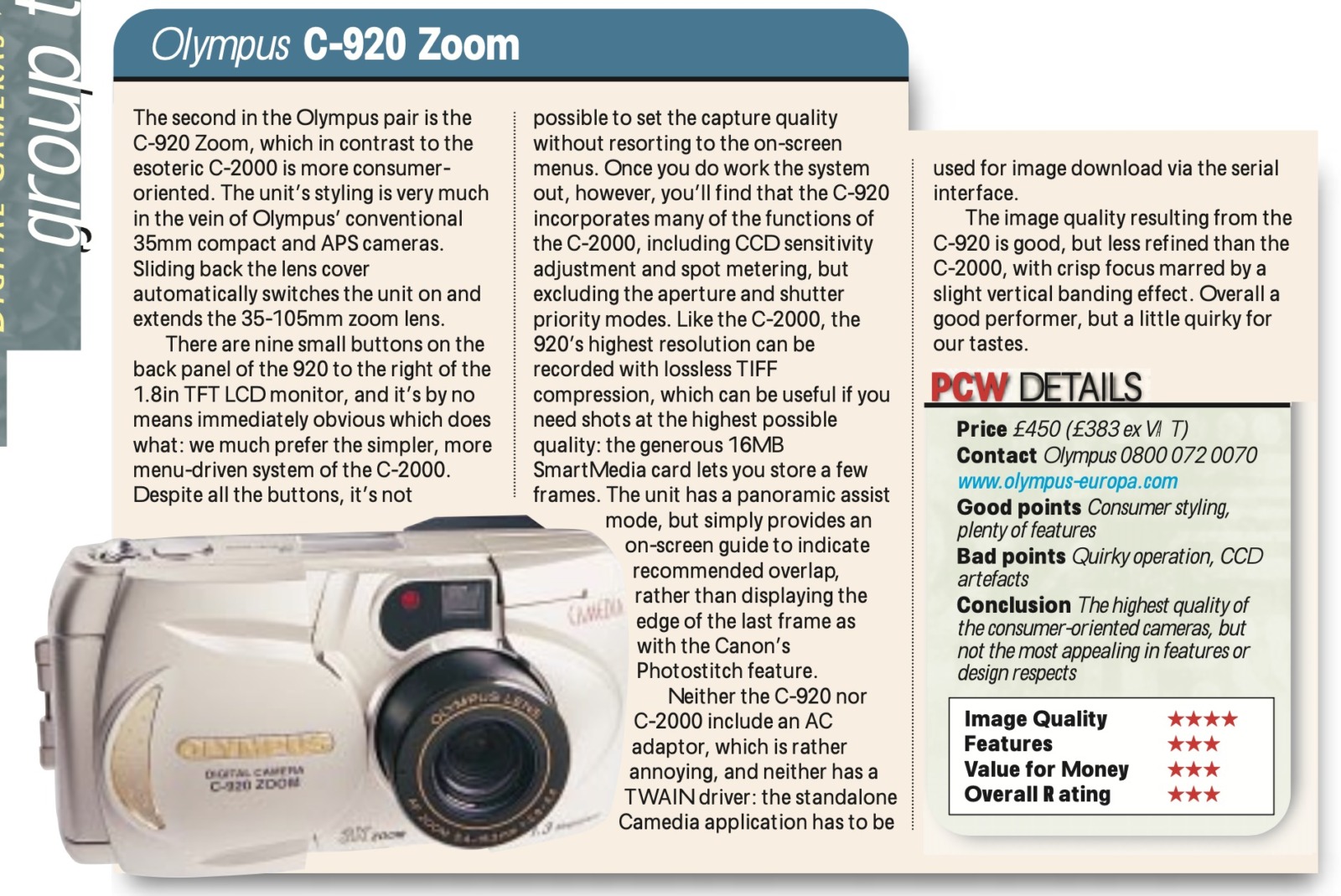
and, as you can see, it’s “fine” but, what’s that? It’s less refined than the C-2000? Maybe that’s a better idea for something to write about? Let’s have a quick search for that… Oh… I’ve already reviewed it! Well, not quite but it’s very, very similar successor the C2020. This is the camera that comes without an IR filter so you can do really cool infra red shots with a cheap filter and adapter. I really enjoyed using that camera but I didn’t exactly need another. Perhaps there was another angle worth pursuing in this group test? At first, it seemed there was.
Two months later in March 2000 they launched, for the small sum of £1999.99 (£3946 today), this absolute monster:
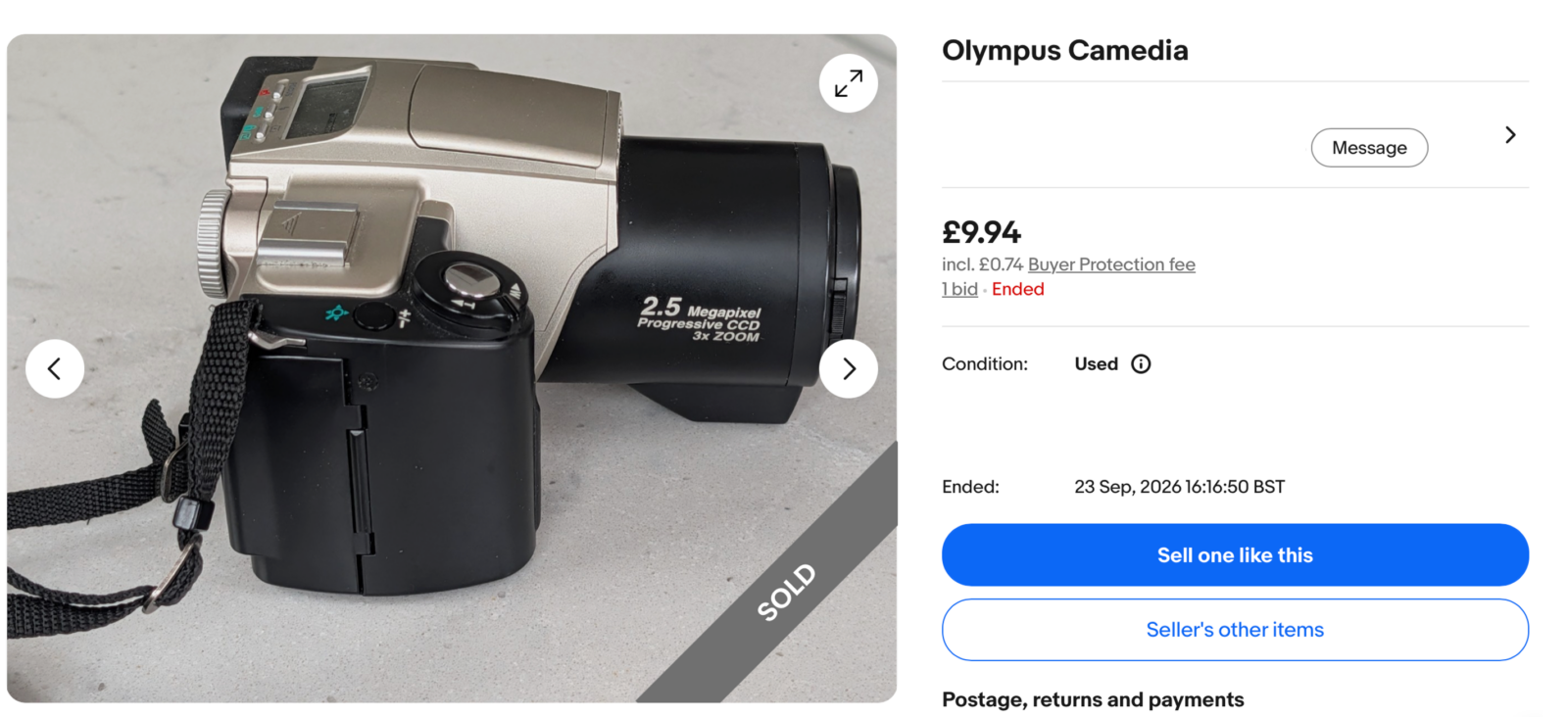
This is an Olympus Camedia C2500-L and you may be asking yourself why have I blanked out so much of the detail in this image. The description was along the lines of “found when clearing out Dad’s loft. Looks in great condition and was a. great camera in its day!” Well, It arrived with a memory card in the camera and I can tell you that dad, how shall I put this, was an open minded man who lived an active and varied retirement…
Long time readers of the site will know I keep advocating the importance of either not selling your memory cards or at least securely erasing them. Suffice to say, the memory card that came with this camera completely justified that opinion and there were images that my eyes will never be able to un-see. Please, please, please check what you’re selling before you sell it and if you’ve no technical expertise, why not ask someone who does to help you prep your devices for sale? It matters…
Anyway, this camera won the “editors choice” award in PCW magazine and is interesting because it was one of the very first compact “through the lens” or SLR type digital cameras. Boasting an impressive 2.5 megapixels and a large 3x (36-110mm equivalent) lens it was one step down from the hugely expensive DSLR’s that had just launched such as the Nikon D1 which was squarely aimed at professionals with bottomless pockets. For £9.94 this seemed interesting enough on its own so I ordered it thinking it would be more inspiring and… Well… It wasn’t. The only difference between this and the smaller, arguably more fun C2020 is the lens is better quality. That’s not enough is it?
If something is going to be interesting after using this many old cameras, it needs to do something a bit different.
No really, stop buying cameras now.

In the year 2000, Canon had released some really amazing cameras including the Powershot S10 we’ve mentioned earlier and used here before. In terms of image quality, they couldn’t be beaten and in side by side comparisons the Canon cameras generally produced crisper, more defined images than any other compact camera on the market. However, for a very short time around mid 1999 and into late 2000, Nikon were seen as the defacto leaders in the compact digital camera market and had released three models that reviewers, users and the internet in general were wildly excited about. These were the Coolpix 700, 800 and 950 and they’re all great, innovative cameras in their own right. At this point, Nikon could basically do no wrong.
This was an era of rapid innovation, cool designs and, dare I say it, fun to use technology. No one really knew what worked best in terms of ergonomics, features, image processing, sensor types and so forth and so designers were just throwing out all kinds of wonderfully shaped cameras, each with something to try and win over consumers to their brand. No dull, beige square boxes here. This is very much like Formula 1 when they introduce a new set of regulations, everyone brings out unique and interesting designs for their cars before scrutinising what everyone else is doing and then copying the best bits. Within a couple of years, everyone has pretty much converged on the same car and they have to start again with the rules.
The pick of the crop in 1999/2000 was the brand new, exciting Coolpix 950. The original Coolpix 900 had been a great hit and was widely regarded as the best consumer digital camera available bar none. It had a really cool swivel lens that a couple of makers seemed to think was the ideal feature for compact cameras – but they didn’t get there first by a long shot. Casio were first a few years prior with the excellent QV-10, Ricoh had a go with a completely detachable lens and Sony… well, they went over the top and fitted the most comically large lens to a tiny body I’ve ever seen in the DSC-F505. But imitation is surely the best form of flattery so Casio must’ve been chuffed to bits to see all this when they were already losing market share to everyone.
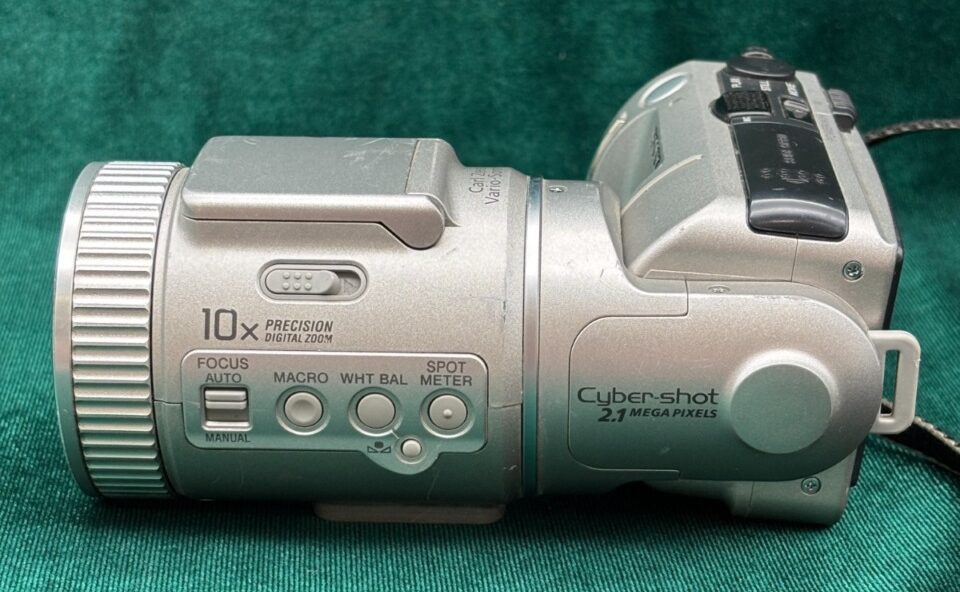
Make no mistake, however, the Sony might look impractical but that lens was a trade off which gave almost unrivalled image quality. Which camera could match it at the time? That’s right, the altogether smaller Nikon Coolpix 950. Do you know what else is better about the Nikon? It’s not a Sony, which means no proprietary batteries and no ridiculous proprietary “memory stick” which makes using a Nikon today all that bit more practical than a Sony that you’ll need to source battery, charger and memory stick for. As an aside, it doesn’t matter which Sony compact I’ve ever looked for, they all seem to have lost their chargers along the way. Why? You tell me. Sony owners obviously don’t like giving up their chargers, do they?
Nikon had the enthusiast compact market sewn up in 1999/2000 and tempted consumers had three cameras to choose from, which were very closely matched. All used the exact same 2.1 megapixel sensor and the only real differentiating factors were the body design, lens and macro ability. The entry level 700 launched for £499 and had a compact body with a fixed lens, the 800 came just a few months later with a 2x zoom lens and a higher £599 price tag and the range topping 950 had a swivel, 3x zoom lens with excellent macro ability and a hefty £799 (£1,576.49 in 2026) premium attached to it. We moan about new camera prices today but you could buy a Leica M3 or a 25 megapixel mirrorless camera for that much now.
Once again, I’d dived into eBay and bought the first working, half decent looking camera I could find. I have previously searched for the 900 and 950 but found the prices were prohibitively high so I’d defaulted to a best compromise position without checking again and went after a Coolpix 800 – it’s 95% the same camera as the 700 or 950 and so would more than do. I settled on this one which came with two memory cards and put an offer in for £20.
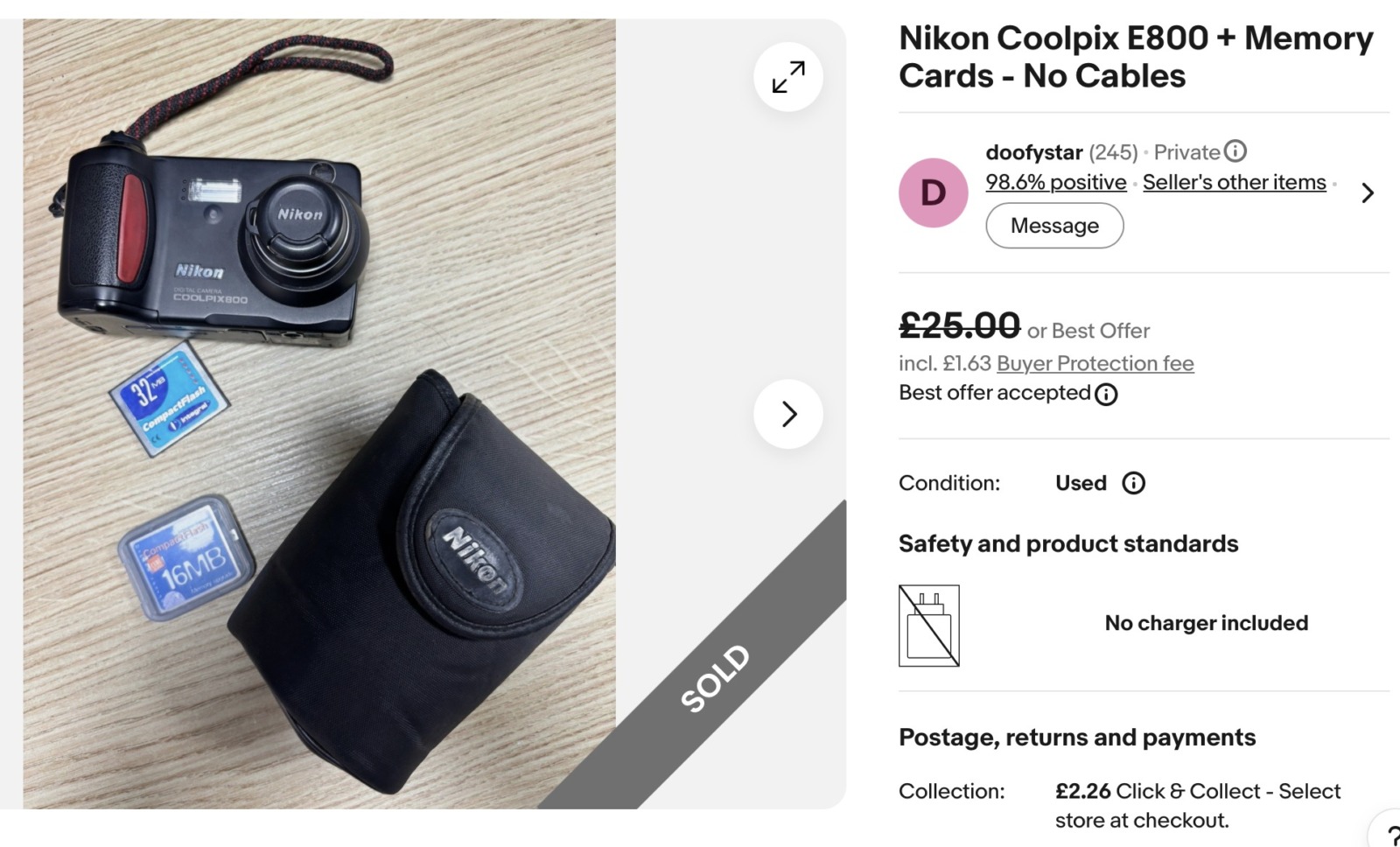
What arrived was a slightly dirty, but otherwise well looked after camera. I am constantly and persistently baffled by the fact so many people cannot be bothered, or simply don’t care, to give things a clean before selling them. If anything, this just seems courteous to me, but so many things turn up looking like they’ve been buried in a garden or used as an ash tray that little surprises me any more. It’s either that or people decide to use completely crazy packaging, usually with all the tape in the world wrapped round some shreds of cardboard that have been hacked together. My favourite is still the Olympus C-860L which turned up stuffed in a 2 litre water bottle, packed with egg boxes and wrapped in an entire roll of parcel tape…
At least these memory cards had been sanitised. One card contained a single very blurry image of text message on a mobile phone, taken well over 15 years ago.
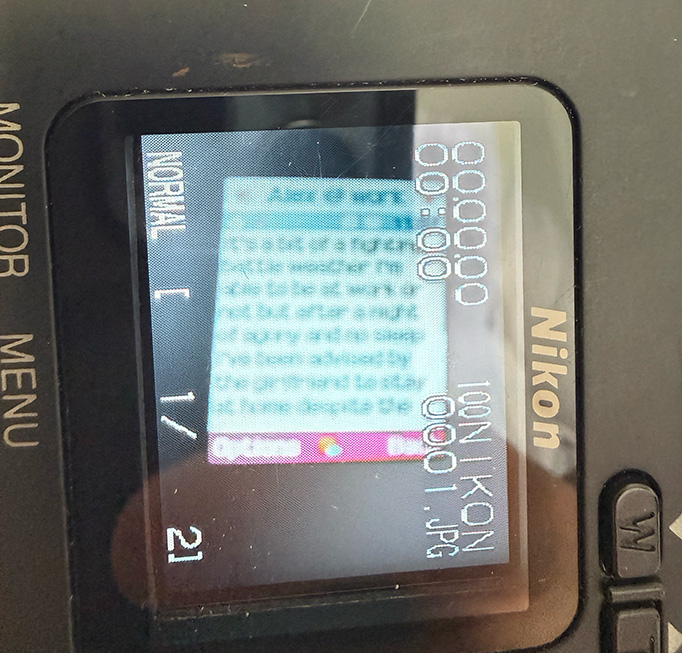
I took a picture of it on the back of the camera LCD because the actual image file was so blurred it was really hard to read. The low resolution of the camera display helped to make the text legible again:
“It’s a bit of a fighting battle weather [sic] I’m able to be at work or not but after a night of agony and no sleep I’ve been advised by the girlfriend to stay at home despite the…”
What a cliff hanger! Despite the what?! We need to know… and I also want to know whether “the girlfriend” was a doctor. She was certainly in charge regardless.
Of course, the purchasing didn’t stop there because a cursory search for the Coolpix 950 revealed it was available for around £20 and so I pulled the trigger on one of those as well, not expecting it to be hugely different. At this point, buying four cameras with no clear purpose for any of them is probably a little excessive, but who can resist a swivel lens…? Ok, I’m clutching at straws now for justifications.
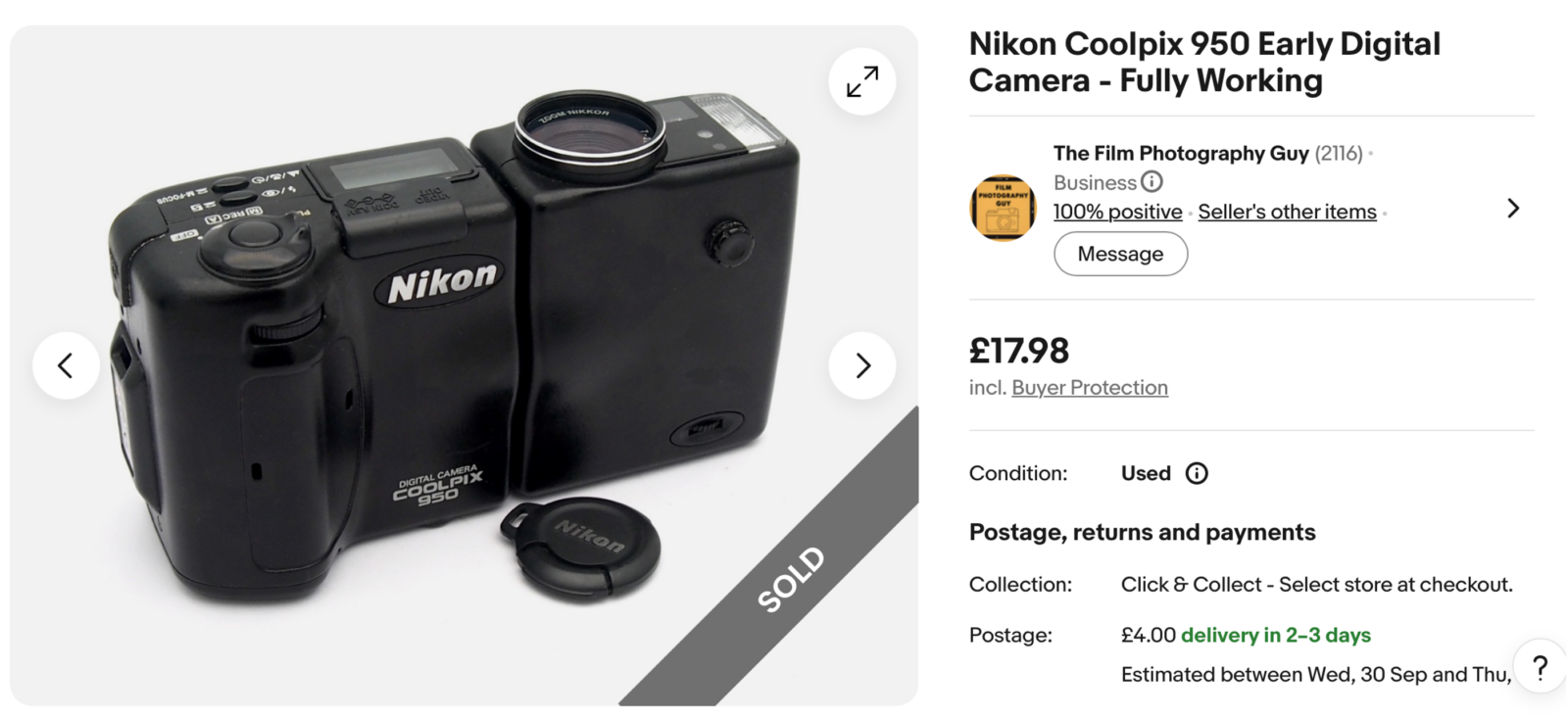
In terms of condition, the only real issue with any of these old cameras is that the battery doors are inevitably knackered. Plastic becomes brittle as it ages and the pressure on battery doors with 4 AA batteries pressing against them is quite considerable. The Nikons fortunately have a two stage door lock, but the 950 is suffering from two broken catches so the door doesn’t sit flush when closed, the 800 has one broken catch and, incredibly in my experience of old Olympus cameras, the old Camedia is still perfect. A miracle. It does mean, though, that changing batteries (which you’ll do regularly on these cameras) is deeply unpleasant as you’re just waiting for the door to eventually fail rendering the camera either useless or a candidate for a severe duct taping.
Just… one more thing
Now I had three (four) cameras, it was time to use at least two of them.
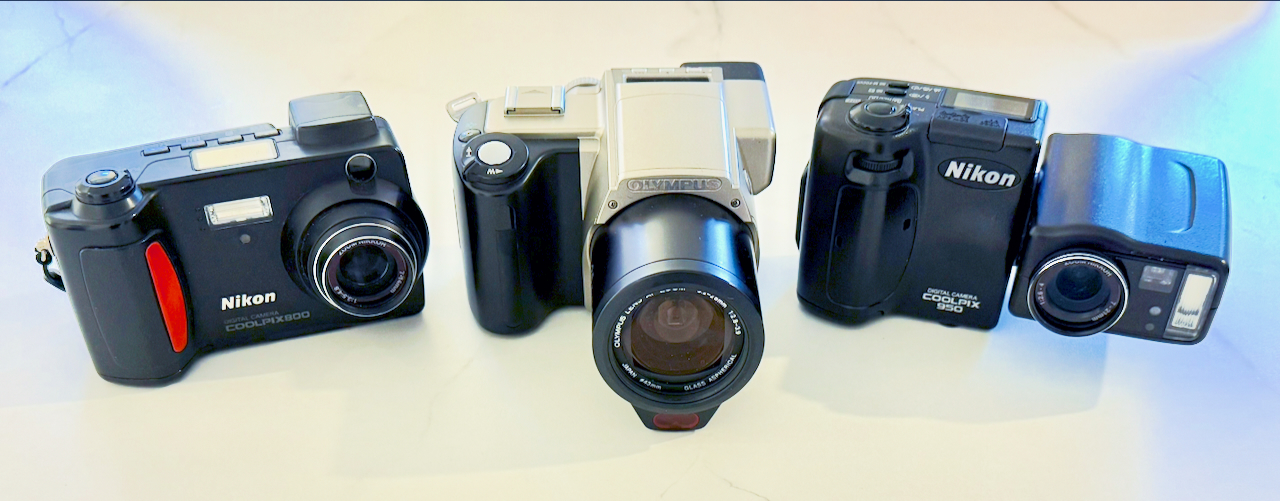
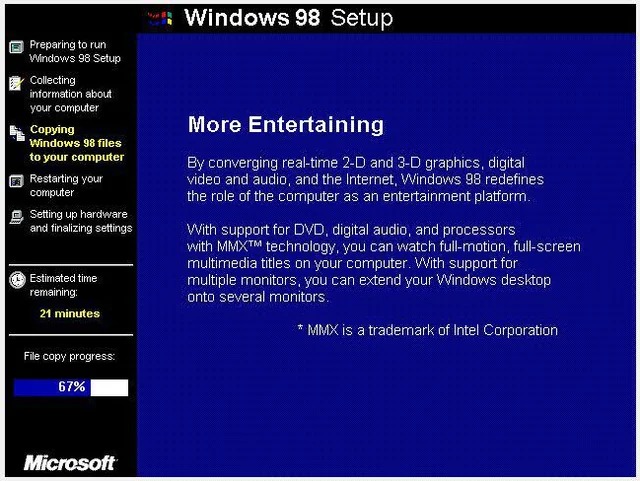
The two Nikons make for a really interesting insight into the state of a tech world in a state of transition in the year 2000. Twenty six years ago, advanced though things felt, we were still in the infancy of mass adoption of tech into the home. Windows 95, which had kick started a revolution in terms of accessibility to and desirably of PC’s, was only five years old and already we’d upgraded to the more polished Windows 98, bought ourselves 56Kbps modems and connected to this weird thing called the “Information Superhighway” or… World Wide Web. As you can imagine, when the world is changing so rapidly, standards were being flung out all over the shop to try and address problems such as how to connect all these new digital things to your computer and every device inexplicably coming with a different connector.
As time has passed, we’ve quickly forgotten the pain of being those trail blazers of tech where using a PC and a camera required an in depth knowledge of various connectors, the ability to install and configure software packages and God help you if you needed to set up a COM port to talk to your serial device and there was an IRQ conflict… That’s on top of the fact that sometimes you’d install a piece of software, do the required restart and then get a “Windows Protection” error or similar. You knew instinctively when your PC was going to refuse to boot, you could tell by listening to the hard drive or simply the amount of time it took between the loading screen showing you various bits of your Autoexec file running during boot up. This was true of the internet too, listening to the screaming sounds from your modem you knew whether you’d get online or not and how fast or stable your connection was going to be. Machines were alive back then and the soundtrack they created was a useful diagnostic tool. However, before you knew it, you’d be reinstalling Windows 98 for the second time that week – because reinstalling Windows and nuking your whole PC was invariably the answer to all tech problems.
The first thing that surprised me about this particular crop of cameras was their connectivity. We’ve discussed quirky memory card formats and proprietary connectors here before – none more frustrating than the Fuji Finepix 40i when the entire point in USB was it’s universal… hence… Universal Serial Bus? Rather than “make it a slightly different shape so you can only use our cable.” and lets not forget the joys of getting the Casio QV10 to work. That used a very special serial cable which would only work with a specific old motherboard.
Looking back, I don’t remember things not using USB in 2000. Once USB came out it seemed to just become an overnight default for printers, cameras and other peripherals. Even Windows 95 was updated in the last release to be aware of USB devices, but Nikon had apparently missed the briefing on it and were still shipping cameras with serial only connections. As one reviewer at the time described it “this renders the direct connection entirely pointless” as it would’ve taken several minutes just to transfer a single image to your PC. I suppose they were relying on people buying card readers which was definitely the way to go if you didn’t have a fetish for waiting for batteries to charge repeatedly, but would’ve set you back £30-50 at the time.
The next difference to modern times is that operating systems did not have built in, out of the box support for photo browsing and previewing. Today, you can easily whip through a folder of photos without using any specific software but users of Windows 98 were out of luck entirely.
Lightroom didn’t exist, Photoshop and Bridge were not the default they are for most people today and so, to fill the gap, cameras came bundled with a CD of fairly essential software that you were meant to use to organise, edit and print your photos. Some, like Kodak, linked to online printing services that are long since dead. On the whole, these software packages were God awful things that were developed with the minimum of effort and thought to just get the job done and give you something, anything that you could connect your new shiny toy to and extract pictures from it.
For Nikon users this meant using Nikon View which was simply an image browsing, import and basic organisation tool. I think at this point the industry had completely failed to grasp the sheer scale of image collections that users would amass with their new digital tools and that organising, rating, editing and archiving was about to become an industry in itself.
How cool would a Coolpix be if a Coolpix could be cool?
I’ve used a fair few early 2000’s cameras, most of them from Fuji and Olympus. There’s been the 1MP Camedia C860L, the Finepix A201, Finepix 40i, the Camedia C2020Z and not to forget the Canon Powershot S10. With the exception of the Powershot, all these cameras have one thing in common – they’re jarringly slow. For everything.
Take a picture? Wait a while. Review a picture? Watch it be drawn on the screen.
This shouldn’t be taken out of context, however. Processor speeds in the year 2000 had just approached 1Ghz, but mobile chips in laptops were still around 600mhz at most and battery life in a laptop the thickness of a kitchen worktop was about 2 hours. As you miniaturise chip technology, you gain battery life but lose performance and complexity. This means if you want to stuff a chip inside a digital camera then you’re not going to have to accept it is slower than you’d ideally like and that’s a shame because image processing is not a simple task. Add on top the fact that the better your processor, the more expensive it will be to produce and you can see why many early cameras were a compromise and came out slow and with crap battery life. Yes, they could’ve been better, but you’d have paid for it and these compacts were already knocking on £1000 in old money as it was.
It doesn’t take long with either of these Nikons to understand why they stood head and shoulders above the rest. They’re fast. Startlingly fast for this generation of camera. Initial power up takes a second or two, but after that everything is really quick in context of the time when they were made. Switching modes is fluid, playback is done cleverly – the camera shows a super compressed, low resolution image immediately and then as you look at the picture it changes to the full resolution version. Nikon had taken the time to work out how to squeeze the most out of the processing power available in their camera and also how to mask when it was taking time behind the scenes to chomp through image data.

Picture to picture speed is great, image review after taking an image is instant. This is hugely impressive and goes a long way to building a really positive impression of the camera. If I’d had one of these at the time I’d have felt like I was holding a seriously impressive piece of engineering in my hands. I’d also have needed a really well paid job but that’s another matter.
Build quality is definitely a step ahead of competing compacts and that’s just the Coolpix 800. The 950 is next level with its metallic body feeling very premium, sturdy and well built. Whilst the Canon Powershot S10 feels chic with its brushed metal case, ergonomically it isn’t as good as either Nikon. There are trade offs here – the Canon was the ultimate pocket camera and could slip into any jacket or jeans pocket, whereas the Nikon was far too large for anything other than the biggest coat pockets for comfortable carrying.
This doesn’t mean they’re bulky or unwieldy, just that Nikon made the decision to prioritise lens quality (therefore it has to be physically larger) and ease of handling. They’re akin to holding a really nice modern compact mirrorless camera and whilst both are good, the Coolpix 950 feels really steady, well balanced in the hand and altogether more solidly built. You’ve got to do something to justify that monster price tag.
There are quirks, of course. None more odd than the card slot. Both cameras feature what at first glance looks like an identical CF card slot. They’re both on the bottom of the camera, behind a little rubber door. On the Coolpix 800, the card slots in and off you go. On the 950, however, you plug it in and the eject button pops right out of the bottom of the camera and then needs to be physically folded over to tuck it behind the rubber door. This is really, really odd. I can’t think of a sensible reason for this difference unless they felt somehow this made it harder to… accidentally eject the card? I’m clutching at straws here.
Unlike so many cheaper cameras, these two are packed full of features. The cheaper 800 has enough manual controls to keep most people happy and the “clever” best shot mode where you can take up to 10 images and it’ll pick the best one. According to DPReview back in 1999, this was probably done by simply selecting the largest file size of the 10 images as JPG’s tend to be larger when they contain more detail. The 950, though, adds many more manual controls including the usual Program, Shutter and Aperture priority modes – all within the constraints of the cameras relatively limited capabilities by todays standard. You can also select from one of three metering modes, although the default matrix metering is surprisingly good even with backlit subjects.

However, quirks aside, we should take a moment to appreciate just how good these two cameras are for such early examples. So many devices were badly made back then to the point comedians in the 80’s and 90’s made entire careers out of “programming the video recorder” jokes – and they had a point, interfaces were needlessly complex or had been created by the one and only person who actually understood how to use them.
For what could be considered a second or third (at best) generation digital camera, these Nikons are so intuitive to use. The only time I felt the need to consult the manual is when I couldn’t understand the flippy-flappy CF card eject button on the Coolpix 950 and that… that’s rather embarrassing in itself. Otherwise, the buttons are clearly labelled and obvious, everything is where you’d expect it, on screen icons make sense and menus are easy to navigate.
If you think I’m labouring the point here, the Olympus Camedia C920 that I mentioned at the start of this post is a different story. All three cameras were launched at the same time, but the user experience couldn’t be more different. On the Olympus, without reading the manual, you’re going to have a hard time working out what some of the buttons are for or you’re not going to have a clue that, for example, you need to very quickly double press a button to review an image after taking it. This makes no sense today, but 26 years ago strange design choices like this were the norm and you were expected to sit and read the manual cover to cover before using something.
Having fun with old tech
Well, last time I had an old Nikon to test I thought it deserved a trip to Iceland. This time round, to break with convention, I thought… I’ll take them to Iceland.

Iceland in autumn is a nightmare in photography terms. Invariably it’s raining, the sky will either be plain white or grey and if you’re lucky enough to get some texture from a storm rolling in you’re not going to be outside with your Coolpix because the rain in Iceland falls so hard it’ll dent your head. With zero weather sealing, dramatic skies are out of the question.
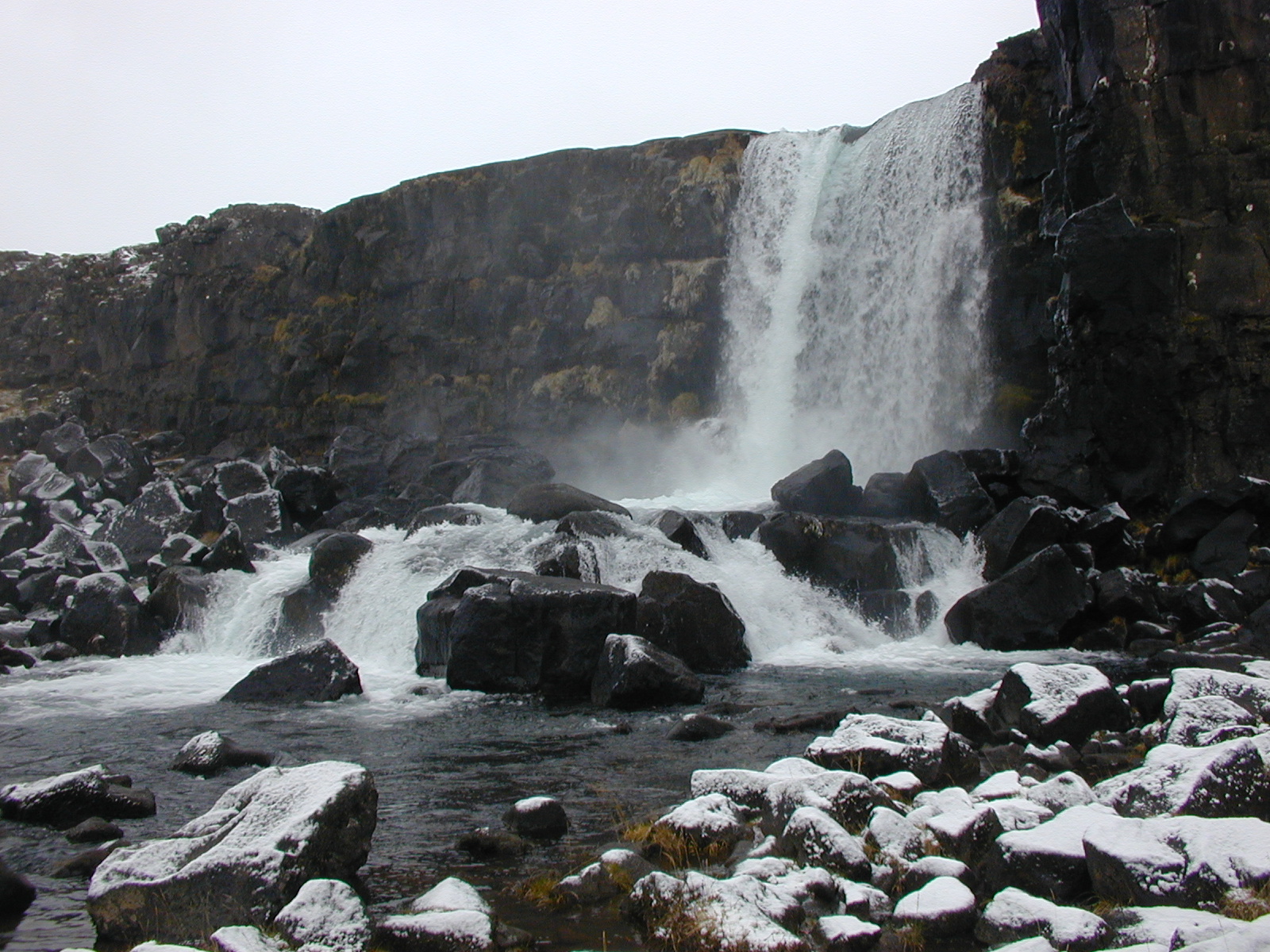
This, then, is a seriously testing environment for such an old digital but it’s absolutely representative of what someone with all the money to spend at the turn of the century would’ve done with their new toy. In the right circumstance, you can get a reasonable snap of the landscape in front of you, but with scenes featuring huge areas of contrast such as white waterfalls against dark rock (which most of Iceland is) then you can expose for one, but not the other. The dynamic range simply isn’t there for these kinds of scenes although both models give a decent effort at exposing in a balanced manner.
The picture below is a perfect example of a typical tourist shot. The highlights are blown and the shadows crushed. By modern standards, you’d not be impressed and it is definitely a shame you’ve got no sort of RAW capabilities to try and rescue a bit of colour saturation in the image too. Having said that, knowing what tech was like back then, you’d have been more than impressed by these kinds of results bearing in mind that only a year or two earlier such digital images were basically impossible.

For context, here’s the exact same scene on an iPhone 16:

Unexpectedly, this comparison goes some way to showing how good the Nikon actually was. The iPhone too struggles here with exposure despite the fact that it uses a crazy amount of image processing before you see the final picture. It too has prioritised the lighter areas of the image despite my best attempts to coax it to do otherwise. Whilst the sky and shadows are obviously more detailed, don’t forget this image comes from a sensor with 20 more megapixels to play with and other than the more dramatic contrast and saturated colours, the Nikon has done an honest job here.
There are a couple of unavoidable impracticalities of this camera. Despite bing built like a tank, I could find no practical benefit of using the 950 over the 800. Indeed, the 950 is too large to comfortably fit into anything other than a large coat pocket. Furthermore, its battery door is shot and they kept popping out. This isn’t Nikon’s fault, after 26 years the plastic clips are so brittle they just snap off and so many digital cameras of this era suffer the exact same problem. The 800 does have a better design in this respect and shows no signs of dying.

I had one scary moment where the memory card from the 950 would work in the camera, but point blank refuse to even mount on a computer. Whilst I managed to get the images off in the end, it goes to show that you should never trust a memory card.
The swivel lens is a nice novelty at times and does come in useful if you don’t want to bend down, sit at awkward angles or, dare I even suggest, take a selfie. In many ways, it makes the camera more stable to hold having the lens twisted forward and I suppose this design was just the tilt/flip screen of its day that so many photographers are addicted to using today. On both cameras, the wide angle isn’t wide enough and I found myself constantly zooming out every time I turned the camera on. Why it doesn’t default to wide angle at power up is a mystery.
Conclusions and Learning

The late 1990’s and very early 2000’s were just fun in terms of technology. Designs were interesting, quirky and different. Everyone trying something new and different created so many winners and loses and to keep on top in such a rapidly changing environment called for constant innovation. Somewhere along the way convergence inevitably happened and we ended up with the incrementally better but still boring rectangular boxes of the mid to late 2000’s. Not much has changed since to the point manufacturers are now releasing “retro themed” designs to try and keep people buying new models whilst perhaps acknowledging that we literally don’t need a camera that completely destroys the entire point in photography by making all the decisions for you and, in some cases, taking the picture for you so you just select the best one. What fun.
It would be stupid to suggest anyone bins their camera phone, trades in the mirrorless camera and runs out to buy a swivel lens Coolpix to “get back to basics” and take “real pictures” but I’ll never stop advocating for the idea of using a dedicated camera rather than the one in your phone. We’ve discussed the downsides of this in detail in our previous look at why people are spending outrageous sums on old compact cameras and those conclusions still stand here – don’t be so silly as to think that deliberately using a crap camera somehow makes you an artist or gives you “a look” other than “these pictures were taken on a device that exhibits the limitations of its time but you have to know what you’re looking for, squint and be looking for them.”
What I personally find interesting is being able to go back and buy a bunch of cameras that would’ve set you back thousands and see the vast differences there were at the same point in time. Being a consumer of tech back then wasn’t easy – prices for even poor devices were sky high compared to today and if you wanted something half decent for your money well, then, you were going to have to bite the bullet and put your hands deep in your pocked and God forbid you backed the wrong horse and bought into a dead tech like Smart Media or Memorystick, for example. You’d be investing all over again in no time at all.

These cameras are a perfect snapshot of an era when you could buy a camera at the absolute top of its game one day and then within two months a more advanced and refined model would come out that had real differences, genuine steps forward compared to your model that you were still paying off. Nikon were just constantly iterating their designs and released the Coolpix 990 straight after the 950 featured here and it had resolution increase to 3.2 megapixels at a time when manufacturers had been telling everyone that 2 was some kind of ceiling and you didn’t need more anyway. They also sorted out a bunch of quirks like the CF card placement and battery door. Ouch.
Both of these cameras were great to use. They’re way more refined and responsive than so many others I’ve used of the same era from Fuji and Olympus in particular and it isn’t difficult to see why Canon, Nikon and Sony eventually ended up totally dominating the compact market. That little bit extra spent on design, better components and ultimately faster processors made all the difference. Sensible design choices like using compact flash and AA batteries were icing on the cake decisions.
If I’d had the means to own any of these cameras in the year 2000 I’d have been over the moon and probably totally obsessed with taking endless pictures of everything I ever saw. Yes, film undoubtedly gave better results in every circumstance compared to these cameras but that isn’t the point here. A young, excitable teenager would’ve taken the hit to image quality to have instant access and endless pictures any day of the week.
The usual disclaimer applies here. Today, these cameras are novelty, historic curiosities that are fun to use in any circumstance where you don’t need reliable, high quality results. I never have bought into the “old digital nostalgic aesthetic” and never will. The limitations in lenses, sensors, noise, dynamic range and image processing are all obvious to see but in 2000, they were hands down the best you could get. If you want to have a bit of fun, these are cheap enough to buy on a whim, stick some batteries in and play with.
The real thing to get nostalgic about here is a lost era of fearless design. What I’d give to go back to a time when designers were all trying new things, not afraid to be different and throw things at the market to see what stuck, all based on this vision that the Millennium was the future and we were about to accelerate into a technology wonderland where anything would be possible. Whatever happened to that?



Thoroughly enjoyed reading this.
However good phone pictures may be, I still remember the great satisfaction derived from using a real camera. Yes, technology bought instant results, but the sheer joy (unfortunately sometimes disappointment) when that film is developed and the magical moment images come to life in the printing stage of the process. (Or later on the prints arriving from the processor in the post) Though I can see how once hooked on the new technology each higher spec proved tempting to them.