


By the end of the year 2000, the writing was already on the wall for film SLR’s. The launch of the insanely brilliant EOS 1v signalled the end of serious R&D spending on film cameras as attention shifted to the growing digital market. Although 35mm SLR’s would continue to sell for many years, Canon would release no further professional level bodies and only a few entry level cameras in the form of the 300v and 300x and curiously one final update of the EOS 7 in 2004 before the curtain finally fell on their film range.
The EOS 7/30 is an iteration of the EOS 50/55, a camera that I have waxed lyrical about in the past and still think is one of the greatest value cameras available today when you balance price, handling, features and performance. Canon packed some serious performance in to the EOS 7/30 – high fps, the predictive auto focus algorithm from the 1v, an upgraded (over the EOS 50) 7 point auto focus system, silent film rewind and more. This camera was one final nod to the film faithful and as far as I can tell, it was so packed with new technology and trickle down features from higher end cameras that the only thing which changed in four years and the updated 7n was that they transplanted the auto focus system from the digital EOS 10D into it.
All in, the EOS 7 should be the best Canon film SLR you can buy short of an EOS 1v or the earlier EOS 3. Having owned and used the 300v, 300x, 300, 50 and EOS 1n and the 10D, I thought it would be interesting to see how the EOS 7/30 stacks up, whether it is worth buying over any of those cameras and whether it could really be the best EOS camera worth buying today.
Let’s find out.
Buying an EOS 7 / 30
There’s a reason I’ve not used an EOS 30 before now and that reason is cost. They are not budget cameras by any stretch of the imagination and whilst prices fluctuate, as of writing you’re looking at around the £50 for a working copy.
Whilst I can’t find sales numbers, I think it would be reasonable to presume that the EOS 30 didn’t sell as well as the EOS 50 before it simply down to the fact that the EOS 50 was launched during the absolute peak era for 35mm film SLR’s and the EOS 30 coincided with the digital hype train. This, coupled with the upgraded performance over previous models probably goes some way to explain the much higher prices.
It could be total coincidence but there do seem to be a significant amount of these cameras that are breaking or only available for parts. Failures range from being completely dead, viewfinder displays no longer working to the all too common broken film door latch. Despite this, prices remain high even for these copies that are totally broken.

As always, it pays to be patient and to closely examine what’s on offer in some of these “parts or not working” auctions. We know all too well that “untested” usually means broken beyond repair, but every now and again you’ll get a genuine sale where the faults are clearly shown and you can make a judgement.
The copy I bought was advertised as having a broken film door, but the seller had also taken the time to stick a battery in and show that everything else looked pretty much ok. Generally, if one of these later cameras turns on with a battery in it, the worst you’re going to face is some dirty contacts and a sticky grip. My EOS 30 had the sticky grip problem as usual but it was by no means the worst I’ve ever seen and quickly came off with some alcohol and kitchen towel.
All in, I paid about £24.75 for an EOS 33 body only and that price was due to one other person competing for the same lot. I popped in a maximum bid of £30 and that did the trick in the end. Would I have paid more for one of these? Probably not. Although the EOS 30 is a great, fully featured camera it isn’t some top of the range beast that you can justify spending large chunks of cash on and it isn’t different enough from the altogether cheaper and more widely available EOS 50 to justify blowing the bank on. Oh, and before confusion sets in, Canon decided to produce the EOS 30 both with and without eye control auto focus. The 33 is the model without eye control auto focus, but is otherwise completely identical.
Fixing the film door
It only took a few days for my EOS 30 to turn up with yet another surprise camera bag to add to the collection. There must’ve been a boom in camera bag sales around the year 2000 and people cannot wait to use them as extravagant packaging these days when sending cameras through the post. Is there anyone that still uses those single, “perfectly formed to one camera and a lens” shaped bags any more?
Regardless, as described the camera had a poorly door latch. One solution would be a healthy dose of duct tape, another is to 3D print yourself a new part if you have a 3D printer and can actually get it to actually print something without it finding one of the million ways they like to fail. The obvious, sensible thing to do is to buy a replacement part – the original Canon OEM parts are no longer available but you can pick up Ali-Express specials for around £5 or £8-10 if you want one that’s already been imported.
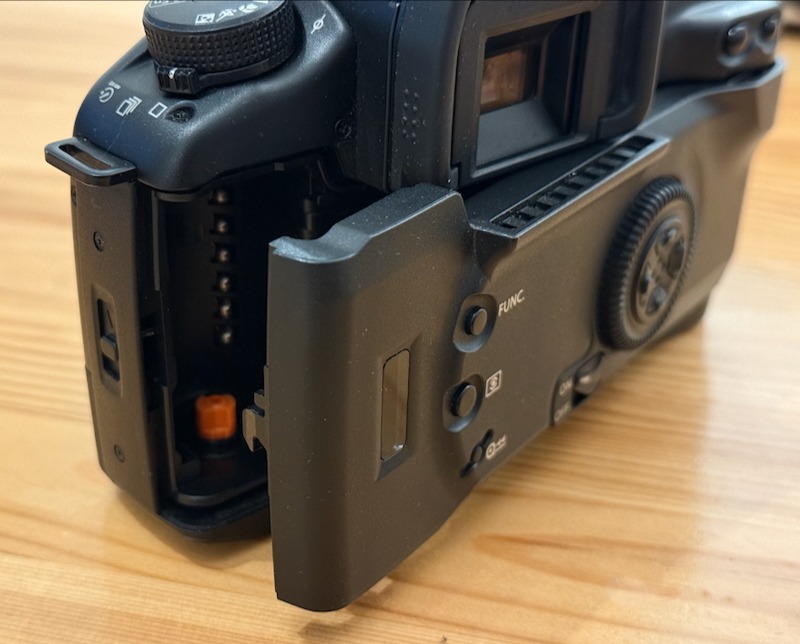
As if you needed any bigger hint that this is the evolution of the EOS 50, the film door latch is an identical component. Whilst I waited for the repair part to turn up I did the unthinkable and borrowed the part out of my EOS 50. The swap is painfully simple, the latch is £9 from your favourite online tat bazaar and if you have a small screwdriver and a soldering iron you’re sorted. The replacement doesn’t come with a metal contact that tells the camera whether the film door is open or not, this is “plastic welded” from the factory and some deft work with an iron will both remove the contact from the old latch and smush it in to place on the new one. Just be careful you don’t over do it with the heat and be careful of the plastic fumes which are fairly wild.
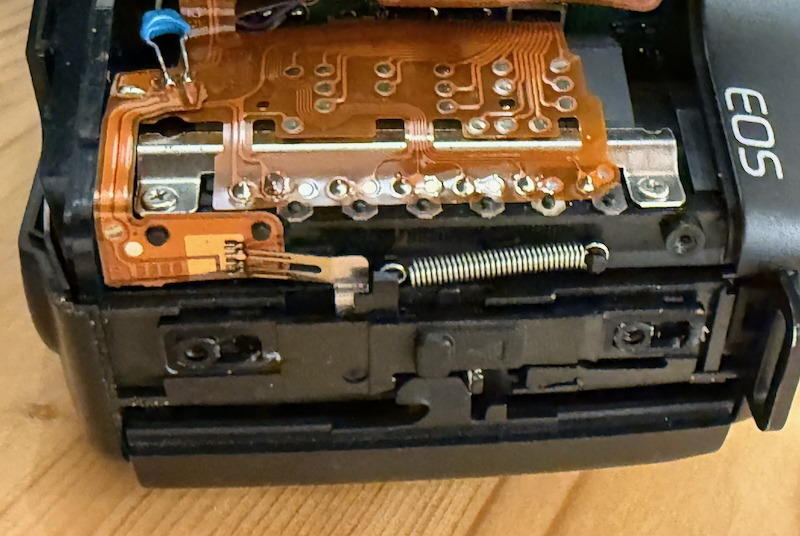
If you find one of these with a broken door latch, factor and extra £10 or so in to the price for the parts and absolutely buy it at a discount. It’s an extremely quick and easy job which can be completed by anyone within ten minutes.
Compared to the EOS 50
Taking the camera apart gives an insight in to the build quality and materials used – and they’re good. The body is predominantly cast aluminium and where plastics are used they’re solid and well put together. At this point I should say “except the door latch, which is crap” but honestly, I’m not sure how people are breaking so many of these. I can understand if you get unlucky, I can understand if the part is cheap and flimsy but it doesn’t seem to be the case. The door certainly does put a lot of pressure on the latch but…? I don’t know, perhaps I’ve been lucky with the three or four of these that I’ve had. Just be careful with them and you should be fine.
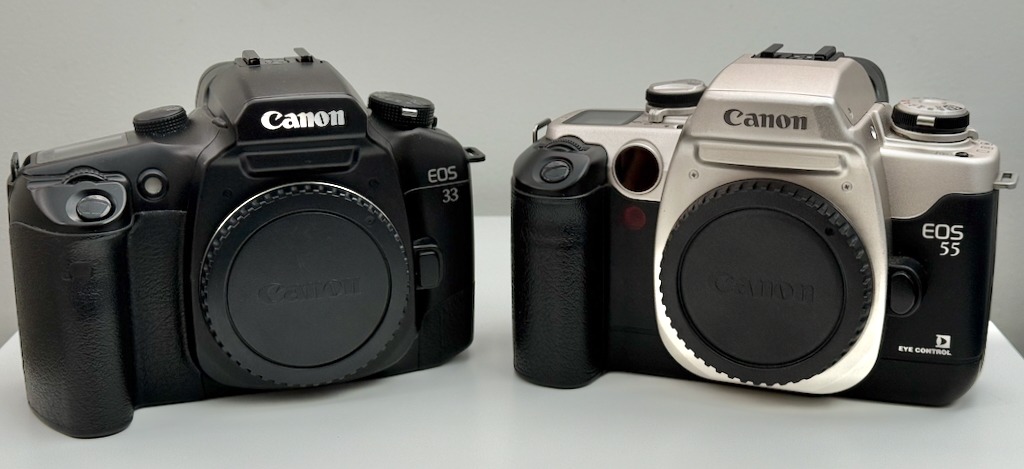
At a quick glance you’d be forgiven for thinking they look basically the same, but looking more closely reveals that the EOS 30 is a classic case of constant, subtle improvement which reminds me a lot of the evolution from the AE-1 to the AE-1 Program. The EOS 30 is subtly smaller and thinner than the EOS 50 and slightly less boxy in design.
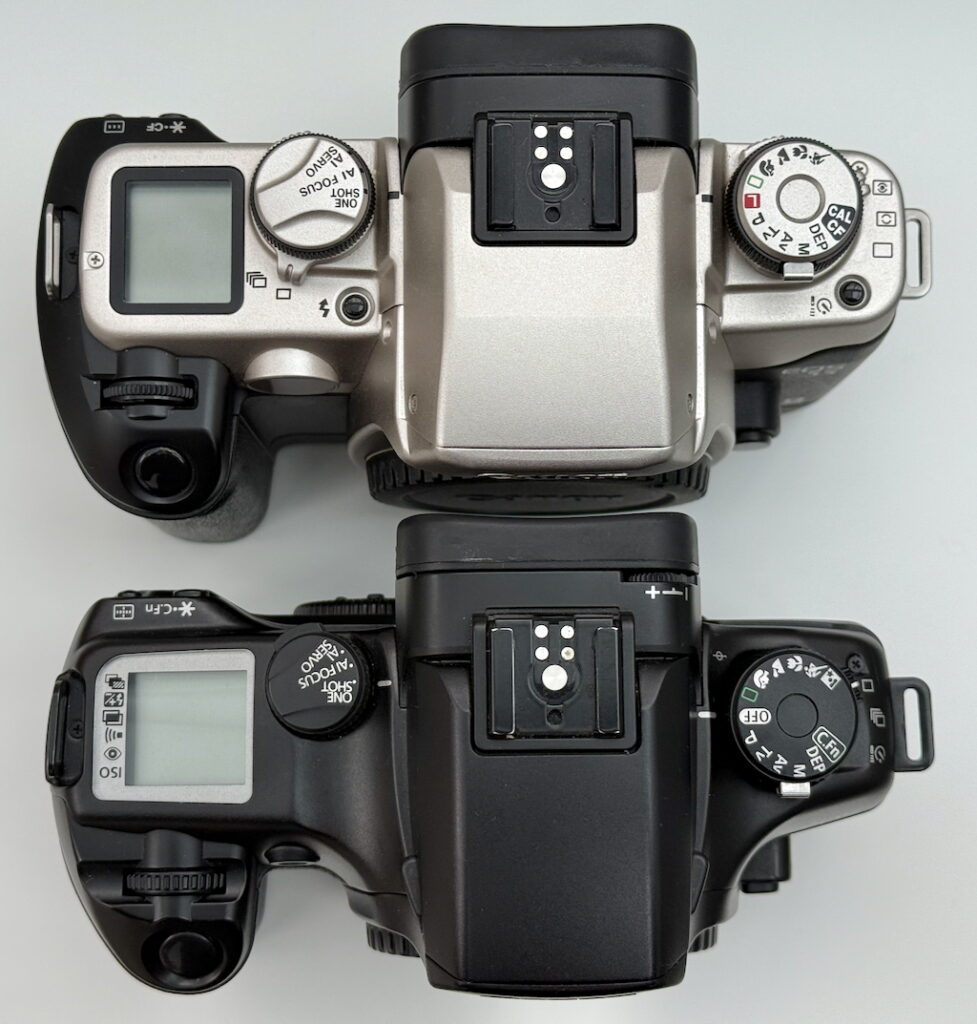
Anyone coming from an EOS 50 to the 30 must’ve felt right at home. The grip is very slightly changed but still feels well made and fits in the hand nicely, all main controls have stayed in the same place with the exception of the drive mode being moved over to a switch on the main mode dial. These secondary switches underneath dials are almost unique to the EOS 50 and 30 and is a design choice I’ve always loved. I’d much rather have a physical switch or dial than have to press a button and then navigate an on screen menu. Top design marks are awarded here.
The LCD gets a small update with a row of icons down one side to guide you through the various settings and custom functions and again, there is one small subtle change around the back as a consequence where the function button is now called just that – Function. Exciting stuff, right?
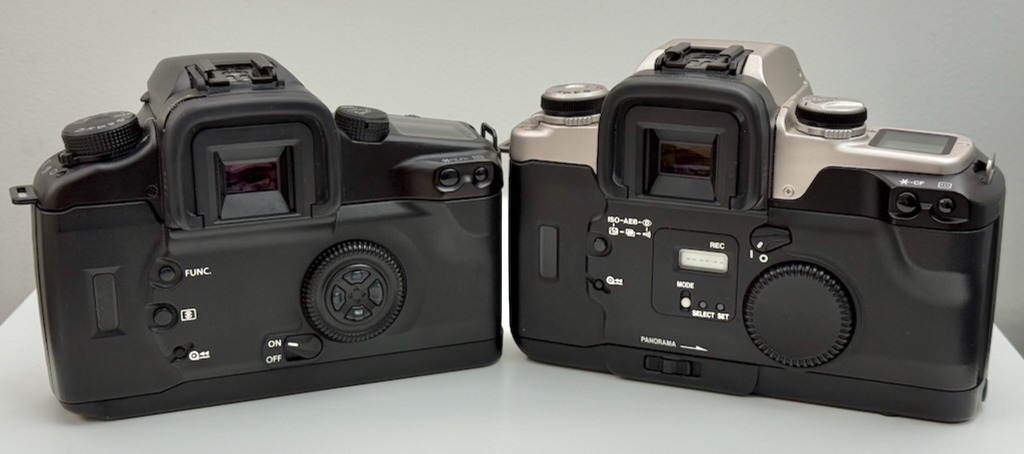
Ignoring the fact my EOS 50 has the date back, they’re otherwise identical except for the addition of a new set of arrow keys that are used exclusively for focus point selection. The EOS 33 now has seven auto focus points compared to just three in the 50. This is a precursor to the funky joystick controller that turned up on their DSLR’s as a method of directly selecting a focus point. This is the one and only part of the camera I had any kind of trouble with as I repeatedly failed to get the buttons to work when I wanted them. Why? User error is most likely – they require a press of the focus point button, then a definite click of an arrow key. I’m so used to the alternative which is hold the button and spin the wheel that this just felt counter intuitive.
Final things of note for the EOS 50 fans is that the 30 has a far more refined, quiet shutter and film advance. Indeed you’d be lucky to even hear the film rewind on the 30 as the motor is so quiet. This obsession with being quiet came in with the EOS 5 and I can understand why. In today’s mirrorless camera world where you can effectively fire off 40fps in near total silence, it’s easy to forget how utterly brutal some film cameras are. The EOS 1n sounds like a machine gun when it gets going, and the 50 isn’t exactly subtle in the way it goes about things. If you were a wedding or baby photographer, it must’ve been anxiety inducing every time you pressed the shutter in a quiet environment.
General performance and features

So, in the EOS 30 we have refinement rather than revolution, but none of that really matters more than what it is like to use. I loaded the camera with a few different rolls of film and took it to different places to test out how the camera behaved in various circumstances and the first thing that impressed was the metering.
I pointed the camera at a number of tricky metering situations and in all of them it gave sensible, decent exposures. Low light, backlit scenes and high contrast did little to persuade the meter to do something stupid and all negatives came out well or required only a small amount of rescuing to give a decent picture.
The EOS 30 does everything a decent camera should do – let you get on with taking pictures without really thinking about the camera you’re using. The controls are 99% classic Canon in that they’re clear and intuitive, allowing you to control nearly all aspects without removing your eye from the viewfinder. Talking of the viewfinder, as with nearly all 35mm SLR’s, it’s big, bright and clear with all the information you need presented along the bottom in green text.
Autofocus is noticeably improved over the EOS 50 and has that “modern” feel about it. The camera very rarely hunts unless you do something odd, the EOS 50 had much more of a habit of doing this. The availability of 7 focus points helps as well, although I still rarely use anything but the fixed centre focus point unless there’s a reason not to. Performance was extremely fast with decent lenses and this is a camera that definitely appreciates faster focussing USM lenses.
Finally, the EOS 33 is a really nicely balanced body. I wouldn’t want an SLR to be much smaller in the hand, the reduction in size whilst physically insignificant is very obvious when you hold it. However, the solid construction makes it feel very sturdy in your hands, it fits nicely and the weight is just right for a camera that you’d carry around on a day trip. As a “one camera to do nearly everything” it’s pretty sorted.
How about that servo performance
These days, the idea of sticking your film camera into AI Servo, continuous shooting at maximum frames per second mode is an expensive proposition. To put this in to some kind of context, it cost me £22 in developing alone for the colour shots taken during this test and approximately £9 per roll of film. That’s at least £40 in film costs (literally more than I spent on the camera) and you might notice there aren’t many colour shots here. Why? Because there weren’t many worth keeping. Ouch.
Still, that’s exactly what I did. I went to a local race track and took along the EOS 33 and the best lens I have in the form of the 24-104 F4 L to ensure I really was testing the camera rather than the ability of the lens to keep up. For comparison, I also took the manual focus T90 and an FD 100-300mm lens that I’d recently repaired.
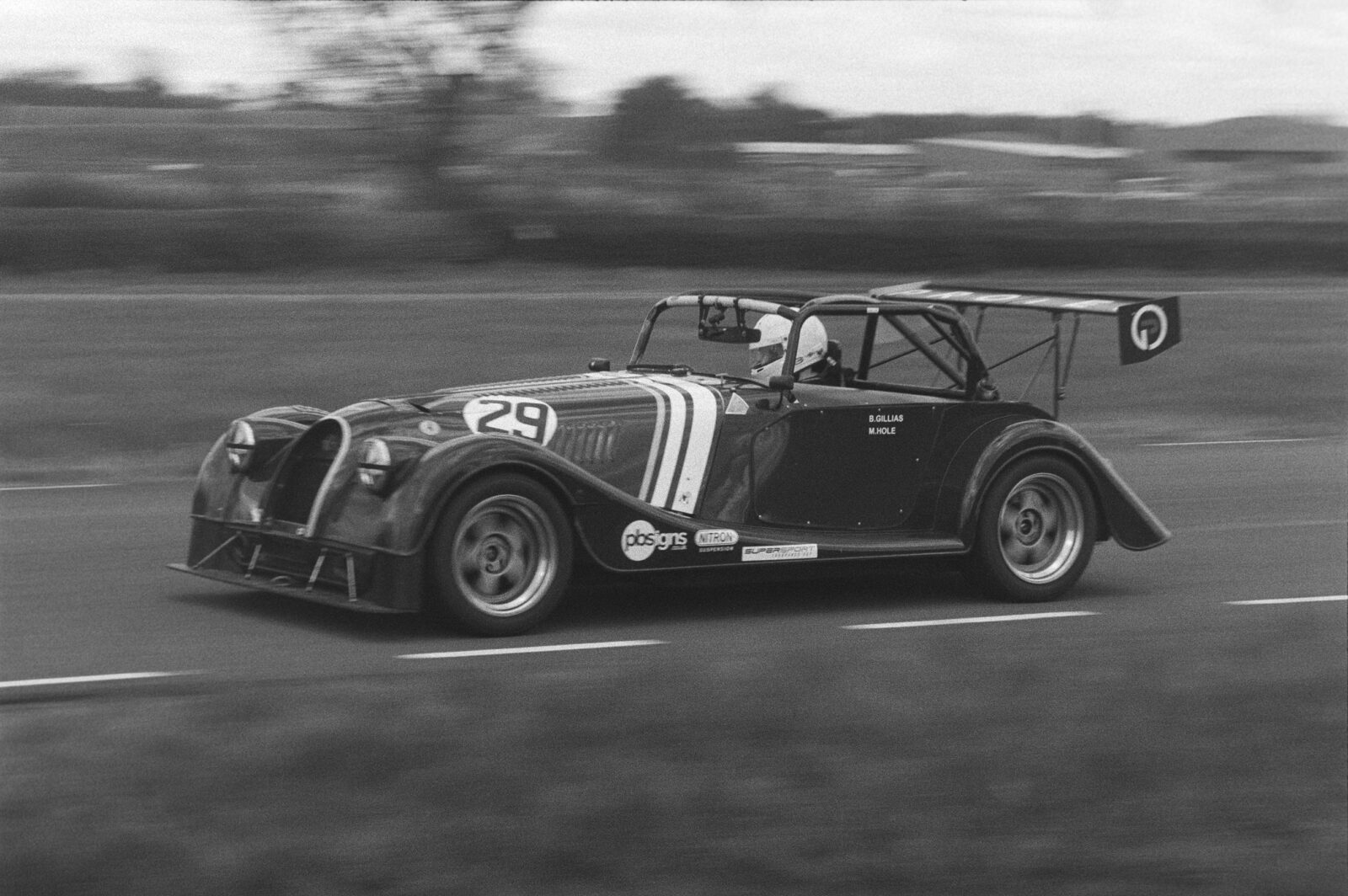
Servo performance on the EOS 33 was surprisingly decent 99% of the time. It quickly and quietly got on with tracking cars around a race track and could cope with the changes in direction and speed as they went around a hairpin bend and started coming towards the camera. It did, however, let me down quite consistently as I panned round at the last moment when a car went past. As the subject filled the frame completely the AF seemed to lose the plot and not know what to do any more so just as the shutter was about to be fired it’d go out of focus and you’d miss a shot. This really was odd behaviour because it genuinely had no issues tracking the subject anywhere else.
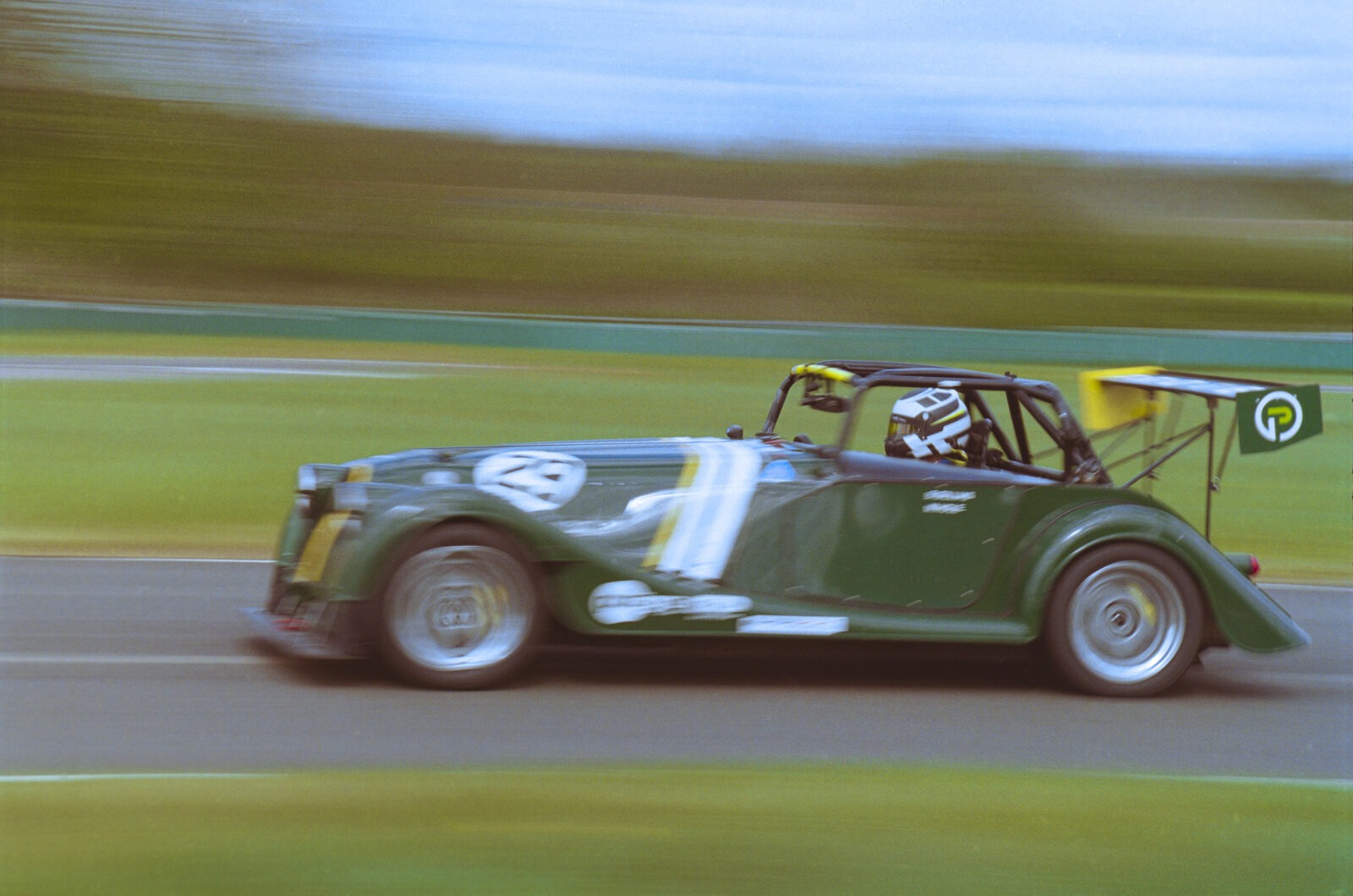
The irony is that the T90 produced more shots that were worth keeping than the EOS 33. Why is that? There are a couple of reasons, some obvious and some a surprise.
Other than the obvious caveat of experience (I’ve shot motorsport twice in my life) which accounts for some of the lack of keepers, I do still know how to pan a camera reasonably well once I’ve got my eye in. The first difference comes down to focus. The T90 being manual focus requires a totally different technique – you pre focus the lens on a piece of track where you know cars will drive and you want to take your picture. With focus fixed you then concentrate solely on sweeping the camera round and taking the pictures.
Essentially, as long as you remember to focus and don’t knock it out of focus when panning, you’re guaranteed a shot that’s at least in focus if nothing else. Why didn’t I just do the same with the EOS 33? Well… that wasn’t the point, was it? The idea was to make use of the “as good as an EOS 1v” tracking performance that Canon promoted on their website.
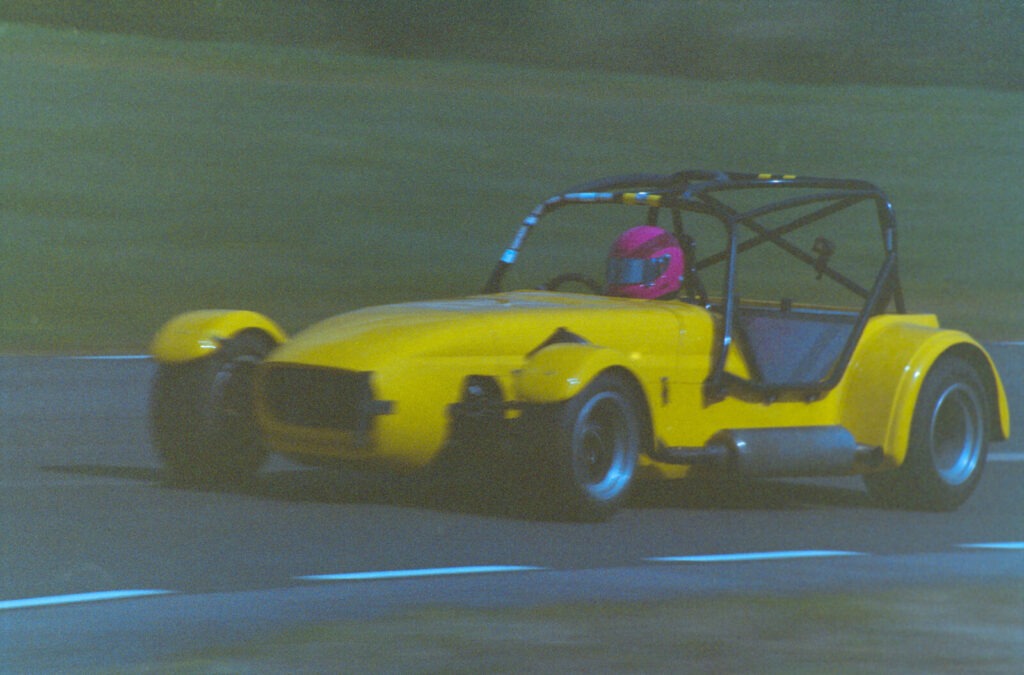
The second reason the T90 performed better in this scenario is one of responsiveness and handling. I would suggest that the viewfinder is a better experience in the T90 and furthermore, it absolutely has a better shutter button feel and response. The T90 feels every bit a professional camera in use and it requires only the slightest, deftest of touches to fire off the shutter or a burst of shots.
Which camera did I prefer in this scenario? The T90 without a doubt. You’d think that in a high speed environment with rapidly moving subjects you’d want modern auto focus and as many features as you can throw at a camera. I found the exact opposite. Learning to pre-focus and plan your shot in advance was far more successful than relying on AI focus and smashing the shutter button.
Conclusions – the ultimate non professional Canon?
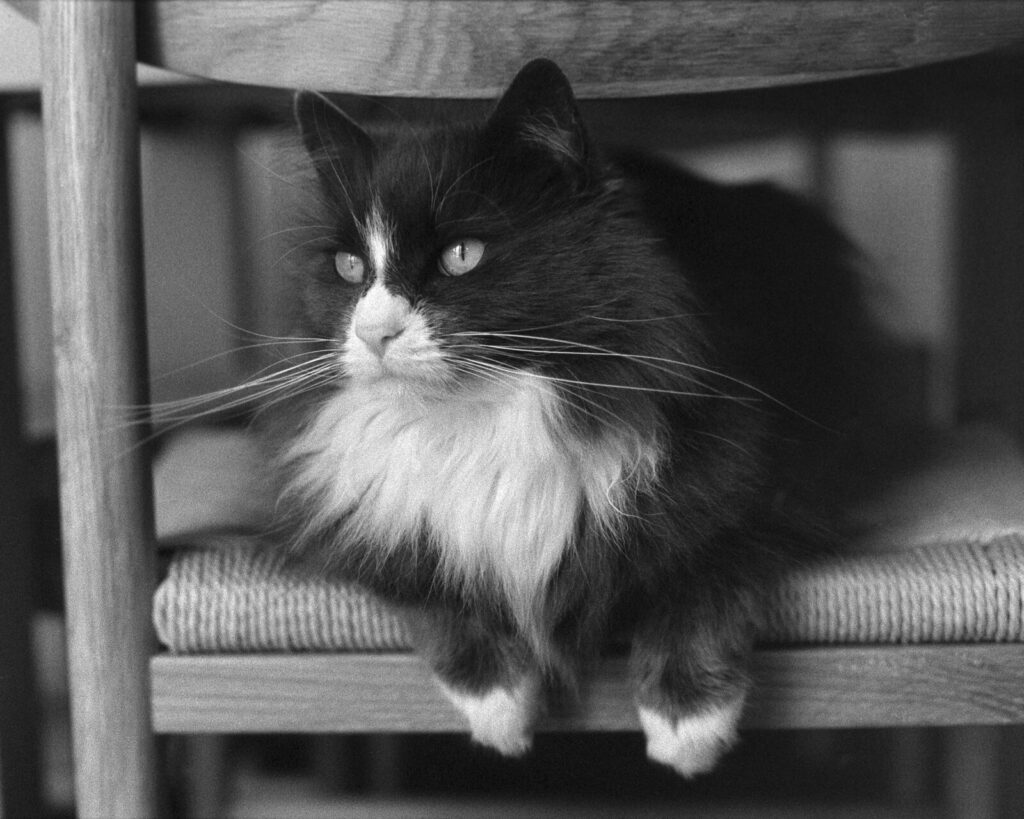
Some obvious questions are raised by this “pretty much last in the line” camera. Is it better than the EOS 50? Should it take the place as my recommended “best value” SLR? Does it benefit from being crammed with technology that has trickled down over years of development? Is it better than even higher end models that were released many years before?
Hmm.
I should say immediately that the EOS 33 is a brilliant camera. There’s almost nothing you could want in a film SLR that this doesn’t have. It’s a very refined experience, goes about its work quietly and quickly and takes excellent pictures. Is it better than the EOS 50? Functionally, yes, without a doubt.
Does this mean I now recommend this over the EOS 50? That’s where we have to have the awkward price conversation again. Price is personal to many people. For some it is the one, single deciding factor. For others blessed with deeper pockets, it is secondary to their other requirements. For me, it’s about value.
What is value? It’s the trade off between price, performance and features. Do those extra features command and justify a higher price? Do you objectively get more as you spend more?
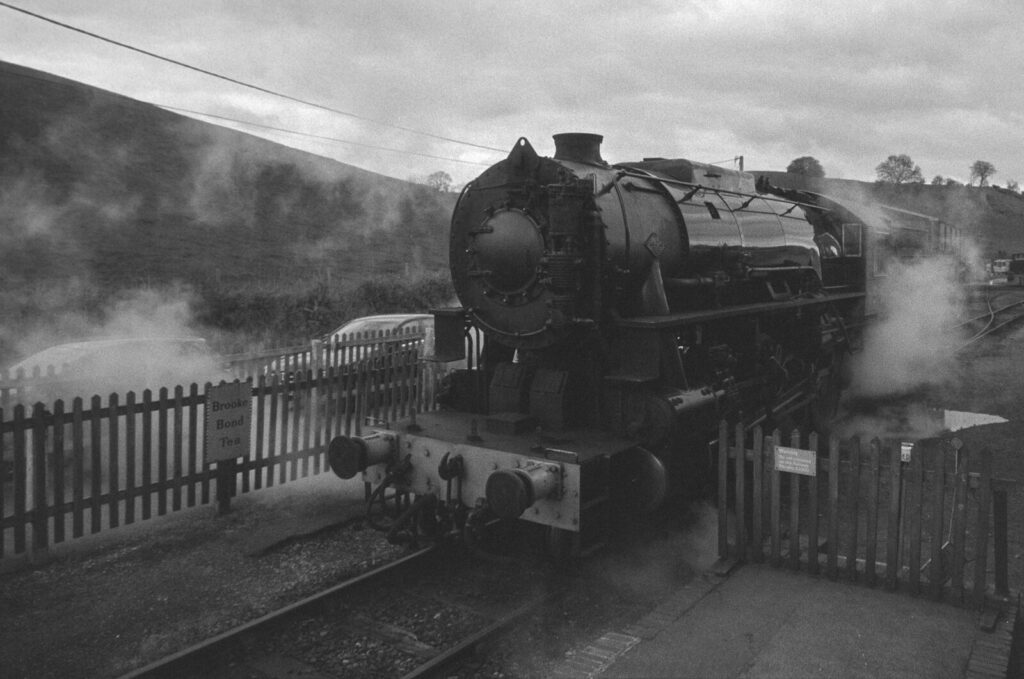
We all know that the undisputed king of value is the EOS 300, it’s literally £1 and packed with modern design, features and conveniences. You can’t argue with a £1 camera. For that little bit more, the EOS 50 is undeniable value. Regularly selling for between £15 and £20, it offers superb build quality and performance to match. I’ve nailed my colours firmly to the mast in this regard and you can read more if you missed it by clicking the link. For me, it is the perfect price to performance ratio for a film camera right now.
The problem with the EOS 30/33/Elan 7 is that it is objectively a better camera, but a better camera that attracts a much higher price in todays market. At £50 plus for a working copy (and yes, we can definitely get broken ones cheaper) it represents a significant chunk of change. At twice the price of an EOS 50, it would need to be twice the camera and it isn’t. If you used an EOS 50, you’d not lament that you didn’t spend double to buy an EOS 33.
Arguably, these days £50 isn’t a huge amount of money, I almost spent that much on film and developing in half an hour on this test, and if you were buying one single 35mm film SLR then it is absolutely a fantastic investment. You are getting a camera which according to Canon themselves has many of the good bits of the EOS 3/1v which is arguably one of the best cameras ever made and you’re getting it at a fraction of the price. There’s no denying the AF performance of this camera is great and if that’s your key deciding factor, you should absolutely buy one of these.
One thing we can all agree on, though, is that regardless of price and budget this is a very, very good camera.
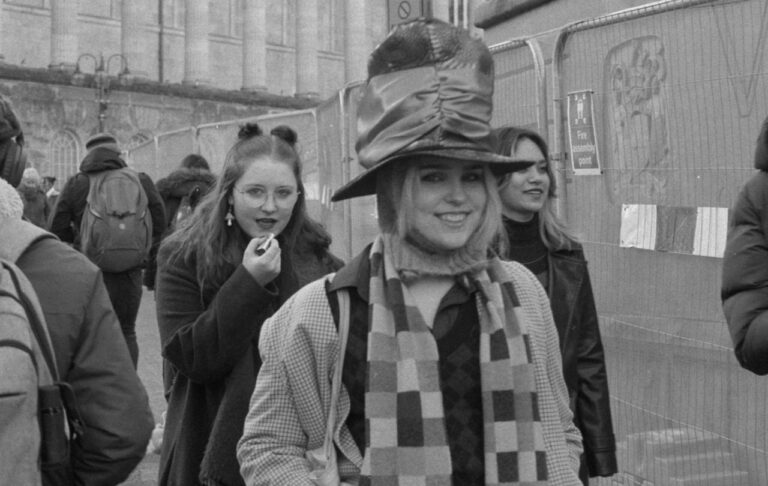

The “obsession with being quiet” didn’t come with the EOS 5, but somewhat earlier with the EOS 100.
I find it odd that Canon used the door latch from the EOS 50 on the EOS 30. Surely they must have known by then that it had a high failure rate? The door latch on the EOS 100 is also of plastic, but seems to a bit less fragile. I managed to fix an EOS 50 by adapting (some cutting and filing) a door latch from a faulty (sticky shutter) EOS 100. The small locking tab that had broken off from the latch on the EOS 50 seems to be thicker on the EOS 100. The part from the EOS 100 protrudes a couple of mm when used on the EOS 50, though.
Thank you for article. I just got one from local thrift store and looking forward to test it in the coming months. The article gave good insight in its history & where it fit in Canon line up. 🫶
They’re superb, you’ll not find it letting you down – I could quite happily live with it as my one and only EOS film camera. Enjoy it and thanks for reading.